

Gorgias has become the go-to helpdesk for Shopify stores, but it is not the right fit for everyone.
As your store grows, you might find the ticket-based pricing model starts to bite.
Or maybe you need stronger phone support and Gorgias treats voice as an afterthought.
The good news: there are solid alternatives that solve different problems. Some focus on AI phone support.
Others offer better value at scale or deeper enterprise features.
This article breaks down 7 options worth considering, including what each does best and where it falls short.
Editor’s note: Want to hear some sample AI support calls made for your Shopify store?
- Just paste your store URL
- Get sample calls in under 20 seconds (no email required)
- Listen to demo calls for my store
What is Gorgias and why look for alternatives?
Gorgias is a customer experience platform built specifically for e-commerce. It pulls all your support channels (email, chat, social, SMS) into one inbox and integrates deeply with Shopify to show order data alongside customer messages. The AI Agent can handle returns, refunds, and FAQs automatically.
But Gorgias has limitations that push merchants to explore other options:
- Ticket-based pricing means costs climb as your volume grows. The Starter plan is $10 for 50 tickets, but overages add up fast.
- Phone support exists but requires add-ons and is not the primary focus.
- Reporting is limited with only 90 days of historical data on lower tiers.
- Shopify-centric design makes it less ideal if you run WooCommerce, BigCommerce, or multiple platforms.
What you need in an alternative depends on your priorities. If phone support is critical, you will want a tool built for voice. If you are scaling fast, look for predictable pricing that does not punish growth.
Why this matters for ecommerce brands
If you run a Shopify store — especially in health, wellness, or beauty — your customers expect fast phone support. Most calls are about order status, shipping, and returns. The right answering solution handles these automatically, so your team focuses on growth instead of phone queues.
Comparison at a glance
Here is how the 7 alternatives stack up side by side:
| Tool | Best for | Starting price | Key channel | Free trial |
|---|---|---|---|---|
| Ringly | AI phone support | $349/mo | Phone | 14 days |
| Zendesk | Enterprise customization | $19/agent/mo | Omnichannel | 30 days |
| Freshdesk | Small teams on a budget | Free | Email/chat | 14 days |
| Re:amaze | Mid-sized e-commerce | $29/user/mo | Omnichannel | 14 days |
| Help Scout | Simple, email-first support | $25/user/mo | 15 days | |
| Kustomer | CRM-integrated support | $89/agent/mo | Omnichannel | Contact sales |
| Front | Team collaboration | $25/seat/mo | Email/omnichannel | 14 days |
The 7 best Gorgias alternatives
1. Ringly

If phone support is a priority, Ringly is the only option built specifically for AI-powered voice. While other tools treat phone as an add-on, we built the AI (our AI phone agent) to handle inbound calls 24/7.
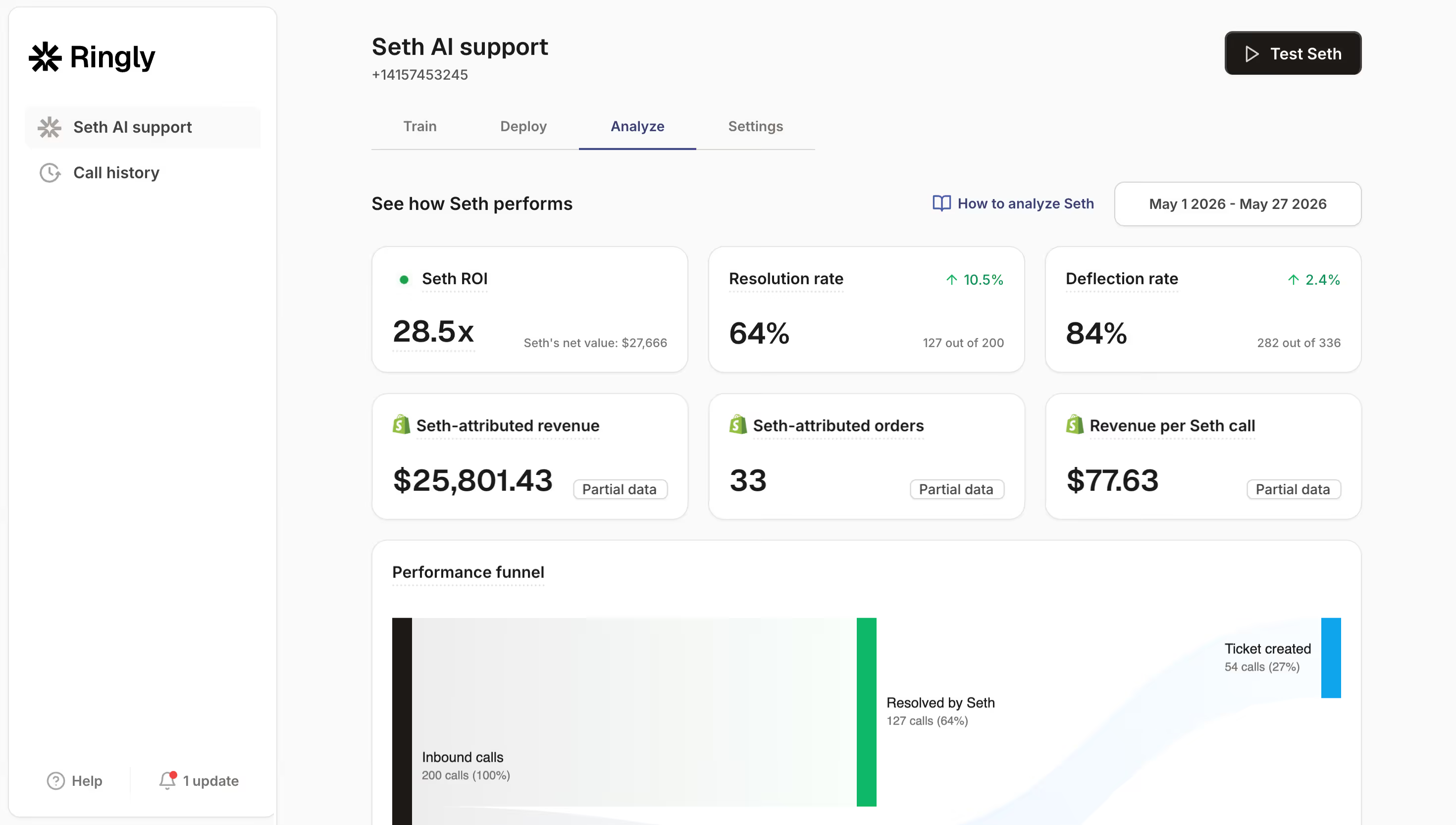
the AI answers questions, looks up orders, processes returns, and escalates to your team only when necessary. It resolves around 73% of calls without human intervention. Setup takes about 3 minutes, and we integrate directly with Shopify for real-time order data.
Key features:
- the AI AI phone agent with 24/7 availability
- Shopify integration for order lookups and returns
- 40-language support
- Call recordings and transcripts
- Knowledge base uploads for custom policies
Pricing:
| Plan | Monthly price | Minutes included |
|---|---|---|
| Grow | $349 | 1,000 |
| Enterprise | Custom | 5,000+ |
Overage minutes cost $0.19 each.
Pros:
- Resolves most calls without human agents
- Transparent, usage-based pricing (no per-agent fees)
- Quick setup with no technical work
- Multilingual support out of the box
Cons:
- Phone-focused, not a full chat/email replacement
- Best suited for stores with significant call volume
Why it stands out: Most alternatives bolt phone onto a chat-first platform. We built for voice from day one, which shows in call quality and automation rates.
2. Zendesk

Zendesk is the enterprise standard for a reason. It scales to thousands of agents, offers 1000+ integrations, and provides the customization large teams need. If you have complex workflows or need strict SLA management, Zendesk delivers.
The platform covers every channel: email, chat, phone, social, and messaging. AI agents can handle routine queries, and the help center builder is robust. But all this power comes with complexity and cost.
Key features:
- Omnichannel ticketing with advanced routing
- 1000+ integrations including Salesforce and Slack
- AI agents for automated resolution
- SLA management and advanced analytics
- Customizable workflows and macros
Pricing:
| Plan | Annual price | Monthly price |
|---|---|---|
| Support Team | $19/agent/mo | $25/agent/mo |
| Suite Team | $55/agent/mo | $69/agent/mo |
| Suite Professional | $115/agent/mo | $149/agent/mo |
| Suite Enterprise | $169/agent/mo | $219/agent/mo |
Pros:
- Scales to any team size
- Extensive ecosystem and integrations
- Mature, reliable platform
- Advanced AI capabilities
Cons:
- Expensive at scale (per-agent pricing adds up)
- Complex setup and steep learning curve
- Can be overkill for smaller teams
Best for: Enterprise teams with complex requirements and dedicated IT resources.
3. Freshdesk

Freshdesk offers the most generous free plan of any major helpdesk. You get up to 10 agents for 6 months with basic ticketing, a knowledge base, and email support. For small teams testing the waters, it is hard to beat.
The platform includes AI-powered ticketing through Freddy AI, gamification features to motivate agents, and solid reporting. As you grow, you can upgrade to unlock custom objects, advanced automation, and more.
Key features:
- Free tier for up to 10 agents
- AI-boosted ticketing with Freddy
- Shared inbox and customer portal
- Gamification and agent motivation tools
- Mobile app for on-the-go support
Pricing:
| Plan | Annual price | Key features |
|---|---|---|
| Free | $0 | 10 agents, basic ticketing |
| Growth | $19/agent/mo | Portal, basic reporting |
| Pro | $55/agent/mo | Custom objects, advanced reporting |
| Enterprise | $89/agent/mo | Audit logs, approval workflows |
AI Agent sessions: First 500 included in Pro/Enterprise, then $49 per 100 sessions.
Pros:
- Generous free plan
- User-friendly interface
- Good value for growing teams
- Strong gamification features
Cons:
- Limited advanced features on lower tiers
- AI features cost extra beyond included sessions
Best for: Small teams wanting to start free and scale gradually.
4. Re:amaze

Re:amaze sits in the sweet spot for mid-sized e-commerce stores. It offers deep Shopify and BigCommerce integration, supports multiple brands, and includes voice and SMS without requiring enterprise-level contracts.
The platform feels built for online retailers. You get live chat with chatbots, social media integration, proactive messaging (called Cues), and even in-chat video calls on higher tiers.
Key features:
- Deep e-commerce integrations (Shopify, BigCommerce)
- Live chat with customizable chatbots
- Voice and SMS support
- Multi-brand management
- Proactive messaging and live visitor view
Pricing:
| Plan | Monthly price | Annual price |
|---|---|---|
| Basic | $29/user/mo | $26.10/user/mo |
| Pro | $49/user/mo | $44.10/user/mo |
| Plus | $69/user/mo | $62.10/user/mo |
| Starter (flat) | $59/mo | - |
Pros:
- E-commerce focused with strong integrations
- Affordable compared to enterprise alternatives
- Good automation and chatbot capabilities
- Supports multiple brands
Cons:
- Less enterprise-ready than Zendesk or Kustomer
- AI features still in Beta
Best for: Mid-sized e-commerce teams running Shopify or BigCommerce.
5. Help Scout

Help Scout keeps things simple. The interface feels like email, which means minimal training for your team. It is affordable, reliable, and the customer support team has a stellar reputation.
You get shared inboxes, a knowledge base builder called Docs, and the Beacon widget for live chat. The AI features (Assist, Drafts, Summarize) are included, though the AI Answers chatbot costs extra at $0.75 per resolution.
Key features:
- Email-like interface for minimal learning curve
- Shared inboxes with collision detection
- Knowledge base with Docs
- Beacon widget for live chat
- 100+ integrations
Pricing:
| Plan | Annual price | Key features |
|---|---|---|
| Free | $0 | 5 users, 1 inbox, 100 contacts/mo |
| Standard | $25/user/mo | 25 users, 2 inboxes, unlimited contacts |
| Plus | $45/user/mo | 50 users, 5 inboxes, CRM integrations |
| Pro | $75/user/mo | Unlimited users, SSO, HIPAA |
Pros:
- Simple and intuitive
- Affordable pricing
- Excellent customer support
- Free plan available
Cons:
- Limited channels (no native phone/SMS)
- Fewer enterprise features
- AI Answers costs extra
Best for: Small to medium teams who want simple, email-first support.
6. Kustomer

Kustomer takes a CRM-first approach to support. Instead of tickets, you get a conversation timeline for each customer that pulls in data from across your stack. It is powerful, but it comes at a price.
The platform includes omnichannel messaging, purpose-built AI assistants, and advanced workflow automation. Enterprise plans support up to 300 brands and unlimited languages.
Key features:
- Customer timeline view (CRM approach)
- Omnichannel messaging (chat, email, text, voice)
- AI Agent Team Assistant
- Data Explorer for analytics
- SLA management and business rules
Pricing:
| Plan | Annual price | Minimum seats |
|---|---|---|
| Enterprise | $89/seat/mo | 8 |
| Ultimate | $139/seat/mo | 8 |
AI add-ons: $0.60 per engaged conversation (AI for Customers), $40/user/mo (AI for Reps).
Pros:
- CRM-integrated approach
- Powerful AI capabilities
- Data-driven routing
- Enterprise-grade features
Cons:
- Expensive ($89+/seat, minimum 8 seats)
- Complex for small teams
- No free trial
Best for: Enterprise teams wanting CRM-integrated support with advanced AI.
7. Front

Front turns your shared inbox into a collaborative workspace. It looks and feels like email, which makes adoption easy, but underneath it has powerful workflow automation and AI features.
The platform supports omnichannel on higher tiers, including SMS, social, and WhatsApp. AI features include Topics (analyzing why customers contact you), Copilot (drafting responses), and Autopilot (automated resolutions).
Key features:
- Shared inbox with email-like interface
- AI Topics, Copilot, and Autopilot
- Omnichannel support (Professional and up)
- Workflow automation with smart rules
- Knowledge base with multi-language support
Pricing:
| Plan | Annual price | Key features |
|---|---|---|
| Starter | $25/seat/mo | Single channel, basic AI |
| Professional | $65/seat/mo | Omnichannel, advanced analytics |
| Enterprise | $105/seat/mo | Unlimited rules, AI included |
AI add-ons: Copilot $20/seat/mo, Smart QA $20/seat/mo, Smart CSAT $10/seat/mo.
Pros:
- Familiar email interface
- Strong collaboration features
- Good automation capabilities
- AI features available as add-ons
Cons:
- Starter limited to single channel
- AI features cost extra on lower plans
- Less e-commerce specific than alternatives
Best for: Teams that prioritize collaboration and want an email-first experience.
How to choose the right Gorgias alternative
Picking the right tool comes down to understanding your priorities. Here is what to consider:
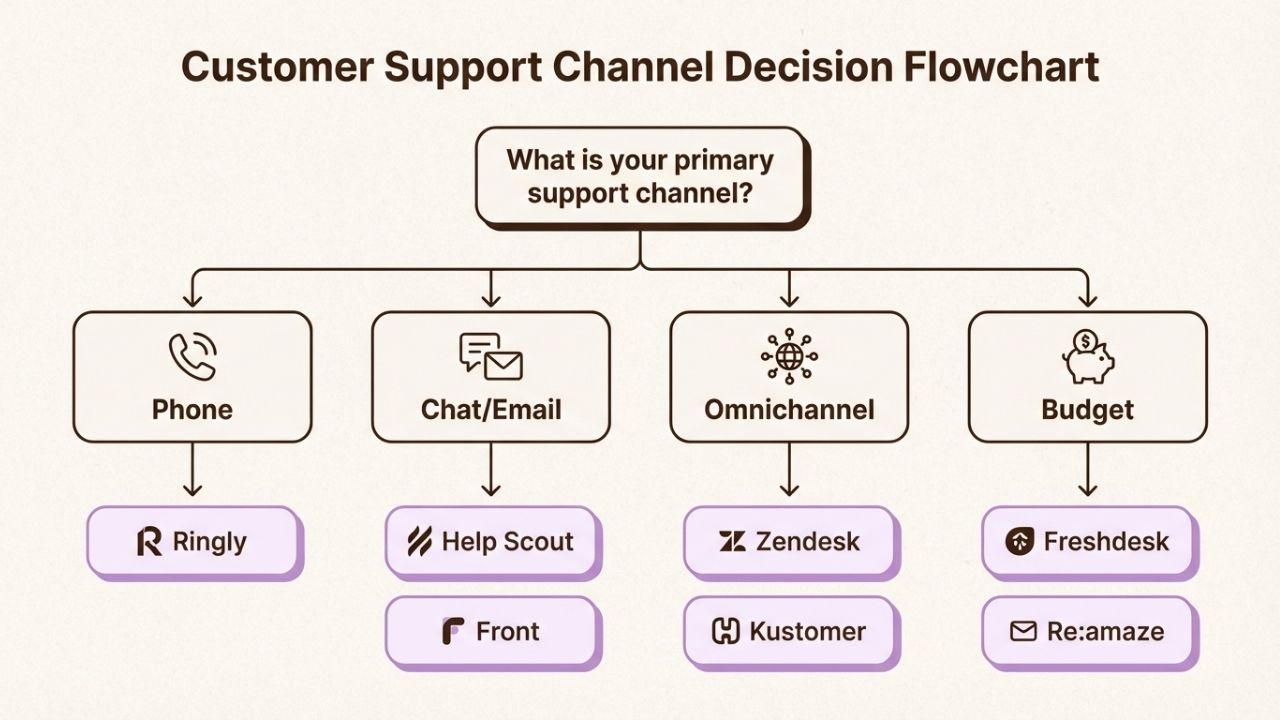
Primary support channel: If most of your volume is phone calls, a tool built for chat will frustrate you. Match the platform to your main channel.
Team size and growth: Per-agent pricing (Zendesk, Kustomer) works for stable teams but gets expensive fast if you are hiring aggressively. Usage-based or flat-rate pricing (Gorgias, Ringly) scales more predictably.
Shopify integration depth: If you run Shopify, tools like Re:amaze and Gorgias offer deeper integration than generalist platforms.
True cost comparison: Look beyond the headline price. Factor in overages, add-ons, and implementation costs.
Test before committing: Most tools offer free trials. Use them to test your actual workflows, not just the demo data.
Switching from Gorgias: what to expect
Moving helpdesks is never fun, but planning makes it smoother.
Data migration: Most platforms offer import tools for tickets and customer data. Historical conversations usually transfer, but check what formats are supported.
Team training: Even intuitive tools need some ramp time. Budget a week for your team to get comfortable with new workflows.
Integration reconfiguration: You will need to reconnect Shopify, email, and any other integrations. This is a good time to audit which integrations you actually use.
Timeline: Plan for 2-4 weeks for a full transition, depending on data volume and team size.
Try Ringly for AI phone support
If phone support is a gap in your current setup, we built the AI to solve it. He handles inbound calls 24/7, resolves most issues without human help, and integrates with your Shopify store for real-time order data.
Setup takes about 3 minutes. You can start a free trial here and see how AI phone support fits your store.
Best pick for Shopify DTC brands
If you're running a health, wellness, or beauty brand on Shopify, most generic solutions won't understand your store data. Ringly.io connects directly to your Shopify store and handles the calls your team shouldn't spend time on — order status, returns, product questions — 24/7, at a fraction of the cost of a VA or call center.
- Connects to Shopify in 2 minutes
- Handles order status, returns, and FAQs automatically
- Used by supplement, skincare, and wellness brands
- Starts at $21/month
Why look for Gorgias alternatives for Shopify?
Gorgias is effective for consolidating text-based support channels, but its model presents certain challenges as businesses scale.
A common concern is the pricing model. Gorgias bills based on ticket volume, which can lead to fluctuating costs, especially during high-volume periods like Black Friday. This can make budgeting challenging. Some smaller teams also feel it offers more features than they need.
Another area is AI. While effective for text channels, its Voice add-on is more focused on organizing calls than automating them.
If phone support is a significant cost center, Gorgias may not fully address that specific challenge.
Lastly, while its deep Shopify focus is a strength, it may not be as flexible as some general-purpose platforms. If you require extensive customization or a simpler interface, you might be better off looking at other solutions. To summarize, here are the key reasons Shopify merchants explore alternatives.

A quick comparison of the top Gorgias alternatives for Shopify in 2026
| Platform | Best For | Key E-commerce Features | Pricing Model |
|---|---|---|---|
| Ringly.io | Automating phone support 24/7 | AI-powered order lookups, returns, and FAQs over the phone | Starts at $349/mo (includes 1,000 mins) |
| Zendesk | Enterprise teams needing deep customization | Advanced reporting, robust integrations, omnichannel AI agents | Starts at $19 - $55/agent/month |
| Kustomer | Data-rich teams wanting a CRM-centric view | Unified customer timeline, intelligent routing, AI agents | Starts at $89/seat/month |
| Help Scout | SMBs wanting simplicity and a human touch | Shared inbox, AI-powered self-service, proactive messaging | Starts at $25/user/month |
| Freshdesk | Growing brands needing Vertical AI Agents | AI-powered ticketing, pre-built agentic workflows, omnichannel support | Starts at $0 (Free) or $15 - $29/agent/month |
| Re:amaze | Multi-store merchants needing a unified inbox | Live chat, pre-built chatbots, multi-brand support | Starts at $29/team member/month |
| Tidio | Small teams focused on sales-driven chat | AI chatbot (Lyro), visual flow builder, proactive chat | Free tier available; Paid starts at $29/month |
Finding the right Gorgias alternatives for Shopify
Gorgias is a popular tool, but it's not the only option available for Shopify brands.
The customer service market is filled with capable options designed for specific needs, whether that's handling enterprise complexity or keeping things simple and human-centric.
The main takeaway from this analysis is that the best solution isn't always another all-in-one helpdesk.
For many stores, the most significant improvement comes from automating the channels that create the most work and have the highest costs, such as the phone. A call handled by a human costs about $2.35 on average, while an AI-resolved call is around $0.38.

If your team is constantly answering "Where is my order?" calls, a traditional helpdesk may not fully resolve the underlying efficiency issue.
An AI phone agent like the AI agent from Ringly.io can work with your existing tools to automate that entire channel, freeing up your team to focus on conversations that can grow your business.
Ready to see how AI can impact your phone support? Book a call with Ringly.io and see the AI in action.
Why look for a gorgias voice alternative?
While gorgias is the best at seeing order data in a sidebar, it has its limits. The most common reason for comparing gorgias to other tools is pricing. Because gorgias offers a ticket-based model, your costs skyrocket during peak seasons like Black Friday.
Another issue is automation. Standard gorgias automation uses basic macros and "if-this-then-that" rules. Modern ecommerce brands now want a true ai agent that can actually solve problems, not just tag a ticket.
Why this matters for ecommerce brands
If you run a Shopify store — especially in health, wellness, or beauty — your customers expect fast phone support. Most calls are about order status, shipping, and returns. The right answering solution handles these automatically, so your team focuses on growth instead of phone queues.
1. Ringly.io – best for ai voice automation

If you feel that gorgias voice is too manual, Ringly.io is the top gorgias competitor for automation. unlike gorgias, which requires a human to answer every call, Ringly uses an ai platform to resolve 73% of customer calls automatically.
Why it's a top gorgias alternative:
- seamless integration: It works with your existing helpdesk (including gorgias, zendesk, or help scout).
- automate voice: It handles inbound and outbound calls without needing a huge support team.
- shopify data: The bot can check order status and tracking info directly.
Editor’s note: Want to hear some sample calls made for your Shopify store?
- Just paste your store URL
- Get sample calls in under 20 seconds (no email required)
- Listen to demo calls for my store
2. Zendesk – best for enterprise scale

zendesk is a massive gorgias competitor that focuses on power and customization. While the learning curve is steeper than gorgias, zendesk offers a level of omnichannel support that few can match.
Zendesk or Freshdesk?
like zendesk, Freshdesk is great for general support. However, zendesk is better for complex workflow needs. It includes a robust crm, advanced analytics, and a massive marketplace of 1,500+ apps to integrate your whole tech stack.
- pricing: Starts at $19 per agent, which can be cheaper for high-volume stores.
- ai: Offers "Zendesk AI" to personalize responses and automate ticket management.
- channels: Full omnichannel coverage including sms, live chat, and salesforce sync.
3. help scout – best for simplicity

If you want something like gorgias but easier on the wallet, help scout is a fantastic choice. It focuses on a shared inbox feel that makes customer conversations feel personal rather than like a cold ticketing system.
Features of gorgias vs help scout
help scout is often the best gorgias alternative for smaller teams. It features a knowledge base called "Docs" and a live chat tool called "Beacon" that includes self-service options.
- free trial: They offer a generous free trial to test the workflow.
- automation: Simple workflow triggers to automate tagging and routing.
- customer experience: It lacks a "ticket number" feel, focusing on human customer communication.
4. Kustomer – best for customer data

kustomer is the top gorgias choice for brands that want to move away from a ticket-centric view. gorgias is built for ecommerce, but kustomer is built for the customer relationship.
Features of gorgias vs kustomer
When comparing gorgias to Kustomer, look at the timeline. Kustomer puts all customer data, from shopify orders to loyalty status, on one screen. This helps your support team provide personalized support without switching tabs.
- ai agent: Includes a native chatbot and ai tools to deflect customer inquiries.
- collision detection: Prevents two agents from answering the same ticket.
- pricing: High-end pricing, best for established ecommerce brands.
Final verdict: the best gorgias alternatives in 2026
gorgias is built to be easy, but if you want to scale, you need a tool like Ringly.io to handle your phone lines or zendesk for your complex omnichannel needs.
If you want a free plan or very cheap entry, zoho desk or the free plan from Tidio are alternatives to consider. However, most gorgias alternatives for 2026 focus on how much they can automate using ai to increase customer satisfaction.
gorgias focuses on e-commerce heavily, but the right gorgias alternative for 2026 should give you the freedom to grow without a success tax on your tickets.
Would you like me to help you compare the pricing for Zendesk and Help Scout for your specific team size?
Best pick for Shopify DTC brands
If you're running a health, wellness, or beauty brand on Shopify, most generic solutions won't understand your store data. Ringly.io connects directly to your Shopify store and handles the calls your team shouldn't spend time on — order status, returns, product questions — 24/7, at a fraction of the cost of a VA or call center.
- Connects to Shopify in 2 minutes
- Handles order status, returns, and FAQs automatically
- Used by supplement, skincare, and wellness brands
- Starts at $21/month
FAQs
Does Ringly offer a guarantee? Yes. You don’t pay until we resolve at least 65% of your calls autonomously.
Does Ringly work with my current helpdesk? Yes. Ringly can escalate tickets to your existing helpdesk, and you have full control over what gets escalated. Ringly works with platforms like Gorgias, Richpanel, and others.
How does the AI handle order tracking? Our AI pulls data directly from Shopify to answer "where is my order" questions on every live phone call.
Can I forward my existing number? Absolutely. You can use call forwarding to send your business calls to your team.
How do I get started? We offer a free trial so you can start without any risk.
Frequently Asked Questions
What are the best Gorgias alternatives for small e-commerce stores?
For small stores, Freshdesk offers a generous free plan with up to 10 agents. Help Scout is also affordable and easy to use, with plans starting at $25 per user per month.
Which Gorgias alternative offers the best phone support?
Ringly is built specifically for AI phone support, with the AI resolving around 73% of calls without human intervention. Kustomer also offers strong voice capabilities but at a higher price point.
Are there any Gorgias alternatives with better pricing for high-volume stores?
Yes. While Gorgias uses ticket-based pricing that scales with volume, alternatives like Zendesk and Freshdesk offer per-agent pricing that can be more predictable for high-volume operations.
What should I look for in a Gorgias alternative if I use Shopify?
Look for deep Shopify integration. Re:amaze and Ringly both offer strong Shopify connections for order lookups, returns, and customer data.
Which Gorgias alternative is easiest to set up?
Help Scout and Ringly are known for quick setup. Ringly specifically advertises quick setup for AI phone support, while Help Scout's email-like interface requires minimal training.
Do any Gorgias alternatives offer better AI features?
Zendesk and Kustomer both offer advanced AI capabilities. Kustomer's AI Agent Team Assistant and Zendesk's AI agents provide sophisticated automation for enterprise teams.
Can I try these Gorgias alternatives before buying?
Most alternatives offer free trials. Zendesk offers 30 days, while Freshdesk, Re:amaze, Front, and Ringly offer 14-day trials. Help Scout offers 15 days. Kustomer requires contacting sales for a demo.
Also read: