

A single human-handled support call costs your store $7 to $12. An AI phone agent handles that same call for about $0.40. That's a 12x cost difference, and it's why AI customer service ROI is one of the most searched topics among e-commerce store owners right now.
But the raw cost gap doesn't tell you whether AI support is actually worth it for your business. You need the full picture: what you're spending today, what AI would cost, and what you'd gain beyond just cheaper calls.
This article gives you a simple formula, real cost comparisons, and a worked example you can fill in with your own numbers. No guesswork, no vendor hype. Just math.
What AI customer service ROI actually means
ROI is simple: money you save plus revenue you gain, minus what you spend on the AI tool, divided by what you spend on the AI tool. Multiply by 100, and you have a percentage.
The formula:
ROI = (Savings + Revenue Gains - AI Cost) / AI Cost x 100
Most people think about AI customer service ROI purely as cost savings. That's only half the story. The real return comes from multiple sources:
- Cost savings: fewer agents needed, lower cost per interaction
- Revenue recovery: customers you keep because they got instant help at 2 AM
- Cart recovery: abandoned carts you recover because shipping questions get answered on the spot
- Retention gains: reduced churn from faster, more consistent support
According to IDC research, companies earn an average of $3.50 for every $1 invested in AI customer service. Top performers see returns as high as $8 per dollar spent. For e-commerce businesses specifically, the ROI can hit 280% within the first year.
The real cost of human customer support
Before you can calculate ROI, you need to know what you're actually spending on support today. Most store owners underestimate this number (honestly, nearly every founder I talk to is surprised when they add it up).
Here's a breakdown of typical human support costs:
| Cost type | Range |
|---|---|
| Cost per phone call | $7-$14 per call |
| Dedicated support agent (US) | $3,000-$5,000/month |
| Outsourced call center (US) | $28-$40/hour per agent |
| Outsourced call center (offshore) | $7-$16/hour per agent |
| Agent training cost | $5,000-$10,000 per hire |
| Agent replacement cost (turnover) | $10,000-$20,000 per person |
Those numbers add up fast. A Shopify store handling 200 support calls per month at $8 per call is spending $1,600 monthly before you count any overhead.
Call center turnover makes it worse. The industry average is 30-45% annual turnover, with average agent tenure sitting at just 13-15 months, according to research from Insignia Resources. Every time someone quits, you're spending another $10,000-$20,000 to hire and train a replacement.
What most store owners don't count
The biggest cost isn't on your balance sheet. It's your own time.
If you're answering calls yourself, every hour on "where is my order" questions is an hour you're not spending on growth. The hidden costs add up:
- Founder time: answering 20 calls/day at 5 minutes each eats 100 minutes of your day
- After-hours losses: the average business loses about $126,000 per year from unanswered calls, according to Dialzara research
- Lost customers: 85% of people whose calls go unanswered never call back
For e-commerce stores, after-hours support is especially critical. Your customers shop at 10 PM. If no one's there to answer questions, they'll buy from someone who does.
What AI customer service actually costs
AI customer service comes in different flavors. Chatbots, email AI, and voice AI phone agents all have different pricing models.
What each typically costs:
| AI type | Cost per interaction | Monthly platform cost |
|---|---|---|
| AI chatbot | $0.50-$0.70 | $50-$500/month |
| AI email/ticket resolution | $0.99-$2.00 | $200-$2,000/month |
| AI phone agent (voice) | $0.19-$0.40/minute | $99-$1,099+/month |
For AI phone support specifically, Ringly.io pricing breaks down like this:
| Plan | Price | Included minutes |
|---|---|---|
| Start | $99/month | 250 minutes |
| Grow | $349/month | 1,000 minutes |
| Scale | $1,099+/month | 3,000+ minutes |
Overage runs $0.19 per minute. What you don't pay for matters too:
- No training costs: the AI learns from your knowledge base in minutes
- No benefits or PTO: zero overhead beyond the subscription
- No turnover risk: no hiring, no exit interviews, no knowledge loss
Compare that to a US-based call center agent at $28-$40/hour, and the cost difference becomes obvious. A single human agent handling calls for 8 hours costs you $224-$320 per day. An AI call center handles the same volume around the clock for a fraction of that.
How to calculate your AI customer service ROI
Grab a calculator (or a spreadsheet) and fill in your own numbers.
- Step 1: Count your monthly support interactions. How many calls, chats, and tickets does your store handle per month? Check your phone system logs or helpdesk dashboard.
- Step 2: Calculate your current cost per interaction. If you're paying an agent $4,000/month and they handle 400 calls, your cost per call is $10. If you're doing it yourself, estimate what your time is worth per hour and divide by calls handled.
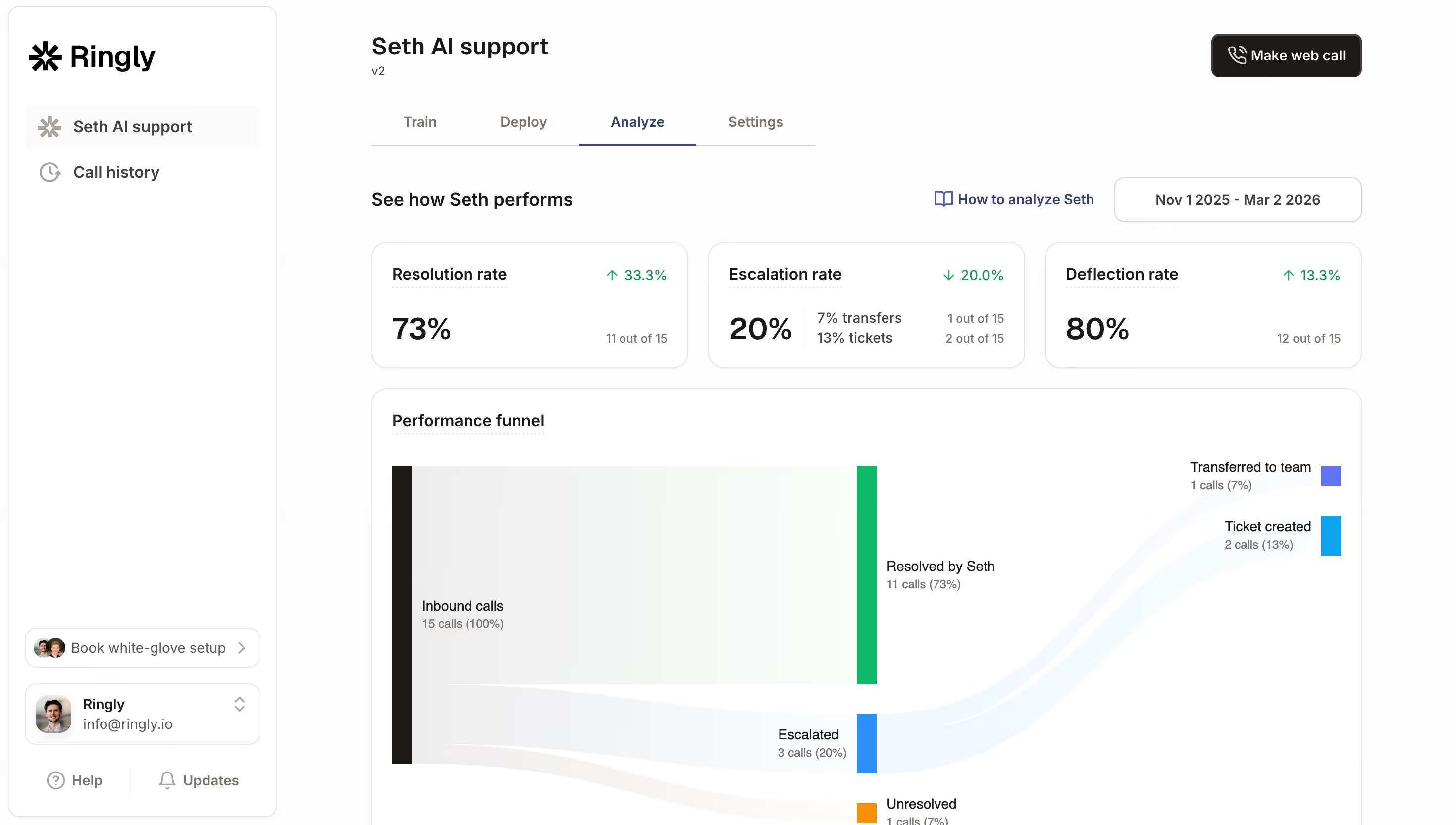
- Step 3: Estimate your AI resolution rate. For voice AI, expect 60-73% of calls resolved without a human. For chat AI, 40-60%. These are industry benchmarks that match what we see across Ringly.io's 2,100+ stores.
- Step 4: Calculate monthly savings. Multiply your monthly interactions by the resolution rate, then by the cost difference per interaction.
- Step 5: Add revenue gains. Factor in sales recovered from after-hours availability, faster response times (4 minutes vs 6+ hours), and reduced cart abandonment.
- Step 6: Subtract AI platform cost. Pull in your monthly AI subscription.
The formula with variables:
Monthly ROI = ((Interactions x Resolution Rate x Cost Difference) + Revenue Gains - AI Cost) / AI Cost x 100
Worked example for a Shopify store
Let's run the numbers for a typical Shopify store.
| Variable | Value |
|---|---|
| Monthly calls | 200 |
| Current cost per call | $8 |
| AI resolution rate | 73% |
| AI cost per call | ~$0.40 |
| Monthly AI platform cost (Ringly Start) | $99 |
| Estimated monthly revenue gain (after-hours) | $300 |
The math:
- Calls resolved by AI: 200 x 73% = 146 calls
- Cost savings per AI call: $8.00 - $0.40 = $7.60
- Monthly call savings: 146 x $7.60 = $1,109.60
- Total monthly benefit: $1,109.60 + $300 = $1,409.60
- Minus AI cost: $1,409.60 - $99 = $1,310.60
- Monthly ROI: $1,310.60 / $99 x 100 = 1,324% ROI
Even if you cut the revenue gains to zero and lower the resolution rate to 60%, the ROI is still over 800%.
Annual savings: $15,727+
The payback period? Less than one month. In our experience onboarding stores, most see their first resolved call within an hour of setup.
AI customer service ROI benchmarks by industry
Your ROI depends on your industry, call volume, and how complex your support requests are. The data across sectors:
| Industry | Typical ROI | Payback period | Key driver |
|---|---|---|---|
| E-commerce | Up to 280% | 1-3 months | High call volume, simple queries (WISMO, returns) |
| SaaS | 210% (3-year) | 4-6 months | Ticket deflection, onboarding support |
| Healthcare | 190% | ~14 months | After-hours triage, appointment scheduling |
| Financial services | Up to 310% | 6-9 months | Compliance-heavy, high per-call cost |
| Retail (general) | 200-250% | 2-4 months | Seasonal spikes, order inquiries |
According to a Forrester Consulting study, companies using voice AI specifically report a three-year ROI between 331% and 391%, with a composite organization saving $10.3 million in agent labor costs over three years.
E-commerce stores tend to see the fastest payback because their call types are repetitive. WISMO calls ("where is my order?"), return requests, and product questions are exactly the kind of queries AI handles well.
Gartner projects that AI will save $80 billion in contact center labor costs by 2026. That number isn't theoretical. It's happening right now.
What actually drives ROI (beyond cost savings)
Cost savings are the obvious win. But the best-performing AI implementations generate ROI from places most store owners don't think about.
- 24/7 availability: Your AI picks up at 2 AM, on weekends, and during holidays. No overtime pay. For e-commerce, where customers shop around the clock, this alone can add 10-15% in recovered revenue.
- Faster response times: AI responds in seconds. Humans take an average of 6+ hours for a first response. That speed difference directly reduces cart abandonment.
- Multilingual support: Ringly.io handles calls in 40 languages without hiring multilingual staff. If you sell internationally, this is free revenue you're currently leaving on the table.
- Customer retention: Customer retention improves when people get instant, accurate answers. Even a 5% improvement in CSAT scores can reduce churn by 2%.
- Consistent quality: AI doesn't have bad days. Every call gets the same level of attention, whether it's the first call of the day or the 500th.
- Data insights: Every AI call generates data you can use to improve your store. Which products get the most questions? What's confusing about your return policy? Call analytics turn support calls into business intelligence.
When AI customer service is NOT worth it
Honesty matters here. AI isn't the right choice for every business.
- Very low call volume (under 20 calls/month): If you're getting 10-15 calls per month, even a $99/month platform might not pay for itself. Answer them yourself until volume grows.
- Highly technical products: If every call needs 30+ minutes of complex troubleshooting with an expert, AI isn't ready to handle that. Think industrial equipment or custom engineering.
- Luxury brands where human touch IS the product: If your brand promise is white-glove, personal service, replacing that with AI undermines your positioning.
- No documented processes: AI needs a knowledge base to draw from. If your team's knowledge lives only in people's heads, you need to document it first.
- Heavily regulated industries (without AI guardrails): If compliance requirements mean every word matters, you need an AI platform with strong escalation rules and human handoff built in.
The sweet spot for AI customer service ROI is businesses handling 50+ support interactions per month with repetitive, predictable query types. That describes most Shopify stores.
How to maximize your AI customer service ROI
Getting positive ROI is the baseline. Here's how to push it higher.
- Start with your most common call types. For e-commerce, that's usually order tracking, return requests, and product questions. These are high-volume, low-complexity queries that AI resolves at the highest rates.
- Build a solid knowledge base first. The better your knowledge base, the higher your resolution rate. Spend an hour uploading your FAQ, shipping policy, and return policy before you go live.
- Set up proper escalation rules. Don't trap customers in AI loops. Configure your call transfer rules so complex calls go to a human. This protects CSAT and builds trust.
- Monitor resolution rates weekly. Check which call types are getting resolved and which aren't. Update your knowledge base based on what you learn.
- Use AI insights to fix root causes. If 40% of your calls are about a confusing return policy, fix the policy. AI analytics help you spot patterns you'd never catch manually.
If those numbers look compelling for your store, try Ringly.io free for 14 days. Setup takes three minutes, and most stores see their first resolved call within the hour.
Frequently asked questions
What is a good ROI for AI customer service?
Most businesses see 150-300% ROI from AI customer service within the first year. E-commerce stores with high call volumes and repetitive queries tend to hit the higher end. According to Forrester, voice AI can deliver 331-391% ROI over three years.
How long does it take to see ROI from AI customer service?
Most implementations show initial cost savings within 60-90 days. For e-commerce stores using a plug-and-play platform like Ringly.io, positive ROI often shows up in the first month because setup is fast and per-call savings are immediate.
Is AI phone support better than AI chat for ROI?
It depends on where your customers reach out. Phone calls cost more per interaction ($7-$14 human vs $0.40 AI), so the per-call savings are bigger. If your store gets significant call volume, AI phone support usually delivers higher ROI.
How much does AI customer service cost per month?
AI chatbots start at $50-$500/month. AI phone agents range from $99/month (Ringly.io Start plan with 250 minutes) to $1,099+/month for high-volume plans. Check Ringly.io pricing for current rates.
Do customers prefer AI or human support?
It's mixed. 53% of consumers dislike AI in customer service according to CX Dive, but this sentiment mostly targets text chatbots that loop and refuse to escalate. Voice AI that sounds natural and resolves issues quickly gets much better reception.
Can AI customer service handle returns and order tracking?
Yes, and these are the best use cases for AI. Order tracking and return requests are high-volume, repetitive queries with predictable workflows. Ringly.io connects directly to Shopify to pull real-time order data and give customers instant answers.
What's the ROI of AI customer service for small Shopify stores?
Even small stores see strong ROI. A store handling 100 calls/month at $8 per call, with a 73% AI resolution rate, saves roughly $550/month after the $99 AI platform cost. That's a 556% ROI with a payback period under 30 days.
The simple version
The math behind AI customer service ROI isn't complicated. If AI costs less per interaction than your current support and resolves most of your calls, it pays for itself.
For most e-commerce stores doing 50+ calls per month, the ROI turns positive within the first month or two. The harder question isn't whether AI support is worth it. It's how much revenue you're losing by not having it.
Start your free trial with Ringly.io and get AI answering your store's calls in three minutes.