
Studies show that the average mid-market brand loses up to 20% of its annual revenue simply because they can’t scale their human teams fast enough to meet customer demands.
You have built a successful brand with a real team, but you are likely hitting a wall where hiring more bodies is no longer the most efficient way to grow.
You feel the pressure of rising overhead and the constant fear that a single missed call or a slow support response is driving your best customers straight to a competitor.
In this article, we will go over how you can use Vapi for eCommerce phone calls and also why another tool might be a better option for Shopify users.
First, we will break down the technical setup required for custom voice agents.
Then, we will compare this developer-heavy path to specialized no-code alternatives built for fast-scaling Shopify brands.
Editor’s note: Want to hear some sample support calls made for your Shopify store?
- Just paste your store URL
- Get sample calls in under 20 seconds (no email required)
- Listen to demo calls for my store
What is Vapi?

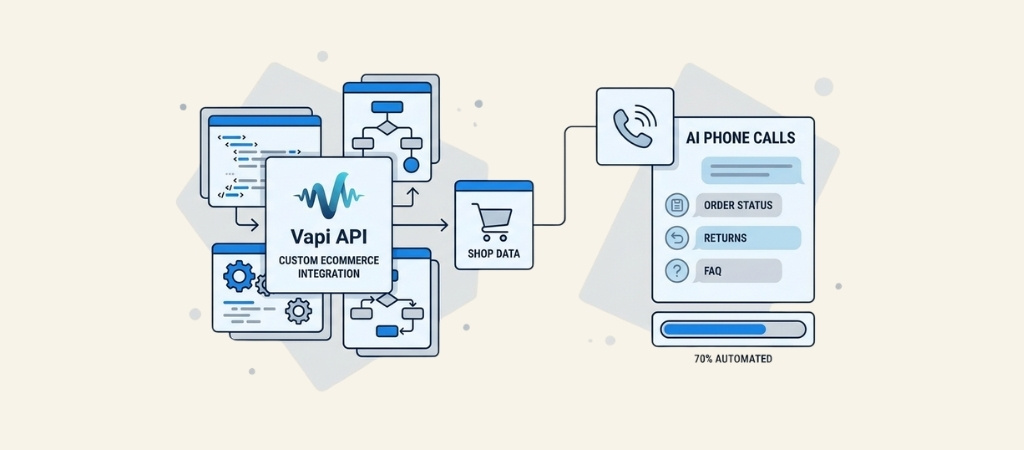
Vapi is an API-first orchestration platform that developers use to build, test, and launch voice AI agents.
It functions more as a toolkit for creating a custom solution rather than a ready-made product.
It is highly configurable, allowing developers to connect various models for Speech-to-Text (STT), Large Language Models (LLM), and Text-to-Speech (TTS).
It works with numerous providers, including OpenAI, Anthropic, and ElevenLabs.
This flexibility is why it is used by a range of companies, but it also means it is a general tool, not one built specifically for e-commerce.
It can manage both incoming and outgoing calls and connect with many applications, but this functionality requires custom coding.
How to set up Vapi for e-commerce phone calls
Preparing a Vapi agent is a technical task for developers.
It involves setting up APIs, writing code to handle your store’s logic, and managing server-side components. Here is a brief overview of the process.

Creating a voice assistant
First, you sign up, get an API key, and define your assistant’s behavior using a system prompt.
This requires careful prompt engineering to instruct the AI on its role, tasks, and the specific details of your e-commerce store.
A developer would need to write detailed instructions on how the agent should greet callers, what to ask for when looking up an order, and how to handle common questions.
This prompt forms the foundation of the AI's personality and capabilities.
Configuring phone numbers and call handling
Vapi offers phone numbers primarily in the United States and Canada.
If your customers are in other regions, your developer will need to integrate a number from a service like Twilio or set up a custom SIP trunk, which is an additional technical step.
Once a number is secured, the assistant must be programmatically linked to it to handle inbound calls.
This is done through API calls or within the Vapi dashboard.
Building custom tools
This is one of the most involved parts of the setup for an online store.
For the voice agent to perform useful actions like checking an order or processing a return, it needs custom functions, which Vapi refers to as "tools." Your developer must build these tools from the ground up.
For a Shopify store, this involves writing code that connects to the Shopify Admin API to retrieve order details, check inventory, or initiate a return.
Vapi's documentation provides examples for creating functions likelookup_customer or track_order that call a backend server. However, the server-side logic that performs these actions must be built, hosted, and maintained by your team, requiring ongoing developer resources.
Common use cases for Vapi in e-commerce
Once a developer has built and integrated the necessary tools, a Vapi-powered voice agent can handle several common e-commerce tasks.
These are not available out-of-the-box but are possible with custom code.
Order status and tracking
With a custom track_order tool, the agent can connect to your shipping carrier's API or your store's backend. When a customer calls asking about their order, the agent can retrieve and share the latest shipping information.
Return and exchange processing
A developer can also build a more involved workflow for returns.
For instance, the agent could first verify an item's return eligibility based on your store's policy, ask the customer for the reason, and initiate the process by calling another custom tool connected to your e-commerce platform.
Answering product questions
You can program the agent to answer common questions by connecting it to an internal knowledge base or a database of your FAQ content.
A developer would need to establish this connection and ensure the agent can retrieve the correct information.
Limitations of Vapi for e-commerce businesses
While Vapi is a platform well-suited for custom projects, its developer-first nature creates certain trade-offs for e-commerce businesses seeking a solution they can manage without a technical team.
High technical barrier
Vapi is designed for developers. Setting it up requires proficiency in a programming language like Node.js or Python, along with experience in API integrations and server management.
This can make it less accessible for non-technical store owners or support managers.
Deployment and maintenance time
Although Vapi's slogan is "Deploy in days," building a fully functional e-commerce agent is a larger project.
Creating reliable tool integrations, refining prompts for natural conversations, and implementing proper error handling can take weeks or months of development.
It also requires ongoing maintenance from your tech team as store policies, APIs, or backend systems change.
No native e-commerce integrations
Vapi is a blank canvas. All e-commerce functionality, such as connecting to Shopify for order details, must be built from scratch.
This is a significant undertaking compared to solutions that offer ready-made integrations with major e-commerce platforms.
Complex pricing model
Vapi's pricing can be complex.
The total cost is a combination of several usage-based fees.

You have to consider:
- Vapi Hosting Cost: This starts at $0.05 per minute for running the agent on their system.
- Model Provider Costs: You also pay for the STT, LLM, and TTS services you use. These are billed separately by their providers "at cost".
This layered model means the total cost per minute could range from $0.07 to over $0.25, depending on the models you choose and call complexity.
This can make it challenging to estimate your monthly costs without technical analysis and testing.
Vapi vs. Ringly.io: A comparison
For an e-commerce business, the choice between a general developer platform and a specialized tool depends on resources, timeline, and goals.
| Feature | Vapi | Ringly.io |
|---|---|---|
| Target User | Developers & Engineers | Ecommerce Store Owners & Teams |
| Setup Time | Days to Weeks (Build-it-yourself) | ~3 minutes (No-code) |
| Technical Skill | Coding & API knowledge required | No-code, simple interface |
| Shopify Integration | Manual (Requires custom API development) | Native, out-of-the-box |
| Pricing Model | Usage-based (Separate costs for STT, LLM, TTS) | Transparent monthly plans + 65% resolution guarantee |
| Maintenance | Ongoing developer effort | Fully managed by Ringly.io |
Ringly.io: The no-code alternative for Shopify stores

For e-commerce businesses looking for an AI phone agent without extensive technical requirements, Ringly.io offers a specialized, no-code solution.
Unlike a general tool such as Vapi, Ringly.io is built specifically for e-commerce stores.
Its AI agent, the AI, includes a deep, native Shopify integration from the start.
This allows the AI to handle key e-commerce tasks like looking up orders, processing returns, and answering product questions immediately after its quick setup.
No coding, API work, or custom tool building is needed; you connect your store, and it is ready to use.
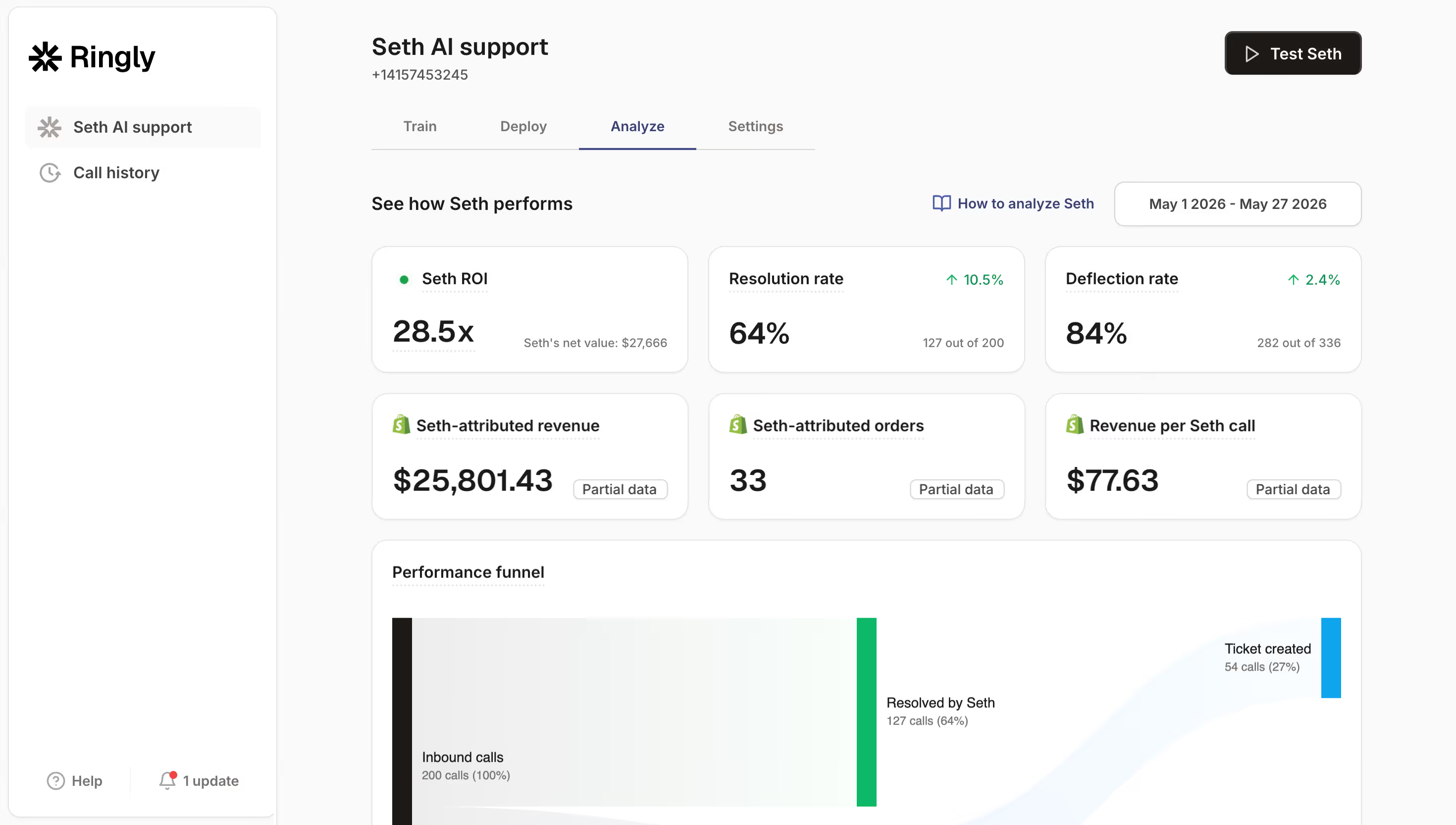
With an average resolution rate of 73% across over Shopify stores, Ringly.io automates a majority of routine support calls.
This allows your team to focus on more complex customer issues and other business-growth activities.
The pricing is straightforward, with clear monthly plans like the Grow plan, so costs are predictable.
Ringly.io also has a unique guarantee: you pay nothing until The AI resolves at least 65% of calls, making it risk-free to try.
For a practical demonstration of how these technical steps come together, the following video provides a walkthrough of building an AI phone support agent for an e-commerce store using Vapi and no-code tools.
This video shows how to build an AI voice agent that provides customer support for Shopify orders.
Final thoughts on using Vapi for e-commerce phone calls
Vapi is a highly flexible platform for development teams that need to build a completely custom voice AI solution.
Its primary strength lies in its configurability and API-first design, which is ideal for companies with the technical resources to build and maintain it.
However, for many e-commerce businesses, particularly those on Shopify, the technical requirements, development time, and variable costs are important factors to consider.
A specialized, no-code solution like Ringly.io provides an alternative path to automating phone support, designed for merchants to launch a sophisticated AI agent quickly. This approach allows merchants to focus on running their store.
Ready to automate your phone support?
Learn how Ringly.io can help manage customer calls. Start your free trial today.
Frequently Asked Questions
What are the main limitations of using Vapi for e-commerce?
The primary limitations are its high technical barrier, the time required for deployment and maintenance, a lack of native e-commerce integrations, and a complex, layered pricing model. It is built for developers, not for store owners to manage directly.
How does Vapi's pricing work?
Vapi's pricing is layered. You pay a per-minute hosting cost to Vapi, and on top of that, you pay separate, "at-cost" fees to the providers of the speech-to-text, LLM, and text-to-speech models you choose. This makes the total cost variable and difficult to forecast.
Is Vapi suitable for a non-technical store owner?
It is generally not recommended for non-technical users. Vapi is a developer-first platform that requires coding knowledge (like Node.js or Python), API integration experience, and server management.
What custom tools are needed to connect Vapi with Shopify?
To connect Vapi with Shopify, a developer would need to build custom tools from scratch. These are functions that use the Shopify Admin API to perform tasks like looking up order details, checking inventory, or initiating a return process.
Are there no-code alternatives to Vapi for e-commerce?
Yes, solutions like Ringly.io are designed as no-code alternatives specifically for e-commerce stores. They offer native integrations with platforms like Shopify, allowing you to set up an AI phone agent in minutes without any coding.