


How much money are you losing every time a customer hangs up because your support team is busy?
If you run a growing brand, you know the weight of a ringing phone.
Your team is buried under calls about tracking numbers and returns, and hiring more people just eats your margins.
This guide will go over how you can use IVR, or other even better alternatives for your phone support.
First, we will look at how modern AI replaces clunky menus.
Then, we will show you how to set up a system that solves problems instead of just routing calls.
Editor’s note: Want to hear some sample support calls made for your Shopify store?
- Just paste your store URL
- Get sample calls in under 20 seconds (no email required)
- Listen to demo calls for my store
What is IVR for ecommerce?
At its heart, Interactive Voice Response (IVR) is an automated phone system that lets customers use their voice or keypad to get things done.
Think of it as a digital receptionist that handles calls so a human doesn't have to.
For an ecommerce business, this tech plays a special role.
It’s your first line of support, ready to answer common questions and handle the tasks customers call about most.
Here are a few things a modern IVR system can do for an online store:
- Check an order's status ("Where is my order?").
- Start a return or an exchange.
- Answer product questions about sizing, materials, or ingredients.
- Give information on shipping policies and return windows.

It’s good to know the difference between a basic IVR and an advanced one. A basic system gives you a simple menu, like "Press 1 for sales, Press 2 for support." A modern, conversational AI agent, however, understands natural language.
A customer can just say what they need, and the AI gets to work solving it.
Core benefits of using IVR for your online store
Putting a modern IVR system in place is more than just managing calls, it's a smart move to make your business more efficient and your customers happier.
When you get it right, it helps you scale support without your costs getting out of control.
Offer 24/7 customer support
Your online store never closes, and customers expect help whenever they need it, not just from 9 to 5.
An AI-powered system offers round-the-clock availability, making sure someone is always there to assist.
This means a customer in another time zone can track their order or start a return at midnight their time.
A great system can even offer support in dozens of languages, helping you serve a global audience without any extra effort. That kind of instant, accessible support really helps build customer loyalty.
Reduce operational costs
Automating common support tasks is one of the best ways to lower your costs.
An AI phone agent can handle most of the usual questions, which frees up your human team to deal with more complex or sensitive customer issues.
The savings can be pretty big. A well-trained AI agent like the AI agent from Ringly.io can resolve a call for around $0.38, while the average cost for a human agent to do the same is about $2.35.
By automating 70-80% of your calls, you can help way more customers without hiring more people.

Handle high call volumes seamlessly
Every ecommerce business has its busy seasons.
During events like Black Friday or holiday sales, call volumes can shoot through the roof, easily overwhelming even the best support teams.
A scalable AI system is made for these moments. It can handle thousands of calls at once, so no customer gets a busy signal or is stuck waiting in a long queue.
For instance, Ringly.io's AI agent can manage 15+ simultaneous calls, keeping your service quality high during your busiest times without needing to bring on temporary staff.
Key features to look for in an IVR system
Not all IVR systems are the same, and the generic ones that work for other industries often don't cut it for online retail.
An ecommerce business has specific needs, so you have to look for features designed to meet them.
Deep integration with your ecommerce platform
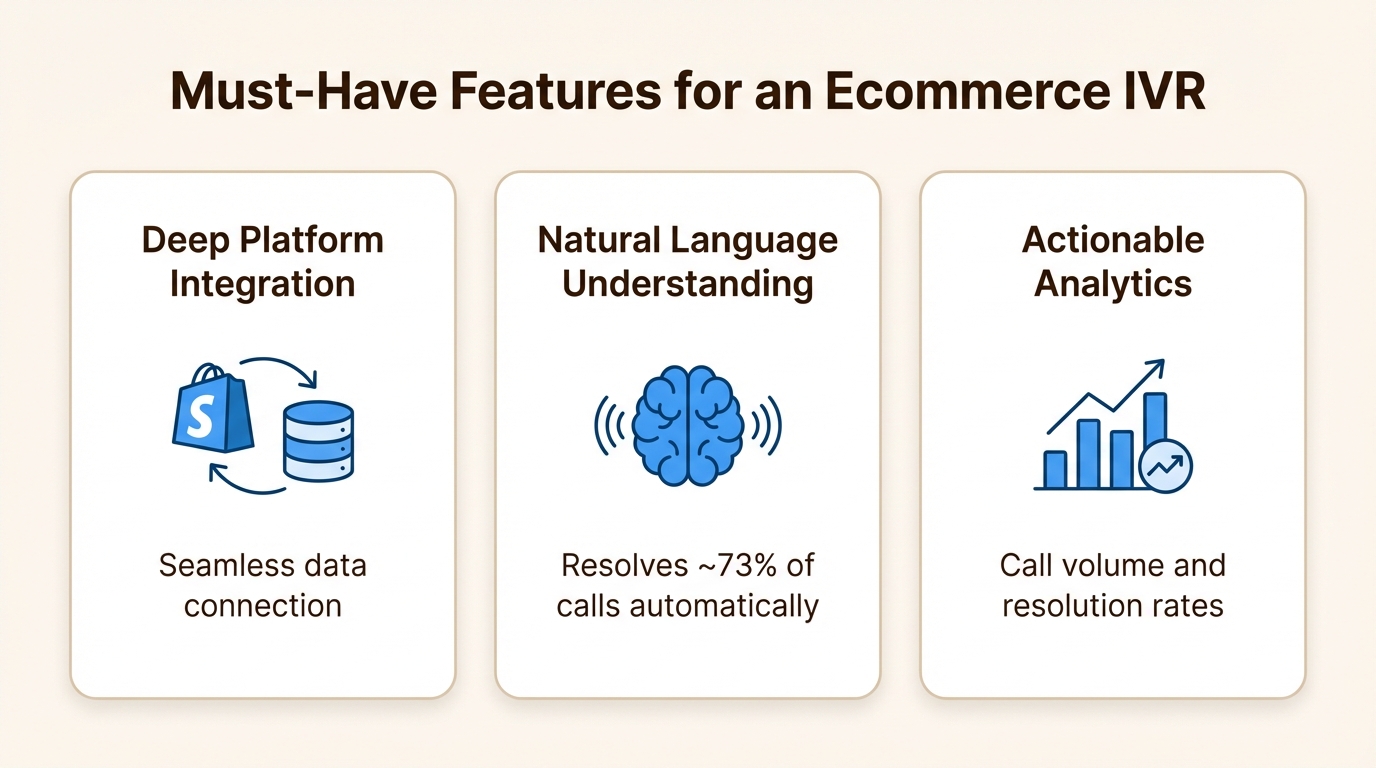
This might be the most important feature of all. Your IVR system has to connect smoothly with your platform, like Shopify.
A deep, native integration lets the system pull real-time data to give customers accurate, personalized answers.
It’s one thing to read data, but another to act on it. A truly integrated system can tell a customer their order has shipped and give them the tracking number.
More advanced solutions, like Ringly.io, can go a step further by starting returns and exchanges right inside your store's system, a feature not always found in generic tools.
Natural language understanding
The days of frustrating button-mashing menus are behind us. A modern system should use AI to understand conversational speech, letting customers explain their problem in their own words.
The main goal of the system shouldn't be to just pass calls along, but to solve them. Look for an agent with a high resolution rate.
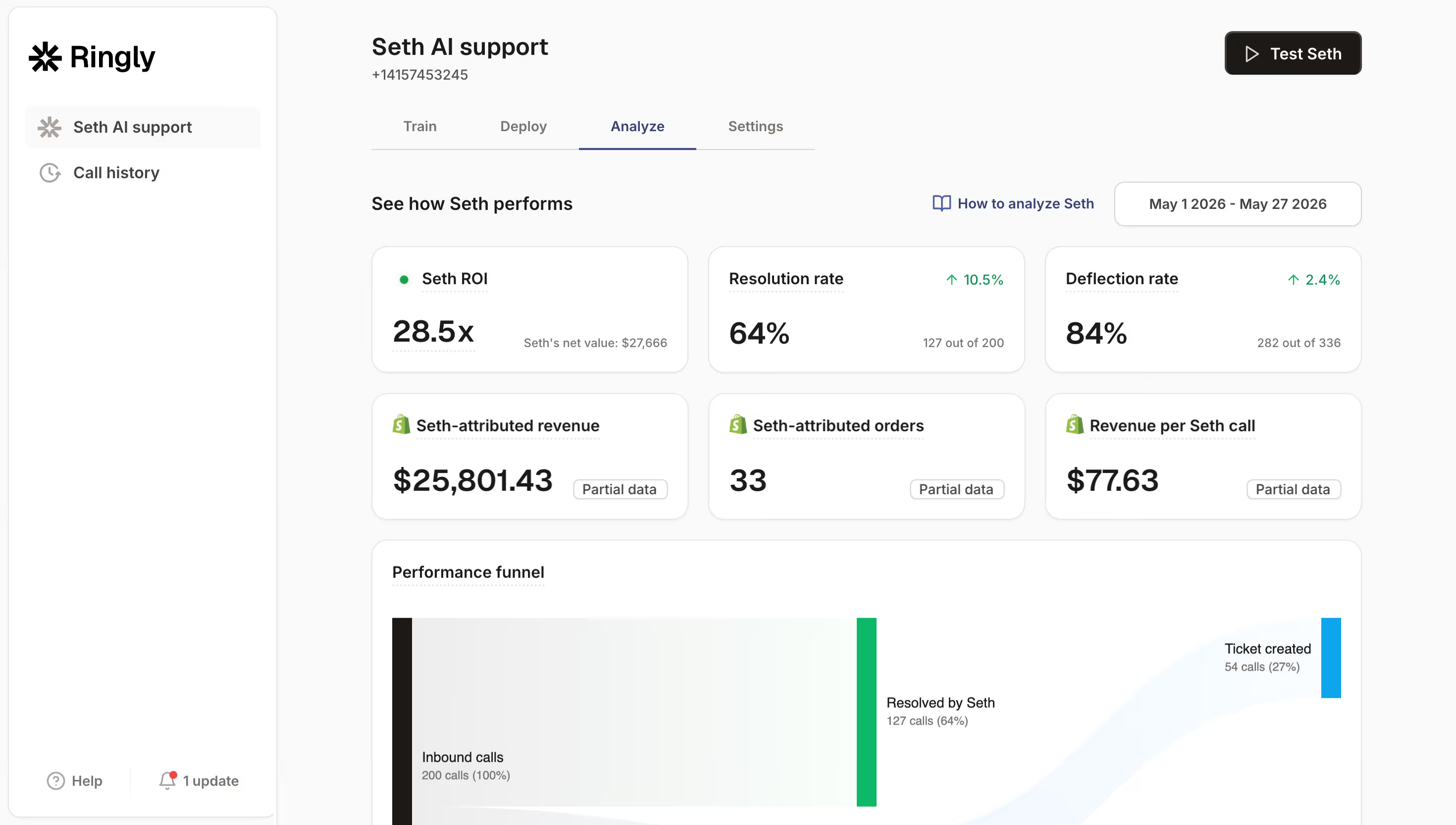
For example, the AI agent from Ringly.io successfully resolves around 73% of calls all on its own.
A good AI is also trained to be safe; it won't make up or guess an answer. Instead, it will politely escalate the call to a human agent when it doesn't have the right information.
Actionable analytics
Your phone support is a goldmine of data. A good IVR system should give you clear analytics on call volume, common customer questions, resolution rates, and any knowledge gaps the AI finds.
These insights are incredibly helpful. They can help you spot recurring problems with a product, find confusing shipping policies, or see where your website's FAQ page could be better.
This data helps you fine-tune both your automated support and your overall customer experience.
Traditional vs. modern IVR: AI phone agents
The term "IVR" has been around for a while, and for many people, it brings back some frustrating memories.
But the technology has split into two very different paths: the traditional, menu-based systems and the modern, specialized AI agents that are a whole new ballgame for ecommerce.
The pitfalls of traditional IVR systems
Many people have experienced being stuck in an endless loop of "press 1 for this, press 2 for that," listening to a robotic voice.
Traditional IVR systems are known for their rigid menus, which can often confuse customers.
These older systems were built mainly to route calls, not to actually solve problems.
They don't have the smarts to handle the specific, data-heavy questions common in ecommerce, like "Does this shirt run true to size?" or "Can I exchange my medium for a large?"
The rise of specialized AI phone agents
The modern alternative is an AI phone agent built specifically for ecommerce.
These systems are designed for natural, conversational support with a clear focus on solving issues on the first try. Here’s what makes a specialized tool different:
- Resolution-Focused: Instead of just passing the buck, modern agents are built to solve the problem. Some providers are so confident in their AI that they even guarantee it. For example, Ringly.io promises its AI agent the AI will resolve at least 65% of calls on its own — or get your last 3 months refunded if Seth resolves under 65% of calls in 90 days.
- Effortless Setup: Traditional IVR systems often need complicated technical setups that can take days or weeks. In contrast, a modern solution like Ringly.io can be set up within an hour for most stores just by connecting it to your Shopify store.
- E-commerce Native: A specialized agent speaks the language of online retail. It knows how to look up SKUs, handle returns based on your store’s policies, and answer detailed questions about your products.

Comparing IVR providers
To see the difference clearly, it helps to compare general communication platforms with a solution built just for ecommerce phone support.
| Feature | RingCentral | Aircall | Ringly.io |
|---|---|---|---|
| Primary Focus | Unified Communications (Phone, Video, Messaging) | Cloud-based Call Center | AI Phone Support for Shopify Stores |
| Shopify Integration | Focuses on general CRM integrations; no native Shopify features. | Displays customer and order data. | Deep, native integration for looking up orders and processing returns/exchanges. |
| Setup Time | Days to weeks; requires IT configuration. | Hours to days. | Under 3 minutes. |
| AI Capabilities | AI Receptionist is a separate product. | AI Voice Agent is an add-on with per-minute billing. | Conversational AI (Seth) is core to the product and included in the plan. |
| Best For | Businesses needing an all-in-one corporate communication suite. | Teams needing a versatile cloud phone system integrated with a helpdesk. | Shopify stores wanting to automate and resolve customer phone support. |
A pricing overview
Cost is always a consideration, and the pricing for these platforms can be quite different. Here’s a quick look to help you understand what you might be investing.
- RingCentral: This platform has a wide range of plans for its communication suite. Its AI Receptionist is a separate add-on that starts at $39 per month.
- Aircall: Plans for its cloud phone system start at $30 per user per month (billed annually with a three-user minimum). Their AI Voice Agent is an add-on that costs extra, starting at $0.99 per minute.
- Ringly.io: This platform offers simple, ecommerce-focused pricing. The Grow Plan is $349/month and includes 1,000 call minutes with its core AI agent, the AI. It also has a unique guarantee: you pay nothing until the agent is resolving at least 65% of your calls.

Making the right choice for your store
An IVR ecommerce system can be a huge help for your business, but the real benefit comes from choosing a modern, AI-driven solution made for the challenges of online retail.
The best systems are conversational, deeply integrated with your store, and focused on solving customer problems, not just passing them along.
While general communication tools have their uses, a specialized tool is often better equipped for an online store.
It's built to handle key ecommerce tasks like order lookups and returns right away, saving you time and giving your customers a better experience.
Ultimately, the goal is to free up your team to focus on growing your business while keeping customers happy.
An AI agent built for ecommerce can handle most of your routine calls, providing instant, 24/7 support at a lower cost.
For a deeper dive into how these systems work, check out this video that explains the fundamentals of Interactive Voice Response technology.
This video explains the fundamentals of Interactive Voice Response technology and how it works.
Ready to automate your phone support?
If you're running a Shopify store and want to see how a specialized AI phone agent can change your customer service, it's easy to get started.
An agent like The AI handles order lookups, returns, and FAQs 24/7, freeing up your team and making your customers happy.
Best of all, you can set it up in just a few minutes.
Start your free 14-day trial of Ringly.io today and see how many calls you can resolve automatically.
Frequently Asked Questions
What are the main benefits of using an IVR ecommerce system for a Shopify store?
An IVR ecommerce system helps your Shopify store by offering 24/7 support, reducing operational costs by automating common questions, and easily managing high call volumes during peak seasons like Black Friday.
How does a modern IVR ecommerce solution differ from a traditional one?
Modern IVR ecommerce uses conversational AI to understand and resolve customer issues directly, whereas traditional systems rely on rigid "press 1 for..." menus that mainly just route calls.
Is it difficult to set up an IVR ecommerce system?
Not at all. Specialized solutions like Ringly.io are designed for easy setup. You can connect it to your Shopify store and have it running in just a few minutes without needing any technical help.
Can an IVR ecommerce agent handle tasks like returns and order lookups?
Yes, a good IVR ecommerce agent can. When deeply integrated with your store's platform, it can access real-time order information to track packages and even initiate returns or exchanges based on your policies.
What should I look for when choosing an IVR ecommerce provider?
Look for a provider that offers deep integration with your platform, uses natural language to resolve calls, and provides clear analytics. A solution built specifically for ecommerce will always be more effective than a generic one.
How much does an IVR ecommerce service typically cost?
Pricing varies. Some platforms charge per user or per minute for AI features as add-ons. Others, like Ringly.io, offer plans like the Grow Plan for $349/month, which includes 1,000 call minutes and its core AI agent.