

Over 40% of the largest Shopify brands run their support through Gorgias, yet Zendesk still powers more helpdesk seats globally than any other platform. If you're picking between the two for your Shopify store, you're facing a real decision with real cost implications.
Choose wrong, and you'll either overpay for features you don't need or deal with a Shopify integration that forces agents to tab-switch for every refund. This comparison breaks down pricing, integration depth, automation, and the one support channel both platforms handle poorly.
Quick comparison: Gorgias vs Zendesk at a glance
Before getting into the details, this is what separates these two platforms at the highest level.
| Feature | Gorgias | Zendesk |
|---|---|---|
| Built for | E-commerce (Shopify focus) | All industries |
| Pricing model | Per ticket | Per agent |
| Shopify integration | Native, actionable | Read-only sidebar |
| Agent seats | Unlimited on all plans | Paid per seat |
| Starting price | $10/mo (50 tickets) | $19/agent/mo |
| Suite starting price | $60/mo (300 tickets) | $55/agent/mo |
| AI resolution cost | $0.90-$1.00/resolution | $1.50-$2.00/resolution |
| Marketplace integrations | ~100 | 1,500+ |
| G2 rating | 4.6/5 (547 reviews) | 4.3/5 |
| Setup time | Days | Weeks to months |
The short version: Gorgias is built for e-commerce customer service. Zendesk is built for everyone, which means Shopify stores get a more generic experience.
How we evaluated both platforms
We didn't just read feature pages. We set up test accounts on both platforms, connected them to a live Shopify store, and processed real tickets through each one. Here's what we compared specifically for Shopify merchants.
- Shopify integration depth: Can agents process refunds, edit orders, and view customer data without leaving the helpdesk?
- Pricing transparency: Is the cost predictable, or does it spiral as your store grows?
- AI automation value: What does AI actually cost per resolved ticket, and is the billing straightforward?
- Setup speed: How fast can a small team go live?
- Daily usability: Does the interface feel built for e-commerce workflows or general ticketing?
- Scalability: What happens when you go from 500 to 5,000 tickets per month?
- Review scores: What do G2, Capterra, and real users on Reddit say?
We also checked our own Gorgias pricing breakdown and Zendesk pricing breakdown for the latest numbers.
Shopify integration depth
This is where the biggest gap shows up. And it's not even close.
Gorgias was built for Shopify from the ground up. When a ticket arrives, agents see the customer's full Shopify profile in the sidebar: order history, subscription status, tracking info, and lifetime value.
More importantly, agents can take action directly from that sidebar. What Gorgias lets you do without leaving the helpdesk app:
- Process refunds: Full or partial refunds with one click
- Edit orders: Change shipping addresses, swap products, apply discounts
- Cancel orders: Cancel and notify the customer automatically
- Create new orders: Build orders from the support ticket itself
- View subscription data: Pull Recharge, Loop, and other subscription info inline
Zendesk's Shopify integration tells a different story. The Zendesk Shopify integration surfaces order data in the sidebar, but it's read-only. Agents can see order information, but they still have to open a separate Shopify tab to process refunds, edit orders, or take any real action.
Users on the Shopify App Store have noticed this gap. One reviewer wrote that viewing order details "takes too many clicks" and that customer notes that used to display automatically now require extra navigation.
For a busy Shopify customer service team handling 200+ tickets per day, that tab-switching adds up fast. If your agents spend even 30 extra seconds per ticket switching between tools, that's nearly 2 hours of wasted time daily at that volume.
Pricing breakdown: per-ticket vs per-agent
The pricing models are fundamentally different, and the right one depends entirely on your team size and ticket volume.
Gorgias pricing
Gorgias charges by ticket volume. You can add unlimited agents on every plan.
| Plan | Monthly | Annual | Tickets/mo | Overage |
|---|---|---|---|---|
| Starter | $10 | N/A | 50 | $0.40/ticket |
| Basic | $60 | $50 | 300 | $0.40/ticket |
| Pro | $360 | $300 | 2,000 | $0.36/ticket |
| Advanced | $900 | $750 | 5,000 | $0.36/ticket |
| Enterprise | Custom | Custom | 5,000+ | ~$0.32/ticket |
For a full breakdown, check our Gorgias pricing analysis.
Zendesk pricing
Zendesk charges per agent seat. Ticket volume doesn't matter.
| Plan | Per Agent/Month (Annual) | Key Inclusions |
|---|---|---|
| Support Team | $19 | Basic ticketing |
| Suite Team | $55 | Omnichannel, basic AI |
| Suite Growth | $89 | SLA management, multiple forms |
| Suite Professional | $115 | Custom analytics, skills routing |
| Suite Enterprise | $169 | Sandbox, advanced AI |
For the full picture, see our Zendesk pricing breakdown.
Real-world cost scenario
Let's say you have a 5-person support team handling 2,000 tickets per month. This is what you'd actually pay.
- Gorgias Pro (annual): $300/month base. All 5 agents included. No overage if you stay at 2,000 tickets. Total: $300/month.
- Zendesk Suite Team (annual): $55 x 5 agents = $275/month base. But you'll likely want Suite Growth for SLA features, which bumps to $89 x 5 = $445/month.
The hidden costs change the picture, though:
- Gorgias AI Agent: If AI resolves 500 tickets/month, add $450 ($0.90 x 500). Those 500 AI resolutions also count against your ticket allotment, so you might hit overages too.
- Zendesk AI resolutions: $1.50/resolution (committed). 500 resolutions = $750. Plus the Advanced AI add-on ($50/agent/month = $250). That's an extra $1,000/month.
Neither platform makes AI costs simple. Honestly, both billing models feel designed to confuse you into spending more than you planned.
Hidden costs to watch
- Gorgias double-billing: AI-resolved tickets count as both a helpdesk ticket and an AI resolution. You pay twice for one conversation.
- Zendesk add-on stacking: Copilot ($50/agent/mo), Quality Assurance ($35/agent/mo), and Workforce Management ($25/agent/mo) can push real costs to 2-3x the base price.
- Gorgias voice add-on: Phone support costs $0.40-$1.20 per ticket on top of your plan.
- Zendesk Talk: Phone support through Zendesk Talk adds per-minute charges and requires Suite plans.
AI and automation features
Both platforms have invested heavily in AI. Here's how they compare for Shopify customer service apps.
Gorgias launched AI Agent 2.0 in July 2025, which can hold natural conversations over email and resolve up to 60% of tickets without human help. It works well for common e-commerce queries like order status, return requests, and product questions.
The AI pulls context directly from your Shopify store, so it knows order details, shipping status, and product specs without extra configuration. In our experience, the AI handles straightforward tickets well but struggles with multi-issue conversations where a customer asks about two different orders in one email.
Zendesk's AI agents use a resolution-based model with per-agent allowances built into each plan. Each Suite plan includes a baseline of 5-10 free automated resolutions per agent per month. After that, you're paying $1.50-$2.00 per resolution depending on your commitment level.
The AI comparison in detail:
- Resolution capability: Gorgias claims up to 60% automation. Zendesk doesn't publish a specific number.
- Cost per resolution: Gorgias charges $0.90-$1.00. Zendesk charges $1.50-$2.00.
- Billing model: Gorgias double-bills AI resolutions (ticket fee + AI fee). Zendesk includes a baseline of free resolutions per agent.
- E-commerce context: Gorgias AI understands order data natively. Zendesk AI works from knowledge base articles.
- Setup complexity: Gorgias AI works out of the box with your Shopify data. Zendesk requires more configuration.
- Channel coverage: Both focus on email and chat. Neither has a strong voice AI solution for phone calls.
For stores receiving a mix of chat, email, and phone inquiries, it's worth looking at how AI is changing call centers alongside your helpdesk decision. Text-channel AI is only half the picture.
Ease of setup and daily use
Gorgias is quick to roll out for Shopify stores. Connect your store, import your macros, and your team can start handling tickets within a day or two. The interface is designed around e-commerce workflows, so agents see order data, customer info, and conversation history in a layout that makes sense.
Zendesk takes longer. A basic setup with ticketing and email can happen in a week. But if you want advanced features like custom analytics, skills-based routing, or sandbox testing, plan for 4-6 months of configuration. We've seen stores give up halfway through a Zendesk implementation because the admin panel feels like it was designed by committee.
Setup experience comparison:
- Gorgias setup time: 1-2 days for full Shopify integration
- Zendesk setup time: 1-2 weeks for basic, 4-6 months for advanced
- Gorgias learning curve: Low. Interface feels intuitive for e-commerce teams.
- Zendesk learning curve: Moderate to steep. More powerful, but more complex.
- Gorgias interface: Modern, feed-style inbox designed for speed
- Zendesk interface: Database-style ticketing. Some users say it "looks like it was designed 10 years ago."
For Shopify stores that want to be up and running quickly, Gorgias has a clear advantage here.
Multichannel support and reporting
Both platforms support multiple channels, but the coverage and depth differ.
Gorgias covers email, live chat, Facebook, Instagram, TikTok, and WhatsApp out of the box. Its reporting focuses on e-commerce metrics: revenue generated per agent, customer retention impact, and ticket resolution speed. The revenue attribution feature (which is genuinely useful) shows you which support interactions actually led to sales.
Zendesk offers a broader channel mix and significantly deeper analytics. Custom dashboards, SLA tracking, and workforce management tools give operations managers the data they need. If you run call center analytics, Zendesk's reporting is stronger.
Reporting comparison:
- Gorgias analytics: Revenue attribution, per-agent performance, response times. Simple but focused on what e-commerce teams care about.
- Zendesk analytics: Custom dashboards, SLA tracking, satisfaction surveys, workforce forecasting. More powerful, but requires setup time.
- Gorgias CSAT: Built-in satisfaction surveys after ticket resolution
- Zendesk CSAT: More customizable surveys with AI-powered sentiment analysis (on higher plans)
For most Shopify store owners, Gorgias's simpler reporting is enough. But if you're managing a 20+ person support team, Zendesk's analytics depth starts to matter.
When Gorgias is the wrong choice
Being honest about limitations matters. Gorgias isn't right for every Shopify store.
- High-volume stores with unpredictable spikes: Ticket-based pricing means a holiday rush or viral moment can blow up your bill. A store that normally handles 2,000 tickets could suddenly face 8,000 tickets in December.
- Multi-industry businesses: If you sell on Shopify but also run a B2B SaaS product, Gorgias can't handle both from one instance.
- Stores needing diverse integrations: With ~100 apps vs Zendesk's 1,500+, Gorgias's ecosystem is limited. If you rely on niche tools, check the integration list first.
- Teams wanting transparent AI pricing: The double-billing on AI resolutions (ticket fee + AI fee) frustrates many users. Check our Gorgias alternatives if this is a dealbreaker.
G2 reviewers (4.6/5 across 547 reviews) consistently praise the Shopify integration but flag pricing unpredictability as the top complaint.
When Zendesk is the wrong choice
Zendesk has its own set of dealbreakers for Shopify merchants.
- Small Shopify stores: Paying $55-$89 per agent per month for a read-only Shopify sidebar is hard to justify when you have 2-3 support agents.
- Stores needing actionable Shopify data: If your agents process refunds, edit orders, or manage subscriptions all day, the read-only integration will slow them down.
- Budget-conscious teams: Add-ons like Copilot ($50/agent/mo), QA ($35/agent/mo), and WFM ($25/agent/mo) can push a $55/agent plan past $165/agent. See more in our Zendesk alternatives roundup.
- Teams wanting fast deployment: If you need to be live this week, Zendesk's advanced features need months to configure properly.
The Shopify App Store reviews for Zendesk reflect this tension. Users like having order visibility but consistently complain about the extra clicks needed to act on that data.
The phone support gap both platforms miss
Something no other Gorgias vs Zendesk comparison talks about: phone support.
According to Zenith Media research, 76% of consumers still prefer phone calls for support, and phone scores a 91% satisfaction rate compared to 85% for live chat. For complex issues like returns, order disputes, or product questions, 69% of consumers reach for the phone.
But neither Gorgias nor Zendesk handles e-commerce phone support well:
- Gorgias voice: Available as an add-on at $0.40-$1.20 per ticket. No AI phone agent. It's basically a call routing tool.
- Zendesk Talk: Separate product with per-minute pricing. Not built for e-commerce order lookups. See our Zendesk Talk pricing analysis.
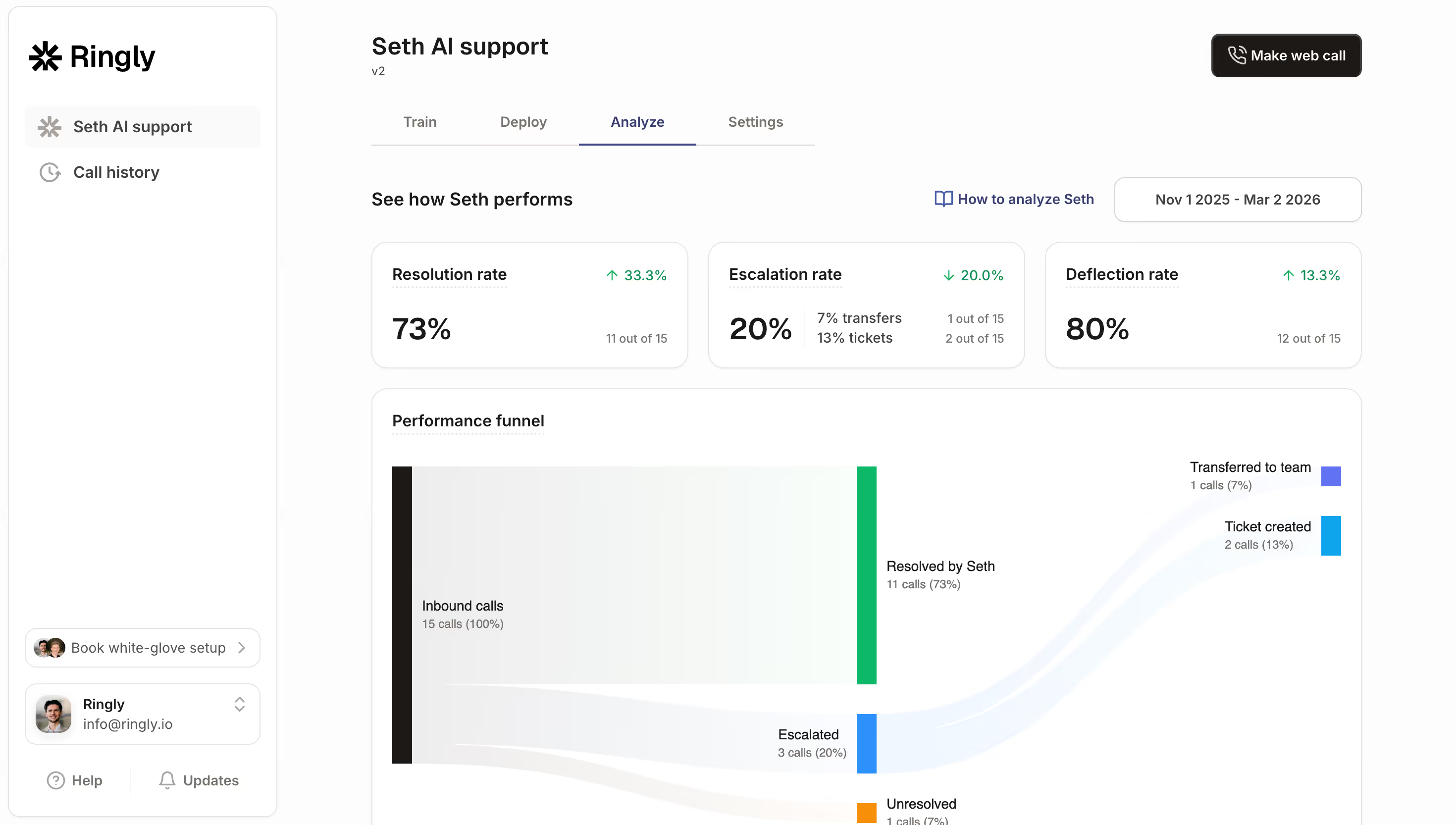
This is where Ringly.io fills the gap. Ringly's AI phone agent handles inbound calls for Shopify stores 24/7 in 40 languages. It looks up orders, processes returns, answers product questions, and escalates to humans when needed, resolving about 73% of calls without human intervention.
The key point: Ringly works alongside either Gorgias or Zendesk. It handles the phone channel while your helpdesk handles chat, email, and social. What the AI covers:
- Order status lookups: Pulls tracking info from Shopify in real time
- Return and exchange processing: Handles the full return workflow by voice
- Product questions: Answers using your store's knowledge base
- Smart escalation: Transfers complex calls to your human team with full context
- 24/7 availability: No staffing gaps, no after-hours voicemail
Setup takes about 3 minutes, no code required. Trusted by 2,100+ Shopify stores. If those resolution rates look good for your store, see what AI phone support sounds like in practice.
How to choose the right helpdesk for your Shopify store
The decision comes down to your team structure, ticket volume, and what matters most to your workflow.
Choose Gorgias if:
- You run a Shopify-first store: The native integration saves hours of tab-switching every day
- You have a larger support team: Unlimited seats mean 10 agents cost the same as 2
- Your ticket volume is predictable: The per-ticket model works when volume is steady
- You want fast setup: Go live in days, not months
- E-commerce is your only business: Gorgias does one thing and does it well
Choose Zendesk if:
- You operate across multiple industries: Zendesk supports e-commerce, SaaS, and B2B from one platform
- You need 1,500+ integrations: Your tech stack includes niche tools that only Zendesk connects to
- You have a small, fixed agent team: Per-agent pricing is predictable at 2-4 agents
- You need enterprise analytics: Custom reports, sandbox testing, and advanced routing
- You're already on Zendesk: Migration costs may outweigh the benefits for your use case
Add Ringly.io for phone support if:
- Your customers call about orders: The AI handles WISMO calls, returns, and product questions
- You want 24/7 phone coverage: No night shifts, no weekend staffing gaps
- You're tired of paying per-minute for phone: Ringly's plans start at $99/month for 250 minutes
- You need multilingual phone support: 40 languages, no extra agents required
Frequently asked questions
Is Gorgias or Zendesk better for small Shopify stores?
Gorgias is the better fit for most small Shopify stores. The native integration lets agents handle refunds and order edits without switching tabs, and pricing starts at $10/month for 50 tickets. Zendesk's per-agent model ($55+/agent/month) gets expensive fast for small teams.
Can I use Gorgias and Zendesk together?
You technically can, but it doesn't make sense. Both are full helpdesk platforms, so running two creates duplicate tickets, confused routing, and double the cost. Pick one for chat, email, and social, then add a specialized tool like Ringly.io for AI phone support.
How much does Gorgias actually cost per month?
The advertised starting price is $10/month, but most real stores spend more. A store handling 2,000 tickets/month on the Pro plan pays $300-$360/month. Add AI Agent resolutions ($0.90-$1.00 each), and costs climb further because of double-billing.
Does Zendesk integrate well with Shopify?
Zendesk has a Shopify integration, but it's read-only. Agents can view order data in the sidebar, but they can't process refunds, edit orders, or take actions without opening Shopify in a separate tab.
What's the best phone support option for Shopify stores?
Neither Gorgias nor Zendesk excels at phone support for e-commerce. Ringly.io fills that gap: its AI agent handles Shopify call center tasks like order lookups, returns, and product questions 24/7 in 40 languages.
Can I migrate from Zendesk to Gorgias (or vice versa)?
Yes, both platforms support migration. Gorgias offers a migration tool that imports your Zendesk ticket history. Expect some manual work re-creating macros, rules, and automations since those don't transfer cleanly.
Does Gorgias work with Shopify Plus?
Yes. Gorgias integrates with both standard Shopify and Shopify Plus. The Shopify Plus features like multi-store management, wholesale channels, and custom checkout flows all work with Gorgias's sidebar.
Picking the right tool depends on your store, not the brand name
For most Shopify stores, Gorgias is the better helpdesk. The native integration, unlimited seats, and e-commerce-first design make it the obvious pick when your support revolves around orders, returns, and product questions.
Zendesk earns its place when you're running a larger, multi-industry operation where e-commerce is just one part of the picture. Its 1,500+ integrations and enterprise analytics are hard to match.
And if your customers call (76% of them prefer to), neither platform solves that well. Ringly.io handles the phone channel with an AI agent built for Shopify, working alongside whichever helpdesk you choose. Try it free for 14 days and hear what it sounds like.