

Each year, brands lose billions in sales just because they can't answer the phone fast enough.
You know the stress of watching your support team drown in the same five questions while payroll costs climb.
You want to give your customers elite service, but you can’t be everywhere at once.
And it only gets worse.
This guide will go over how to use eCommerce voice AI, and resolve 73% of issues without a human.
First, we will look at how the tech works.
Then, we will compare the best tools for your store.
Editor’s note: Want to hear some sample support calls made for your Shopify store?
- Just paste your store URL
- Get sample calls in under 20 seconds (no email required)
- Listen to demo calls for my store
What is ecommerce voice AI?
So, what exactly is ecommerce voice AI? Simply put, it's an automated system that uses artificial intelligence to handle customer phone calls for online stores.
It's like having a support agent who works around the clock, never needs a break, and can talk to hundreds of customers at once.
It works by combining a few clever technologies:
- Speech Recognition: The system listens to your customer and turns their spoken words into text.
- Natural Language Understanding (NLU): This is the brain of the operation. It figures out what the customer actually wants. When someone asks, "Where's my stuff?" the AI knows they're looking for an order status update.
- System Integration: The AI connects directly to your ecommerce platform, like Shopify, to pull up-to-the-minute information. It can check order details, product availability, or your return policy in a flash.
- Text-to-Speech: Finally, it uses a natural-sounding voice to give the customer a clear, helpful answer.

This approach is a significant evolution from traditional Interactive Voice Response (IVR) systems.
Instead of making customers navigate a rigid menu ("press 1 for sales, press 2 for support..."), modern voice AI allows for a natural conversation, much like talking to a real person.
Key use cases for ecommerce voice AI
The real value of voice AI is how it handles all the common, repetitive questions that take up your team's day.
By automating these tasks, you free up your human agents to focus on more complex issues where they can make a real difference.
Provide 24/7 instant support for common questions
The number one question every online store gets is, "Where is my order?" (WISMO).
Instead of having a person manually look up tracking numbers all day, a voice AI can instantly access order details from your Shopify store and give the customer real-time shipping updates.
But it doesn't stop there. The AI can also handle automated returns and exchanges, guiding the customer through the process and sending them a shipping label during the call.
It can answer common questions about your shipping policies, product details, or store hours, giving customers instant answers and your team their time back.
A specialized agent like the AI agent from Ringly.io is built for these exact tasks. In fact, across thousands of Shopify stores, it has a proven track record of resolving around 73% of calls without any human help.
Offer personalized shopping assistance
Beyond support, voice AI can also act as a personal shopper.
A customer could call and ask, "Do you have running shoes in size 10?" and the AI could check your inventory and even offer recommendations based on their past purchases.
This can be a great way to improve the shopping experience and maybe even drive a few upsells.
That said, for most online stores, the biggest wins come from automating post-purchase support calls first.
Evaluating the top ecommerce voice AI platforms
Not all voice AI tools are the same. Some are complex developer platforms that require a team of engineers, while others offer more straightforward automated answering capabilities. The trick is to find a tool that fits your store's needs without causing a technical headache.
Ringly.io

- Description: This is an AI phone agent named the AI, built specifically for Shopify stores. It’s designed so that anyone can set it up in about 3 minutes and let it start handling most inbound support calls immediately.
- Best for: Shopify merchants who want to lower support costs, provide instant answers, and offer 24/7 service without hiring more staff.
- Limitations: Its focus is its strength. It’s made for inbound support automation on Shopify, so it isn't the right tool for outbound sales calls or stores on other platforms like Magento or BigCommerce.
- Pricing:
- Grow: $349/month for 1,000 minutes. It comes with a guarantee where you get your last 3 months refunded if Seth resolves under 65% of your first 100+ calls.
- Enterprise: custom pricing for stores handling 5,000+ minutes/month, with private Slack channel and custom integrations.
Voiceflow

- Description: Voiceflow is a powerful, flexible platform for technical teams to design and launch their own custom voice and chat AI agents. It can integrate with many systems, including Shopify Plus and Zendesk.
- Best for: Larger companies with in-house developers who want to build a completely custom solution from the ground up and have total control over the process.
- Limitations: This is not a plug-and-play solution. It requires technical skill and development resources to build and maintain, making it best suited for merchants with in-house technical teams.
- Pricing: Voiceflow has public pricing tiers, including a free plan, a Pro plan at $60/month, and a Business plan at $150/month. However, its credit-based system for usage can be hard to predict for call volume.
Gorgias
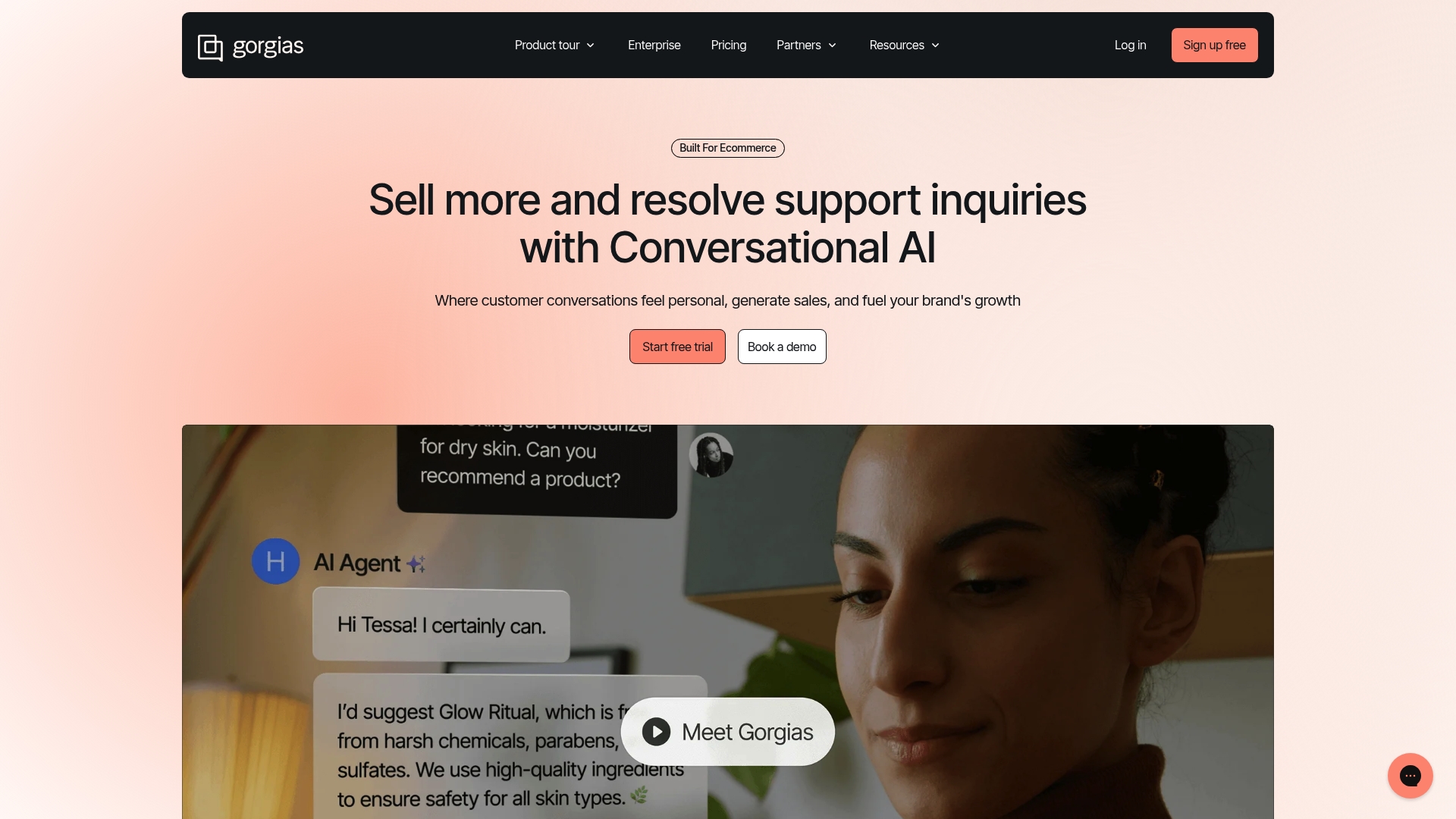
- Description: Gorgias is a popular customer service helpdesk for ecommerce brands. It brings all your customer conversations from email, chat, social media, and voice into one dashboard for your agents to manage.
- Best for: Brands that want a single platform to manage all customer interactions, where voice is just one part of a larger, human-powered support strategy.
- Limitations: Voice is an integrated feature within the helpdesk, designed to centralize calls for a support team to handle. This approach differs from tools built primarily for autonomous call resolution.
- Pricing: The pricing can be complex since it's based on your store's ticket volume. Plans range from a $10/month Starter plan to a $750/month Advanced plan, before you add on extras like voice and AI.
Consio

- Description: Consio is a phone platform for Shopify that's split into two parts: a power dialer for human sales agents making outbound calls, and an AI voice agent for handling inbound calls.
- Best for: Ecommerce stores that focus heavily on outbound phone sales for things like abandoned cart recovery or winning back VIP customers.
- Limitations: The platform's main purpose is to turn phone calls into revenue, especially through outbound campaigns. While its inbound AI can answer basic support questions, the tool is primarily built for sales, not dedicated support automation.
- Pricing: Consio doesn't list its pricing publicly. You have to book a demo for pricing details.
| Feature | Ringly.io | Voiceflow | Gorgias | Consio |
|---|---|---|---|---|
| Primary Use Case | Automated Inbound Support | Custom AI Agent Development | Multi-Channel Helpdesk | Outbound Sales & Inbound Support |
| Setup Time | ~3 minutes | Weeks to Months | Hours to Days | Minutes to 24 Hours |
| Technical Skill | None required | Developer required | Some configuration | None required (No-code) |
| Shopify Integration | Deeply native (Write access) | Custom API integration | Native (Helpdesk sidebar) | Deeply native (Sales focus) |
| Public Pricing | Yes | Yes (Complex/Usage) | Yes | Yes (Starts at $30/mo) |
What to look for in an ecommerce voice AI solution
When you're trying to pick the right tool, it's easy to get lost in a sea of features. Here’s a simple checklist to help you focus on what really matters for an online store.
Depth of integration
A generic AI can't answer "Where is my order?" if it can't see your orders.
A deep, native integration with your ecommerce platform is a must. For example, a tool like Ringly.io plugs directly into Shopify, letting it pull accurate, real-time information instantly. Without that, you're just getting a fancy answering machine.
Speed and ease of implementation
Do you need to hire a developer, or can your support lead get this running on their own? Some platforms like Voiceflow are powerful, but they are a full-blown project requiring a technical team.
In contrast, no-code solutions like Ringly.io are built for a quick setup, so you can start automating calls today, not next quarter.
Autonomous call resolution rate
The whole point of this is to actually solve customer issues, not just answer the phone. Look for a tool that can prove its effectiveness. A high resolution rate, like Ringly's ~73% average, means the AI is actually solving problems and saving your team valuable time.
It's also important to have safety nets, so the AI knows when to escalate a complex problem to a human.
Language support and scalability
If you sell to customers around the world, you need a solution that can speak their language. Good platforms should support dozens of languages to create a smooth experience for international customers.
For instance, Ringly.io supports 30 languages right out of the box, so you can offer great support no matter where your customers are calling from.
Your first step into voice automation
Ecommerce voice AI has become a practical tool for scaling support operations. It offers a way to transform customer support into an intelligent, automated, and consistently available service.
Choosing a tool designed for the specific needs of an online store is key to saving time, managing costs, and improving the overall customer experience.
Ready to automate your phone support?
If you're tired of missed calls, repetitive questions, and a support queue that never ends, it’s time to see what a dedicated AI phone agent can do for your store.
Ringly.io was built from the ground up to solve these exact problems for Shopify merchants.
With a risk-free guarantee, you don't pay anything until our AI agent, the AI, is resolving at least 65% of your calls.
Start your free 14-day trial today and see how it works with your real customer calls.
Frequently Asked Questions
How does ecommerce voice AI handle complex customer questions?
It's designed to handle common queries like order status or returns. For more complex issues, a good ecommerce voice AI will intelligently escalate the call to a human agent to ensure the customer gets the right help.
Can I customize an ecommerce voice AI to match my brand's voice?
Yes, many platforms allow you to customize the voice, tone, and responses. For example, Ringly.io's agent, the AI, can be tuned to align with your brand's specific personality and communication style.
How long does it take to set up an ecommerce voice AI for my Shopify store?
It varies by platform. Developer-heavy tools can take weeks or months. However, solutions built specifically for Shopify, like Ringly.io, can be set up in just a few minutes without any coding knowledge.
What kind of integration is necessary for an ecommerce voice AI to work effectively?
A deep, native integration with your ecommerce platform (like Shopify) is essential. This allows the ecommerce voice AI to access real-time order details, shipping information, and product data to provide accurate answers.
Will using an ecommerce voice AI replace my entire customer support team?
Not at all. The goal of an ecommerce voice AI is to automate repetitive, high-volume questions. This frees up your human agents to focus on more strategic, high-value tasks and complex customer problems where their expertise is truly needed.