
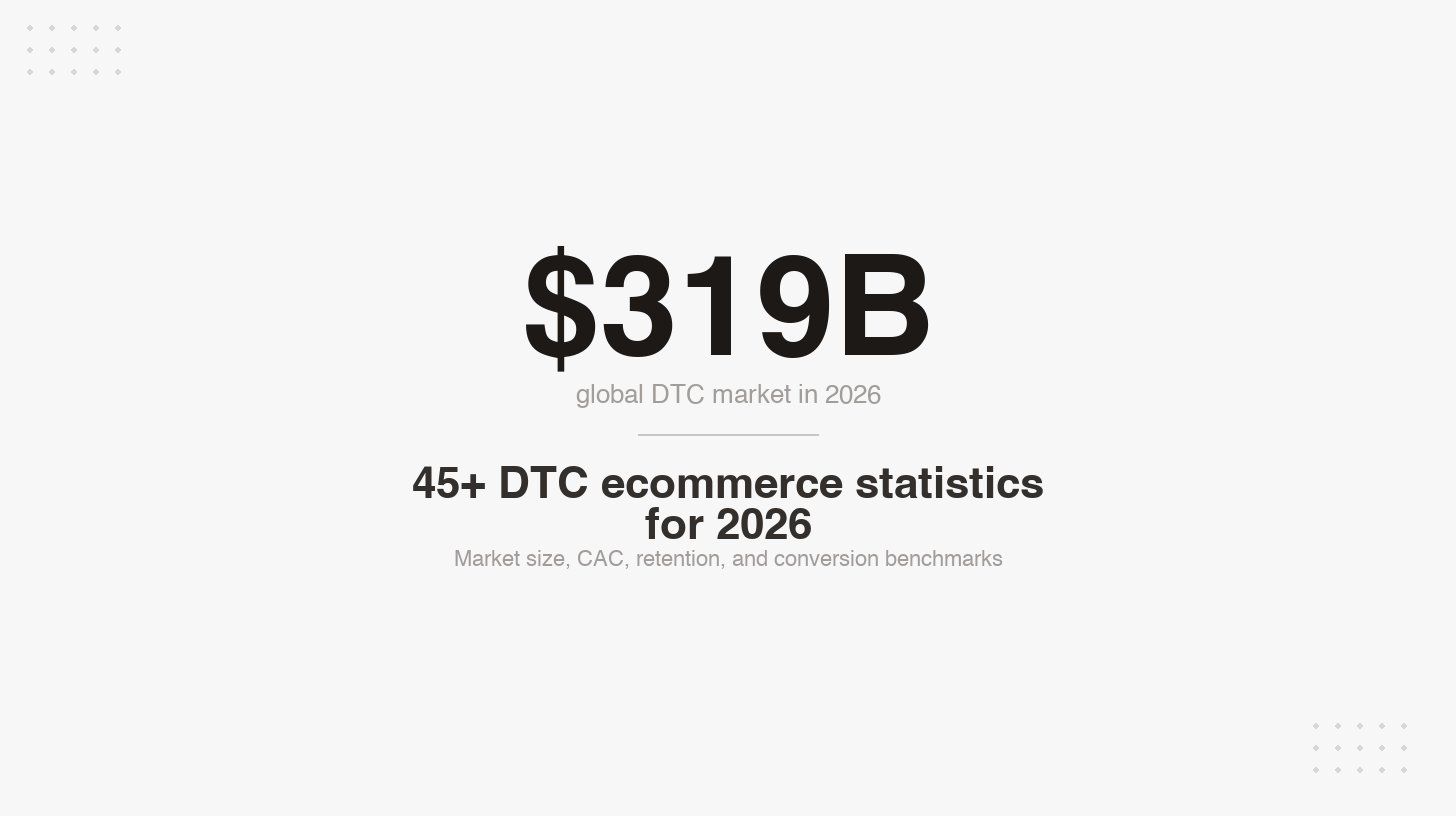
The DTC model isn't slowing down. With the global direct-to-consumer market crossing $319 billion in 2026 and customer acquisition costs climbing year after year, knowing the numbers behind DTC ecommerce is more important than ever. Whether you're running a Shopify store or scaling a subscription brand, these dtc ecommerce statistics will help you benchmark, plan, and make better decisions.
Hear what AI support calls sound like for your store. Just paste your Shopify URL and get sample calls in under 20 seconds, no email required. Listen to demo calls for my store.
Key highlights
- The global DTC market is projected to reach $319.57 billion in 2026, growing at a 7.8% CAGR through 2035.
- US DTC ecommerce hit $212.9 billion in 2025, accounting for 19.2% of all retail ecommerce.
- Customer acquisition costs have risen 222% over the past eight years across industries.
- The average DTC brand retains just 28.2% of customers for a second purchase.
- Social commerce in the US will surpass $100 billion in 2026, with TikTok Shop driving nearly 20% of it.
- Companies using AI personalization earn 40% more revenue than those without it.
DTC market size and growth
The global DTC market is valued at $296.45 billion in 2025 and is projected to reach $319.57 billion in 2026. That puts it on track to hit $639.15 billion by 2035, growing at a compound annual growth rate of 7.8%. (Business Research Insights)
US DTC ecommerce sales reached $212.9 billion in 2025, a 16.6% jump from 2024. The US remains the largest DTC market globally, with North America holding 36 to 40% of the worldwide market share. (Deposco)
DTC now accounts for 19.2% of all US retail ecommerce. That share keeps growing as more brands sell directly through their own websites and apps rather than through third-party retailers. (Statista)
There are over 110,000 DTC businesses operating in the United States. The majority are digitally native brands that launched online first. (Built In)
D2C brands are growing at a compound annual growth rate of 15.4%. That outpaces traditional retail growth by a wide margin, driven by ecommerce trends like personalization, social selling, and subscription models. (Paddle)
58% of supply chain leaders expect most sales to be DTC by 2026. Another 25% already get more than half their revenue from direct channels. (Deposco)
The DTC model keeps gaining ground because it gives brands full control over pricing, customer data, and the end-to-end experience. And with ecommerce marketing tools getting cheaper, the barrier to entry is lower than ever.
Customer acquisition costs
Customer acquisition costs have increased 222% over the past eight years. Digital-first DTC brands specifically saw a 24.7% year-over-year rise in 2025 alone, largely driven by more expensive paid social and search advertising. (Amra & Elma)
The average DTC ecommerce CAC sits between $45 and $70. That's relatively low compared to other industries (financial services averages $644), but it's climbing fast enough to squeeze margins for smaller brands. (MobiLoud)
DTC CAC varies widely by vertical: pet products cost $23, fashion $37, beauty $42, home goods $45, food $51, fitness $67, and supplements $89. Health and supplement brands pay the most per new customer, which is partly why retention matters so much in those categories. (MHI Growth Engine)
Ecommerce brands lose an average of $29 on every new customer they acquire. After factoring in marketing costs and returns, the first purchase is almost always unprofitable. The money is in the second and third orders. (GrowSurf)
69% of DTC brands are increasing marketing spend in 2025, and 76% plan deeper discounts. Brands are spending more to acquire customers while also cutting prices. That's a tough combination. (Digiday)
Referral marketing delivers the lowest CAC of any active channel at $15 to $50 per customer. Influencer-generated content also performs well, delivering roughly 30% lower cost per acquisition than brand-produced creative. (GrowSurf)
Rising CAC is the single biggest headache for DTC brands right now. If you can't make the unit economics work on the first order, your retention strategy has to be airtight. That means investing in customer retention, post-purchase experiences, and support quality.
Retention and loyalty
The average DTC brand retains just 28.2% of customers for a second purchase. That means nearly three out of four first-time buyers never come back. (Metrilo)
About 60% of DTC revenue comes from returning customers, not new ones. Even though retention rates are low, the customers who do come back generate the majority of revenue. (Metrilo)
Loyal customers convert at 60 to 70%, compared to 5 to 20% for new prospects. The conversion gap between returning and first-time shoppers is massive. (Venture Media)
Top subscription brands retain 65%+ of their revenue after one year. Retention above 50% is considered top quartile, with 42% as the median. Subscription models naturally boost retention because they remove friction from reordering. (Recharge)
83% of companies report positive loyalty program ROI, with average returns of 5.2x. Loyalty programs aren't just a feel-good tactic. They directly impact revenue by increasing purchase frequency and average order value. (Venture Media)
78% of consumers are more likely to make repeat purchases from brands that personalize their experience. First-time buyers who receive personalized post-purchase communications show 45% higher second-purchase rates. (Envive)
Retention is where the real profit lives. With CAC at all-time highs, every DTC brand needs to obsess over the post-purchase experience. That includes fast shipping, proactive order tracking updates, easy returns, and customer service that actually answers the phone.
If you're losing customers because they can't reach your support team, that's fixable. Ringly.io gives Shopify stores an AI phone agent that handles order inquiries, returns, and product questions 24/7 in 40 languages. Try it free for 14 days.
Conversion rates and performance benchmarks
The average ecommerce conversion rate sits between 2% and 4%, with Shopify stores typically hitting 2.5 to 3%. Conversion rates have stabilized in this range for established stores in 2026. (Blend Commerce)
Desktop converts at roughly 3.9% versus 1.8% on mobile. The gap is narrowing, but mobile still underperforms desktop by about half. Given that mobile drives 80% of traffic, this represents a massive revenue leak for most DTC brands. (Skailama)
The median AOV for DTC brands is $74.12 across paid advertising channels. High-AOV categories include home and garden ($110) and automotive ($111), while health and beauty sits lower at around $60. (Triple Whale)
The average Shopify store converts 1.4 to 1.8% of visitors. Top 20% convert above 3.2%, and the top 10% exceed 4.7%. The difference between average and top performers is roughly 3x, which tells you how much room there is to improve through conversion rate optimization. (Stagebit)
Food and beverage leads conversion rates at 2.73%, followed by health and beauty at 2.49% and pet supplies at 2.45%. Consumer electronics (1.58%) and automotive (1.59%) sit at the bottom. (Skailama)
If you're in the health, beauty, or pet space, you're working with above-average conversion rates. That's good news. But Shopify conversion rate optimization can push you even higher, especially by fixing mobile checkout flows and adding trust signals like real-time phone support.
Consumer preferences and behavior
76% of consumers prefer shopping on a branded DTC site over a marketplace. But there's a catch: 85% say they'll only do so if the DTC site offers the same browsing experience and payment flexibility they get on Amazon or similar platforms. (BetterCommerce)
71% of consumers now expect personalization as a standard part of shopping. Over three-quarters get frustrated when a brand doesn't tailor the experience to their preferences. (McKinsey)
Millennials and Gen Z account for over 60% of all DTC purchases. These demographics value convenience, personalization, and brand transparency more than older cohorts. (Invesp)
86% of customers say customer service is a key factor in their purchase decisions. And 68% are willing to pay more for products from a company with a strong service record. (Callzilla)
78% of US consumers say a sustainable lifestyle is important to them, and 66% will pay more for sustainable products. Among Gen Z, that number climbs to 75%. (NielsenIQ via Invesp)
47% of consumers value free delivery when choosing a DTC brand, and 35% prioritize free returns. Shipping and returns policies are still a make-or-break factor, especially for first-time buyers who are comparing you against marketplace alternatives. (Paddle)
The takeaway is clear. DTC shoppers want the Amazon experience (fast shipping, easy returns, instant support) but from brands they trust. If you can deliver on those expectations, you'll win. If you can't, they'll leave. Managing returns well and providing great phone support are two of the fastest ways to close that gap.
Social commerce and marketing channels
US social commerce sales hit $87 billion in 2025 and will surpass $100 billion in 2026, growing 18% year over year. Social platforms are no longer just awareness channels. They're full sales engines. (eMarketer)
TikTok Shop hit $15.82 billion in US sales in 2025, up 108% year over year. It now represents 18.2% of all US social commerce. Health, beauty, and wellness products make up 79.3% of TikTok Shop sales. (eMarketer)
Over 70 million Americans use TikTok Shop, projected to reach 80.4 million by 2026. By 2026, one in two US social media shoppers will be making purchases on TikTok. (eMarketer)
86% of consumers make an influencer-inspired purchase at least once a year. Nearly half do so monthly or more. Over 86% of US marketers now work with influencers. (Stack Influence)
58% of DTC brands allocate at least 41% of their marketing budgets to digital channels. Social media, search, and display ads dominate spending, though email and SMS are gaining ground as owned channels with better ROI. (Digiday)
Email drives 20 to 30% of total DTC revenue, with $42 to $45 returned for every $1 spent. Automated emails drive 32% of all email marketing orders while accounting for just 2.4% of sends. (Dash)
SMS marketing delivers an 11% click-through rate and 2.4% conversion rate. At least 4 in 10 DTC brands now include SMS in their tech stack. (Digiday)
Social commerce is where the growth is, but email and SMS remain the highest-ROI owned channels. Smart DTC brands are investing in both: using social for discovery and Shopify marketing apps for retention.
Returns and fulfillment
DTC sites average a 14.2% return rate. That's lower than the broader ecommerce average, but it still eats into margins, especially for apparel brands where fashion returns hit 25%. (Opensend)
Processing a single return costs between 20% and 65% of the item's original price. Direct costs include $8 to $12 for return shipping, $5 to $8 for inspection and processing, and $2 to $4 for restocking. (Opensend)
DTC brands that open physical stores see a 13.9% increase in local online sales. Physical retail doesn't cannibalize ecommerce. It actually lifts it, which is why more DTC brands are expanding into brick-and-mortar. (Shopify)
Health and wellness DTC brands achieve an average contribution margin of about 47.7%. Apparel, beauty, and lifestyle categories typically land between 30 and 40%. Strong margins give these brands more room to invest in customer experience and retention. (Opensend)
Returns are one of the biggest margin killers in DTC. Every return that could have been prevented by a quick phone call (wrong size? wrong product? just a question?) saves you $15 or more per order. That's where having a support agent available around the clock makes a real financial difference.
AI and technology adoption
84% of ecommerce businesses are either integrating AI or have plans to. Key use cases include personalized recommendations (driving up to 31% of revenue), marketing automation, and virtual agents. (EComposer)
92% of businesses now use AI-driven personalization for customer engagement. AI personalization is no longer experimental. It's table stakes for DTC brands that want to compete. (Envive)
Companies using AI personalization earn 40% more revenue than those without. AI also increases customer retention rates by 10 to 15%, which compounds quickly when your average customer lifetime is 2 to 3 years. (Envive)
Mobile accounts for 60% of all online sales and 80% of ecommerce traffic. Yet most DTC brands still haven't fully optimized their mobile experiences, especially at checkout. (inBeat)
Subscription commerce is growing at a CAGR of 17.33%. Subscription-based businesses grow revenue roughly 6x faster than S&P 500 companies. (Mordor Intelligence)
AI isn't just for product recommendations. AI voice agents can handle inbound support calls, look up orders, and process returns without any human involvement. For DTC brands doing 50+ calls a day, that's a significant cost savings.
Ready to see what AI phone support looks like for your Shopify store? Start your free trial. Setup takes about three minutes.
What this means for ecommerce brands
The data paints a clear picture. DTC is growing fast, but the economics are getting harder. Customer acquisition costs are up 222% over eight years. The average brand loses $29 per new customer. And only 28% of first-time buyers ever come back for a second order.
That means the brands winning in 2026 aren't the ones spending the most on ads. They're the ones obsessing over the post-purchase experience. Personalization, loyalty programs, fast shipping, easy returns, and responsive customer support are what separate the top 10% from everyone else.
The social commerce numbers are hard to ignore, too. With TikTok Shop alone driving $15.82 billion in US sales and email returning $42 for every dollar spent, DTC brands have more channels than ever to reach customers. But each channel adds complexity to your operations. More orders mean more questions, more returns, and more support volume.
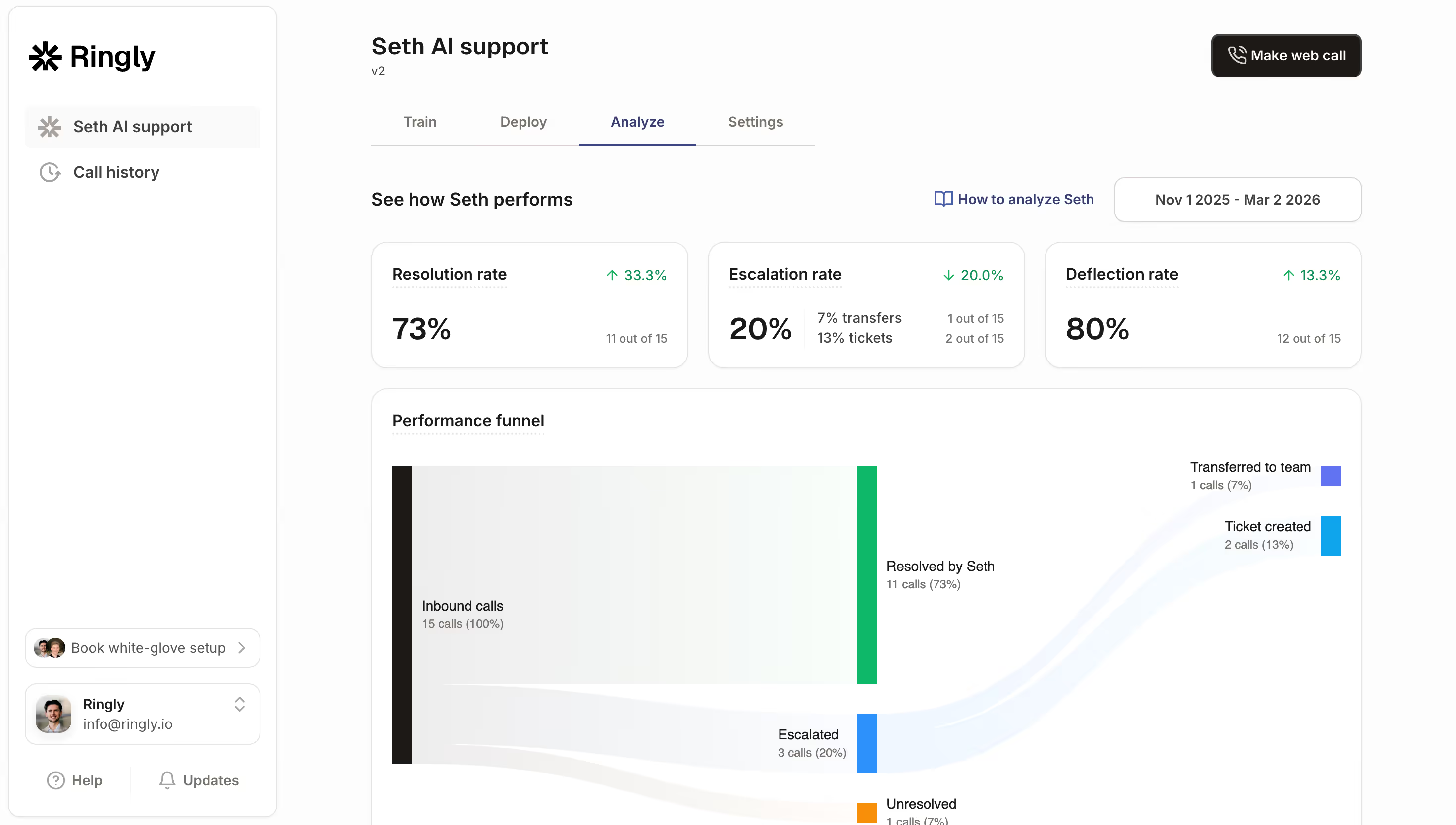
DTC brands live and die by customer experience. AI phone agents give small DTC teams enterprise-level phone support without the enterprise-level headcount. If you run a Shopify store, Ringly.io handles 73% of support calls automatically, from order tracking to returns to product questions, in 40 languages, 24/7. Try free for 14 days.
Frequently asked questions
How big is the DTC ecommerce market in 2026?
The global DTC market is projected to reach $319.57 billion in 2026. In the US alone, DTC ecommerce sales hit $212.9 billion in 2025, representing 19.2% of all retail ecommerce. The market is growing at a compound annual growth rate of 7.8%.
What is the average customer acquisition cost for DTC brands?
The average DTC ecommerce CAC ranges from $45 to $70. It varies significantly by vertical: pet products cost $23 per customer, beauty $42, food $51, and supplements $89. Overall, CAC has risen 222% over the past eight years.
What is a good conversion rate for a DTC Shopify store?
The average Shopify store converts 1.4 to 1.8% of visitors. A good benchmark is 2.5 to 3%, which is the typical range for established stores. Top-performing stores (top 10%) convert above 4.7%.
How important is customer retention for DTC brands?
Extremely important. About 60% of DTC revenue comes from returning customers, and loyal customers convert at 60 to 70% compared to 5 to 20% for new prospects. With the average retention rate at just 28.2%, improving repeat purchase rates has the biggest impact on profitability.
What role does social commerce play for DTC brands?
Social commerce is growing fast. US social commerce sales will surpass $100 billion in 2026, with TikTok Shop driving nearly 20% of it. Over 70 million Americans already shop on TikTok, and 86% of consumers make at least one influencer-inspired purchase per year.
How much revenue should email marketing drive for DTC brands?
Email should generate 20 to 30% of total DTC revenue. The average return is $42 to $45 for every $1 spent. Automated email flows are especially effective, driving 32% of all email orders with only 2.4% of total sends.
What is the average return rate for DTC ecommerce?
DTC sites average a 14.2% return rate, which is lower than the broader ecommerce average. Fashion and apparel are the outlier at 25%. Processing a single return costs between 20% and 65% of the item's original price.
Are DTC brands adopting AI?
Yes, heavily. 84% of ecommerce businesses are integrating or planning to integrate AI. Companies using AI personalization earn 40% more revenue, and AI increases retention rates by 10 to 15%. Use cases span product recommendations, marketing automation, and AI customer service.