

Finding the right search and product discovery platform can make or break your ecommerce conversion rates.
While Constructor has built a strong reputation with its AI-native approach, it is not the right fit for every retailer. Some businesses need more transparent pricing.
Others want open-source flexibility or stronger retail media capabilities.
We researched and tested the leading Constructor alternatives to help you find the best match for your specific needs.
Whether you are a small Shopify store or a Fortune 500 retailer, this guide covers the seven platforms worth considering in 2026.
Editor’s note: Want to hear some sample AI support calls made for your Shopify store?
- Just paste your store URL
- Get sample calls in under 20 seconds (no email required)
- Listen to demo calls for my store
What is Constructor.io?
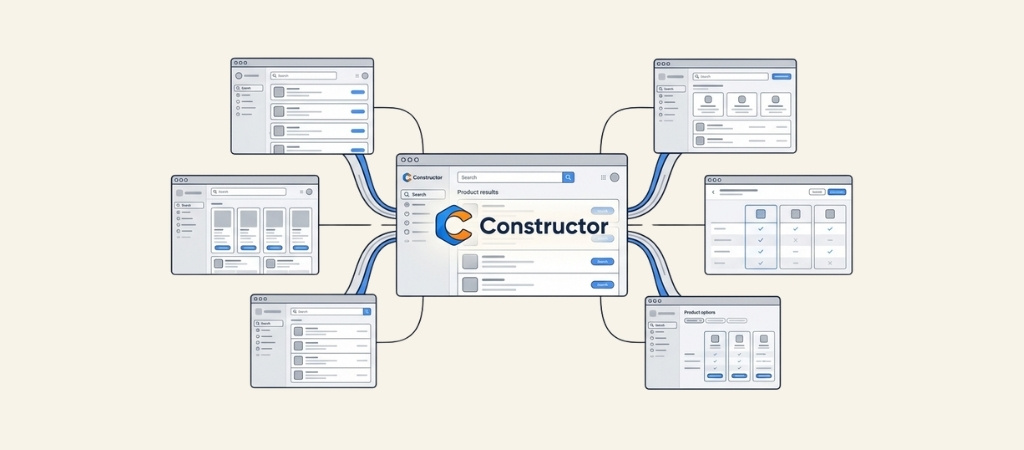
Constructor is an AI-native search and product discovery platform designed for enterprise ecommerce.
It uses behavioral data together with machine learning models like transformers to automate personalized product discovery experiences across your entire site.
The platform consistently outperforms competitors by a minimum of 3% in A/B tests according to their own data.
They have never lost a competitive A/B test in over 70 head-to-head evaluations. Constructor holds a 4.8 out of 5 rating on G2 and scores 92% on Gartner Peer Insights' "Willingness to Recommend" metric.
So why look elsewhere? Constructor does not publish pricing, which typically signals enterprise-only budgets.
Their average contract value reportedly sits around $150,000. They also require significant collaboration with your team for implementation, which can stretch timelines for smaller organizations.
How We Evaluated These Constructor Alternatives
We assessed each platform across five key dimensions that matter most to ecommerce teams:
- AI capabilities - How sophisticated is the search relevance and personalization?
- Implementation complexity - What technical resources do you need?
- Pricing transparency - Can you budget without talking to sales?
- Customer support quality - What do actual users say about the experience?
- Vertical fit - Which industries and business sizes does it serve best?
Our research combined official documentation, user reviews from G2 and Gartner Peer Insights, and hands-on testing where possible.
Constructor Alternatives at a Glance
| Platform | Best For | G2 Rating | Pricing Model | Key Strength |
|---|---|---|---|---|
| Algolia | Technical teams | 4.5/5 | Usage-based | Agent Studio: Fast deployment of agentic workflows. |
| Bloomreach | Large enterprises | 4.6/5 | Custom (Annual) | Loomi AI: Deeply integrated e-commerce personalization. |
| Coveo | Service integration | 4.4/5 | Custom (Tiers) | Strong ecosystem ties (Salesforce/ServiceNow/SAP). |
| Luigi's Box | SMB analytics | 4.8/5 | From €79/mo | Transparent pricing with an industry-leading ROI calculator. |
| Particular Audience | Retail media | 5.0/5 | Performance-based | Yield optimization: Monetizes search via retail media ads. |
| Elastic | Technical control | 4.4/5 | Free to Usage | Vector Search: Unmatched flexibility for custom GenAI apps. |
| Outfindo | SMB enrichment | 4.8/5 | From €99/mo | Guided Selling: Autonomous AI agents (Beacon & Diver). |
The 7 Best Constructor Alternatives
1. Algolia
Algolia powers search for over 18,000 organizations and has become the default choice for teams wanting developer-friendly APIs with instant search capabilities.
Key features:
- NeuralSearch combines keyword and semantic matching for better relevance
- Dynamic Re-Ranking uses AI to automatically optimize results based on business metrics
- Personalization engine delivers 1:1 experiences based on user behavior
- Merchandising Studio gives non-technical teams visual control over results
- Real-time analytics with built-in A/B testing
What it does well:
Algolia excels when you have engineering resources to work with.
The API documentation is comprehensive, SDKs cover every major platform, and the query response times are consistently sub-100ms.
Their new Agentic AI features automate search optimization without constant manual tuning.
Limitations:
Implementation requires real engineering effort. You will need developers to integrate, customize, and maintain the search experience.
Constructor scores higher on service and support according to Gartner Peer Insights, so if you want more hand-holding, Algolia might feel hands-off.
Pricing:
| Plan | Price | Includes | Best For |
|---|---|---|---|
| Build | Free | 10k searches/mo, 1M records | Development, testing, and tiny projects |
| Grow | Usage-based | 10k searches free, then $0.50/1k; 100k records free | Scaling businesses with keyword search needs |
| Grow Plus | Usage-based | 10k searches free, then $1.75/1k; AI Synonyms/Ranking | SMBs wanting self-serve AI without annual contracts |
| Premium/Elevate | Custom (Annual) | Volume discounts, 99.99% SLA, NeuralSearch | Enterprise AI search and high-volume retail |
Source: Algolia Pricing
Best for: Mid-market to enterprise retailers with strong development teams who want maximum flexibility.
2. Bloomreach
Bloomreach offers more than just search. It is a full digital experience platform combining search, merchandising, content management, and marketing automation into one suite.
Key features:
- Search and merchandising with AI-powered relevance
- Content management for personalized experiences
- Marketing automation across email and SMS
- Product information management for complex catalogs
- A/B testing and analytics built-in
What it does well:
Bloomreach excels when you need a single vendor for multiple functions.
If you are already shopping for a CMS, search, and merchandising tools, Bloomreach can consolidate them.
The platform serves large enterprises particularly well, with customers like Albertsons and Neiman Marcus running significant portions of their digital experience on Bloomreach.
Limitations:
The all-in-one approach means you cannot easily swap out components. If you only need search, the extra capabilities add cost and complexity. Implementation timelines tend to be longer than point solutions. Pricing requires sales engagement with no public tiers.
Pricing:
Enterprise pricing only. Contact sales for custom quotes based on modules selected and usage volume.
Best for: Large enterprises wanting a unified digital experience platform rather than standalone search.
3. Coveo
Coveo specializes in AI-powered search with particular strength in service management integration and unifying content from multiple enterprise systems.
Key features:
- Relevance Generative Answering provides direct AI-generated answers
- Intelligent search with ML-powered relevance tuning
- Product recommendations across touchpoints
- Deep Salesforce and ServiceNow integration
- Advanced usage analytics
What it does well:
Coveo shines when you need to connect search with customer service.
If your use case involves helping customers find answers across knowledge bases, product catalogs, and support content, Coveo's unified indexing approach works well. Their security and compliance features also appeal to highly regulated industries.
Limitations:
The learning curve is steeper than some alternatives. Constructor scores higher on ease of deployment in Gartner comparisons.
Support response times can lag compared to Constructor's 98% quality of support rating.
Pricing:
Enterprise pricing only. Contact sales for custom quotes based on query volume and user count.
Best for: Enterprises with service management needs who want to unify multiple content sources.
4. Luigi's Box

Luigi's Box has carved out a niche as the analytics-focused choice for SMB to mid-market retailers, with transparent pricing that stands out in this category.
Key features:
- Advanced search analytics showing exactly how customers search
- AI-powered autocomplete with typo tolerance
- Product recommendations based on behavioral data
- Visual merchandising tools
- Built-in A/B testing
What it does well:
Luigi's Box earns its 4.7 out of 5 rating on Gartner Peer Insights through outstanding analytics and flexible performance.
Users consistently praise the platform's ability to surface actionable insights about search behavior. The European base also means strong GDPR compliance.
Limitations:
Brand recognition lags behind Algolia in North America. The enterprise feature set may not match what massive retailers need. Customer base is smaller, though satisfaction rates are high.
Pricing:
| Plan | Price | Includes | Best For |
|---|---|---|---|
| Self-Integration | From €79/mo | Usage-based pricing, access to all chosen products | SMBs who can handle their own technical setup |
| Custom Integration | Custom Quote | Full expert-led implementation, ROI-focused setup | Growing brands needing a white-glove migration |
| Enterprise | Custom Quote | Unlimited products, dedicated success manager, SLA | Large retailers with complex, multi-warehouse catalogs |
Source: Luigi's Box Pricing
Best for: SMB to mid-market retailers who prioritize analytics and want predictable pricing.
5. Particular Audience
Particular Audience takes a different approach, positioning itself as a comprehensive retail media and personalization platform rather than pure search.
Key features:
- Promotion Hub manages organic, owned, and sponsored content together
- AI-powered bid automation eliminates manual keyword bidding
- Rich media ads including banners, video, and interactive content
- Cross-channel personalization across email, SMS, and push
- Full-funnel attribution linking online ads to in-store sales
What it does well:
If you are building a retail media network, Particular Audience offers capabilities Constructor simply does not match.
Their 1.1% CTR versus the 0.39% industry average represents a 182% improvement. The platform handles everything from sponsored listings to off-site campaigns through Meta and Google integrations.
Limitations:
As a newer player, the customer base is smaller. The search-specific features may not be as mature as dedicated search platforms.
If you only need product discovery without retail media, the extra capabilities add complexity you might not want.
Pricing:
Custom enterprise pricing based on GMV and ad volume.
Best for: Retailers building retail media networks who need cross-channel monetization.
6. Elastic
Elastic offers something no other platform on this list can match: complete open-source flexibility through Elasticsearch.
Key features:
- Elasticsearch distributed search and analytics engine
- Elastic Enterprise Search with App Search and Workplace Search
- Vector search for semantic capabilities
- Machine learning for anomaly detection
- Real-time indexing with sub-second latency
What it does well:
For teams that want total control, Elastic delivers. There is no vendor lock-in. You can customize every aspect of the search experience.
The platform scales to billions of documents and handles complex query patterns that might break other systems.
Fifty percent of the Fortune 500 relies on Elastic for mission-critical search.
Limitations:
Operational complexity is significant. You will need dedicated search engineers to manage shards, capacity planning, and upgrades.
There is no out-of-the-box merchandising interface. The open-source version is free but you pay in engineering time.
Pricing:
| Deployment | Starting Price | Key Features | Best For |
|---|---|---|---|
| Self-Managed | Free | Full open-source feature set, basic security, Kibana | Technical control, high-volume/predictable data |
| Standard (Cloud) | From $95/mo | Managed hosting, basic security, 24/7 monitoring | Small teams, basic logging and search |
| Platinum (Cloud) | From $125/mo | Machine Learning, AI/Vector Search (ELSER), advanced security | AI-powered search, complex threat detection |
| Enterprise (Cloud) | From $175/mo | Searchable snapshots, cold/frozen tiers, AI Assistant | Massive scale, long-term retention, high-end compliance |
Source: Elastic Pricing
Best for: Technical teams wanting full control and companies wanting to avoid vendor lock-in.
7. Outfindo

Outfindo focuses specifically on product data enrichment with a refreshingly transparent pricing model that stands in stark contrast to most competitors.
Key features:
- End-to-end product data enrichment from raw to enriched data
- Real-time customer behavior analysis
- Autonomous AI requiring minimal team involvement
- Customer insight guides for product recommendations
- Multi-category support for complex catalogs
What it does well:
Outfindo's biggest differentiator is transparency. While Constructor and most competitors hide pricing behind sales calls, Outfindo publishes rates starting at €0.4 per SKU. They also offer a free trial, something Constructor does not provide.
The autonomous AI approach means less work for your team.
Limitations:
The focus is narrower than full search platforms. Outfindo excels at product enrichment and guided selling but does not replace a comprehensive site search solution. Enterprise-scale proof points are limited compared to established players.
Pricing:
| Plan | Price | Includes | Key Features |
|---|---|---|---|
| Essential | €99/mo | Up to 200 SKUs, 1 domain | 1 Product Category, ready-made AI guide, unlimited traffic/convos |
| Plus | €599/mo | Up to 2,000 SKUs, unlimited domains | White-labeling, customizable design, custom product cards |
| Enterprise | Custom | Unlimited SKUs & Categories | Full tech integration, custom tone of voice, dedicated support |
Source: Outfindo Pricing
Best for: SMBs wanting transparent pricing and hands-off product enrichment.
Choosing the Right Constructor Alternative
The best platform depends on your specific situation. Here is a simple framework:
Choose Algolia if you have strong developers and want flexible APIs with instant search.
Choose Bloomreach if you need a full digital experience platform, not just search.
Choose Coveo if service management integration is critical to your use case.
Choose Luigi's Box if analytics and SMB-friendly pricing matter most.
Choose Particular Audience if you are building a retail media network.
Choose Elastic if you want open-source flexibility and have engineering resources.
Choose Outfindo if transparent pricing and autonomous enrichment appeal to you.
How AI Phone Support Complements Your Search Investment
Optimizing product discovery is only half the battle. Once customers find what they want, they often have questions that search cannot answer.
Is this in stock in my size? Can I modify my order? What is your return policy?
This is where Ringly.io fits in. Our AI phone agent The AI handles these post-discovery questions automatically.
The AI resolves approximately 73% of calls without human intervention, handling order lookups, returns, and FAQs while escalating complex issues to your team.
The combination works well: your search platform gets customers to the right products, and The AI handles the follow-up questions that close the sale. Start your free trial to see how AI phone support complements your search investment.
Making the Final Decision
Constructor remains a strong choice for enterprise retailers who want proven AI search and do not mind the opaque pricing. But it is not the only option.
Algolia offers more flexibility for technical teams. Luigi's Box provides transparency that SMBs appreciate.
Elastic gives you total control if you have the engineering resources. Particular Audience opens retail media revenue streams that Constructor does not match.
The key is matching the platform to your actual needs rather than just comparing feature lists.
Start with a clear understanding of your technical resources, budget constraints, and primary use case.
Then run trials with your top two or three choices using real data.
Most of these platforms offer trials or free tiers. Take advantage of them.
The best search platform is the one that actually improves your conversion rates with your specific catalog and customer base.
Frequently Asked Questions
What is the best Constructor alternative for small businesses?
For small businesses, Luigi's Box and Outfindo offer the most accessible entry points. Luigi's Box starts at €79/month with transparent pricing, while Outfindo offers per-SKU pricing that scales with your catalog size.
Which Constructor alternative has the best AI capabilities?
Algolia and Constructor are closely matched on AI, with both offering neural search and personalization. Particular Audience leads on AI for retail media specifically, with automated bid management and cross-channel optimization.
Are there any free Constructor alternatives?
Elastic offers a completely free open-source version. Algolia provides a free tier with 10,000 search requests monthly. Both require technical implementation but have no licensing costs.
Which Constructor alternative is best for retail media monetization?
Particular Audience is purpose-built for retail media, offering sponsored listings, rich media ads, and full-funnel attribution that Constructor's newer retail media suite does not yet match.
How does Constructor pricing compare to alternatives?
Constructor does not publish pricing but reportedly averages around $150,000 per contract. Alternatives range from free (Elastic open source) to usage-based (Algolia) to transparent tiers (Luigi's Box, Outfindo).
Can I switch from Constructor to one of these alternatives easily?
Migration complexity varies. API-based platforms like Algolia and Elastic offer the most flexibility for data export. Most platforms provide migration tools or services, but expect some engineering work for any platform switch.
Which Constructor alternative works best with Shopify?
Algolia, Luigi's Box, and Outfindo all offer strong Shopify integrations. Algolia has the most mature Shopify app ecosystem, while Outfindo's autonomous approach requires minimal setup.