

76% of consumers still prefer picking up the phone when they need help. Yet most ecommerce stores only offer a chatbot and maybe an email address.
That gap costs real money. Merchants know phone support delivers better satisfaction scores, but staffing a call center costs $6 to $15 per interaction. That math doesn't work for a store doing 500 tickets a month.
So which channel should your store actually invest in? This breakdown covers real cost data, resolution rates, and a third option that most store owners haven't considered yet.
What customers actually prefer (and why it matters)
The data on customer preferences isn't even close. According to a CivicScience survey, 43% of people choose phone as their preferred support channel. Only 17% pick chat or chatbot.
Phone also wins on satisfaction. Zendesk data shows phone support hits a 91% CSAT score, while live chat sits at 85%. That's not a small gap when you're trying to keep customers coming back.
The generational breakdown is surprising too:
- Gen Z prefers phone: a 2025 Nextiva study found 72% are likely to choose phone support, and 77% have used a phone call for service
- Chatbot adoption remains low: only 8% of customers used a chatbot in their most recent interaction, per Gartner research
- Chatbot sentiment is negative: 45% of US adults view chatbots unfavorably (that number has actually gone up since 2022)
The disconnect is clear:
- Customers want phone support: 76% prefer it for complex or urgent issues
- Most stores only offer chat and email: the phone channel is too expensive to staff
- High-AOV products suffer most: buyers of $200+ items need reassurance before hitting "place order," and that's hard to deliver via chat
- The cost gap is closing: AI phone agents now handle calls at close to chatbot pricing
If you're tracking customer experience statistics, the phone channel consistently outperforms. The question is whether you can afford to offer it.
Chatbot support for ecommerce: the pros and cons
Chatbots are text-based AI tools that handle conversations on your website, through SMS, or on social channels. They've gotten better over the past few years, but they still have clear limits. Here's where they work and where they don't, based on real chatbot statistics.
Where chatbots win
- 24/7 availability: No staffing schedules. No overtime pay. Your chatbot answers at 3 AM the same way it answers at noon.
- Low cost per interaction: Chatbot interactions typically cost $0.50 to $0.70 each. Compare that to $6 to $15 for a human agent call.
- Speed on simple queries: Order tracking, shipping policies, store hours. A chatbot resolves these in seconds.
- Scalability: One chatbot handles thousands of conversations at the same time. No hiring needed during Black Friday.
- Multilingual support: Most platforms support 20+ languages without hiring multilingual staff.
Where chatbots fall short
- Complex issues: Returns disputes, damaged products, billing problems. Chatbots struggle with anything that requires judgment or empathy.
- Customer frustration: 62% of customers abandon chatbots after just two failed attempts. And 30% start looking for alternative brands after a bad chatbot experience.
- Low adoption: 64% of customers told Gartner they'd prefer companies didn't use AI for customer service at all.
- Context switching: When a chatbot escalates to a human, 90% of customers end up repeating their information. That's a terrible experience.
- No emotional intelligence: A chatbot can't hear frustration in someone's voice. It can't adjust its tone when a customer is upset about a damaged order.
Phone support for ecommerce: the pros and cons
Traditional phone support means live human agents answering calls. It's expensive, but there's a reason it scores highest on satisfaction.
Where phone support wins
- Highest satisfaction: 91% CSAT, the best score of any support channel. Nothing else comes close.
- Complex problem solving: Returns, complaints, subscription changes, and high-value orders are all handled better over the phone. Agents can ask clarifying questions in real time.
- Trust building: Voice builds rapport. For premium ecommerce brands in jewelry, supplements, or skincare, that rapport converts browsers into buyers.
- Emotional intelligence: Human agents read tone, detect frustration, and adjust their approach. That matters when a customer is angry about a late shipment.
- Higher conversion on high-AOV products: Customers calling about $200+ products are more likely to buy. Phone availability acts as a trust signal, and brands with strong trust scores see up to 8x higher purchase conversion.
Where phone support falls short
- Cost: $6 to $15 per interaction. Plus hiring, training, management overhead. A single dedicated agent runs $2,500 to $5,000 per month.
- Availability gaps: Staffing 24/7 is expensive for small and mid-size stores. You end up with voicemail during off-hours, which defeats the purpose.
- Scalability problems: Each agent handles one call at a time. Peak hours mean hold times, and hold times mean frustrated customers.
- Wait times: During busy periods, customers wait. And 45% of Gen Z will cancel a product or service if their preferred support channel isn't available.
- Language barriers: Hiring multilingual agents adds significant cost. Most small ecommerce stores can't justify it.
Chatbot vs phone support: a side-by-side comparison
Here's how chatbots and phone support compare across the metrics that matter for ecommerce stores. We've also included AI phone agents as the third column, since they combine elements of both.
| Metric | Chatbot | Human phone | AI phone agent |
|---|---|---|---|
| Cost per interaction | $0.50-$0.70 | $6-$15 | $0.38-$1.50 |
| Customer satisfaction | 80% CSAT | 91% CSAT | 85-90% CSAT |
| First contact resolution | 30-53% (complex) | 70-79% | ~73% |
| Availability | 24/7 | Business hours (unless staffed) | 24/7 |
| Complex issue handling | Poor | Excellent | Good (with escalation) |
| Setup time | Hours to days | Weeks to months | Minutes |
| Scalability | Unlimited | 1 call per agent | Unlimited |
| Best for | FAQs, order tracking | Returns, complaints, high-AOV | All of the above |
The numbers tell a clear story. Phone wins on satisfaction and complex issue handling, while chatbots win on cost and scale. AI phone agents split the difference, offering phone-quality experiences at closer to chatbot pricing.
The third option: AI phone agents
Most of the chatbot vs phone debate misses a critical development. AI phone agents have changed the math completely.
How they work: an AI agent answers your store's phone line, speaks naturally with customers, looks up orders in real time, and handles common questions. If it can't resolve something, it transfers to a human agent with full context.
The cost breakdown tells the story:
- Per-minute cost: $0.15 to $0.50, compared to $6-$15 for a human agent
- Average call cost: $0.38 to $1.50 per interaction (two to three minute calls)
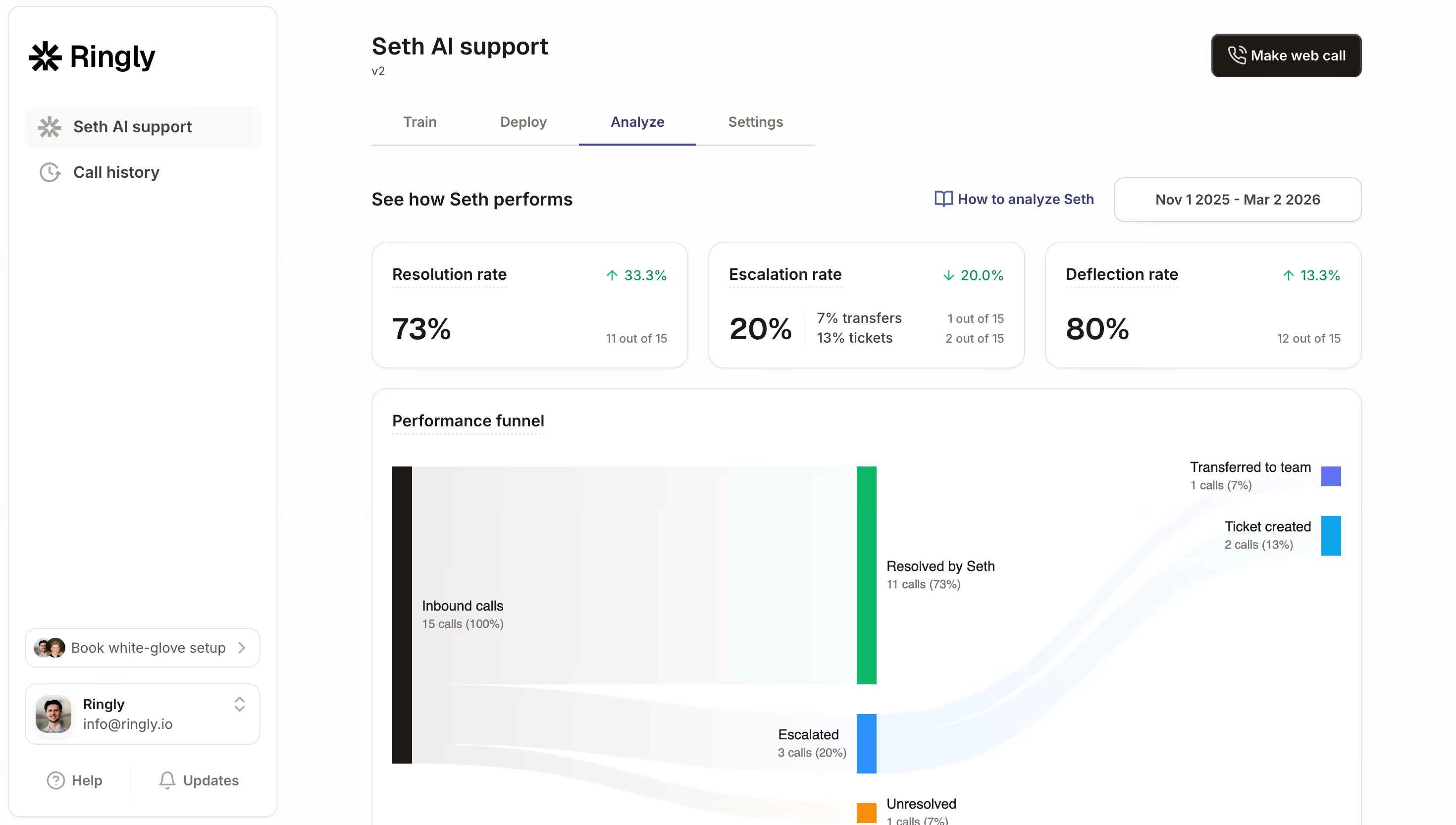
- Resolution rate: about 73% of calls handled without human help
- Languages: 40+ out of the box, no multilingual hiring required
What makes this different from a chatbot? Customers actually use it. 76% of consumers prefer phone, and an AI phone agent gives them that channel 24/7 without the $5,000/month agent salary.
In our experience running Ringly.io across 2,100+ Shopify stores, the remaining 27% of calls get transferred with full conversation context so customers never repeat themselves. Setup takes about three minutes (we've timed it), which is honestly faster than most chatbot configurations we've tested.
When to use chatbots vs phone support vs AI phone agents
The right channel depends on what your customers are asking about. Here's a decision framework based on the data.
Use a chatbot when
- Order tracking (WISMO): Simple lookups. Text is efficient here. Customers just want a tracking number, and a chatbot delivers it in seconds.
- FAQ responses: Shipping policies, store hours, product specs. Anything that lives in your knowledge base works well in chat.
- Lead capture: Collecting email addresses from website visitors or qualifying leads with a quick questionnaire.
- High volume, low complexity: Hundreds of "where's my order" questions daily? A chatbot handles this without breaking a sweat.
Use phone support (or AI phone agents) when
- Returns and exchanges: Customers want to explain their situation. "The color doesn't match what I saw online" is easier to resolve over a call than through a chat tree.
- High-AOV products: $200+ purchases need reassurance. A phone conversation builds the confidence that a chatbot can't replicate, and that improves conversion rate optimization.
- Frustrated customers: Angry callers need to feel heard. Typing at a bot when you're upset makes the frustration worse. 67% of customers abandon interactions when stuck in chatbot loops.
- Complex orders: Custom items, subscriptions, bulk orders. These need back-and-forth conversation.
- Older demographics: 61% of Gen X and Boomers prefer human agents. If your customer base skews older, phone support isn't optional.
For Shopify stores that want to offer phone support without hiring a team, AI phone agents for Shopify are the practical middle ground. You get the phone channel your customers want at a cost your business can absorb.
How much does each channel cost?
Let's look at what each channel actually costs for a store handling 500 support interactions per month.
| Channel | Cost per interaction | Monthly platform fee | Total monthly cost (500 interactions) |
|---|---|---|---|
| Chatbot | $0.50-$0.70 | $50-$300 | $300-$650 |
| Human phone support | $6-$15 | $2,500-$5,000 (agent salary) | $5,500-$12,500 |
| AI phone agent (Ringly.io) | $0.38-$1.50 | $99-$349 | $289-$1,099 |
The gap is massive. Human phone support costs 8x to 20x more than an AI phone agent for the same number of interactions.
The hidden cost nobody talks about? Chatbot failures. When a chatbot can't resolve an issue, that ticket still needs human follow-up, and those unresolved interactions add cost that doesn't show up in the chatbot's per-interaction number.
One thing I've noticed looking at actual call analytics data:
- Resolution rate jumps: stores switching from chatbot-only to chatbot plus AI phone agent see total resolution rates jump from around 55% to over 80%
- Phone catches what chat drops: the voice channel picks up issues customers abandon in text form
Check Ringly.io pricing for current plans.
If those cost savings look interesting for your store, start your free trial and get your AI phone agent answering calls in under three minutes.
When this approach doesn't work
Not every store benefits equally from AI phone agents. A few scenarios where it's not the right fit:
- Ultra-luxury brands: If your entire brand identity is white-glove personal service, automating phone support can feel off-brand. A $5,000 handbag buyer expects a human concierge.
- Very low call volume: If you get fewer than 20 calls per month, the $99/month platform cost might not pencil out. Answer those calls yourself until volume grows.
- Highly technical products: Industrial equipment, custom engineering, or medical devices that require 30+ minutes of expert troubleshooting per call aren't a good fit for current AI capabilities.
For most ecommerce stores with predictable call types (order status, returns, product questions), the combination of chatbot plus AI phone agent covers 85%+ of support volume.
Frequently asked questions
Is a chatbot or phone support better for ecommerce?
It depends on the issue. Chatbots handle simple queries like order tracking and FAQs efficiently at $0.50 per interaction. Phone support wins for complex issues, returns, and high-value purchases with 91% satisfaction scores.
How much does chatbot support cost for an ecommerce store?
Most chatbot platforms charge $50 to $300 per month, plus roughly $0.50 to $0.70 per interaction. For a store handling 500 monthly interactions, total chatbot costs run $300 to $650 per month.
Do customers prefer chatbots or phone calls?
Phone, by a wide margin. 43% of consumers choose phone as their preferred support channel, compared to just 17% for chat. Even Gen Z prefers phone, with 72% saying they're likely to choose phone support.
Can AI phone agents replace human phone support?
Not entirely, but they handle about 73% of calls without human help. AI phone agents answer calls 24/7, look up orders, process returns, and speak naturally. For complex or sensitive issues, they transfer to a human agent with full context.
What is the best support channel for Shopify stores?
A combination of channels works best. Use a chatbot or live chat for simple queries, and add an AI phone agent for voice support. Ringly.io connects directly to your order data, making it the fastest way to add phone support.
How do AI phone agents handle returns and order tracking?
AI phone agents connect to your ecommerce platform's data. When a customer calls, the agent identifies them by phone number, pulls up their recent orders, and walks through the return or order tracking process.
Should I offer both chatbot and phone support?
Yes. Different customers prefer different channels, and 45% of Gen Z will cancel a service if their preferred channel isn't available. Pair a chatbot for simple queries with an AI phone agent for voice support to cover both preferences without the cost of a full call center.
What the data actually tells us
Both chatbots and phone support have their place in ecommerce. But the satisfaction data is clear: phone wins, 91% CSAT versus 80% for chatbots, across every demographic including Gen Z.
The old problem was cost. AI phone agents remove that barrier, offering voice support quality at close to chatbot pricing with 24/7 availability and 73% resolution without human intervention.
If you're running a Shopify store, try Ringly.io free for 14 days and hear the difference for yourself.