
Every single "Where is my order?" call costs your brand about $6, and when you're scaling a team to handle thousands of them, you aren't just losing money.
You're burning the clock on your brand’s growth.
You know the feeling of watching your support queue swell while your best people spend all day repeating tracking numbers like broken records.
It is frustrating to pay a talented team to do work that doesn't actually grow your bottom line.
This guide will go over what WISMO calls exactly are, and how you can start automating them with AI.
First, we will break down why these calls happen and what they really cost you.
Then, we will look at how AI phone agents can handle the heavy lifting for your Shopify store.
Editor’s note: Want to hear some sample support calls made for your Shopify store?
- Just paste your store URL
- Get sample calls in under 20 seconds (no email required)
- Listen to demo calls for my store
What are WISMO calls and why do they happen?
WISMO is short for "Where Is My Order?" It’s the catch-all term for any customer question about their order status, whether it comes in via phone, email, or chat. For some businesses, these simple questions can make up 50% of all inbound support calls.
So, why are so many customers reaching out? It usually comes down to a few key factors that create uncertainty.
The most common reason is a lack of proactive communication.
A significant 93% of consumers want proactive updates, but many brands do not send them consistently. When customers are left in the dark, they start calling.
Then you have unavoidable delivery issues.
With 74% of shoppers having experienced a late delivery in the last year, it’s not surprising that people get worried when a package doesn't arrive on time. A small delay can set off a flood of support calls.
Sometimes the information is technically available, but it's not clear.
Vague tracking updates or hard-to-find tracking pages mean customers have to contact you to understand what's going on. In an age where major retailers give minute-by-minute updates, shoppers expect a level of transparency that many smaller stores find hard to match.

While some customers might send an email, a phone call usually means they want an answer immediately.
It's the channel people use when they want a direct, immediate response, and it is also often the most expensive one for a business to manage.
The true cost of WISMO calls for your business
It’s easy to write off WISMO calls as just a part of doing business, but they have a real impact.
They can affect your profits, your team's morale, and your customers' loyalty.

Let's start with the financial cost. The industry average to handle a single support inquiry is around $5 to $6 per inquiry.
If you're getting hundreds or thousands of these calls a month, that number adds up quickly.
That brings us to the opportunity cost. Every minute an agent spends answering "where's my order?" is a minute they aren't spending on something more valuable.
They could be helping a customer with a complex product issue or turning a complaint into a positive experience.
From an operational standpoint, a constant stream of WISMO calls can create a logjam. It clogs up support queues and leads to longer wait times for everyone, including customers with genuinely urgent problems.
This constant pressure can also contribute to agent burnout, which may lead to higher turnover and more hiring costs.
However, one of the biggest costs relates to customer trust. A WISMO call is a sign that something in your post-purchase experience could be improved.
Failing to provide a smooth, reassuring answer can make things worse.
The stakes are high. Research shows that nearly 80% won't buy again after just one bad post-purchase experience.
On top of that, 39% won't give a second chance after a poor delivery experience. When customers have to work just to find out where their package is, it can damage their confidence.
Common strategies for reducing WISMO calls and their limitations
Most e-commerce stores recognize WISMO as a problem and have tried to solve it with a few common tools. While these can help, they all have certain limitations.
Proactive notifications via email and SMS
This is usually the first thing stores try. It involves setting up automated messages that go out when an order is shipped, out for delivery, or has arrived.
Platforms like Shopify offer this feature built-in.
These notifications are good for keeping customers in the loop and can certainly prevent some basic questions.
They set expectations and give a sense of progress.
However, these notifications are not always a complete solution. An average email inbox can be very cluttered, with some people having over 500 unread emails.
Your shipping update can easily get lost. More importantly, these notifications are one-way. If a customer has a follow-up question, an email can't answer it.
Self-service order tracking pages
Another standard approach is a dedicated tracking page on your website. Shopify provides a standard order status page where customers can enter their order number to see the latest updates.
This lets customers find answers on their own time, which is a big plus.
It reduces the need for them to contact your team for a simple status check.
One limitation is that these pages often display raw data from the shipping carrier, which can be confusing.
If a customer sees a status like "Tendered to delivery service provider" for three days, they may still be concerned. A frustrated customer might prefer speaking to a representative over trying to decode carrier jargon.
Live chat and chatbots
Putting a chat widget on your site can feel like a modern fix. It lets customers get answers without picking up the phone, whether they're talking to a person or a chatbot.
Chat can be great for quick, on-site help. It feels immediate and can solve simple questions without tying up your phone lines.
However, not everyone wants to type out their problem, especially on a phone. Additionally, some chatbots can create frustrating experiences if they get stuck in a loop. Chat solutions also don't serve customers who prefer to resolve issues over the phone.
Here’s a quick breakdown of how these channels stack up.
| Channel | Pros | Cons |
|---|---|---|
| Email/SMS | Proactive, automated, low cost | Easily missed, not conversational, limited interaction |
| Tracking Page | 24/7 self-service, empowers customers | Can be inaccurate, lacks context, requires customer effort |
| Live Chat/Chatbot | Instant response, on-site | Text-only, bots can be frustrating, doesn't serve the phone channel |
This video explains how reducing "Where Is My Order?" inquiries can improve your last-mile logistics and customer satisfaction.
Using AI phone support to manage WISMO calls
Even with tracking pages and chatbots, many customers will always prefer to call.
They want the reassurance of hearing a voice and getting a direct answer right away. This is where WISMO inquiries can have the largest impact on your budget and team.
This is a challenge that AI-powered phone agents are well-suited to address.
This technology puts a voice on the other end of the line that can answer calls 24/7, understand what customers are asking, and give them accurate information instantly.
An example is Ringly.io and its AI phone support rep, the AI. It is designed specifically for e-commerce stores and connects directly with Shopify, allowing it to pull real-time order details, customer information, and tracking data from your store.
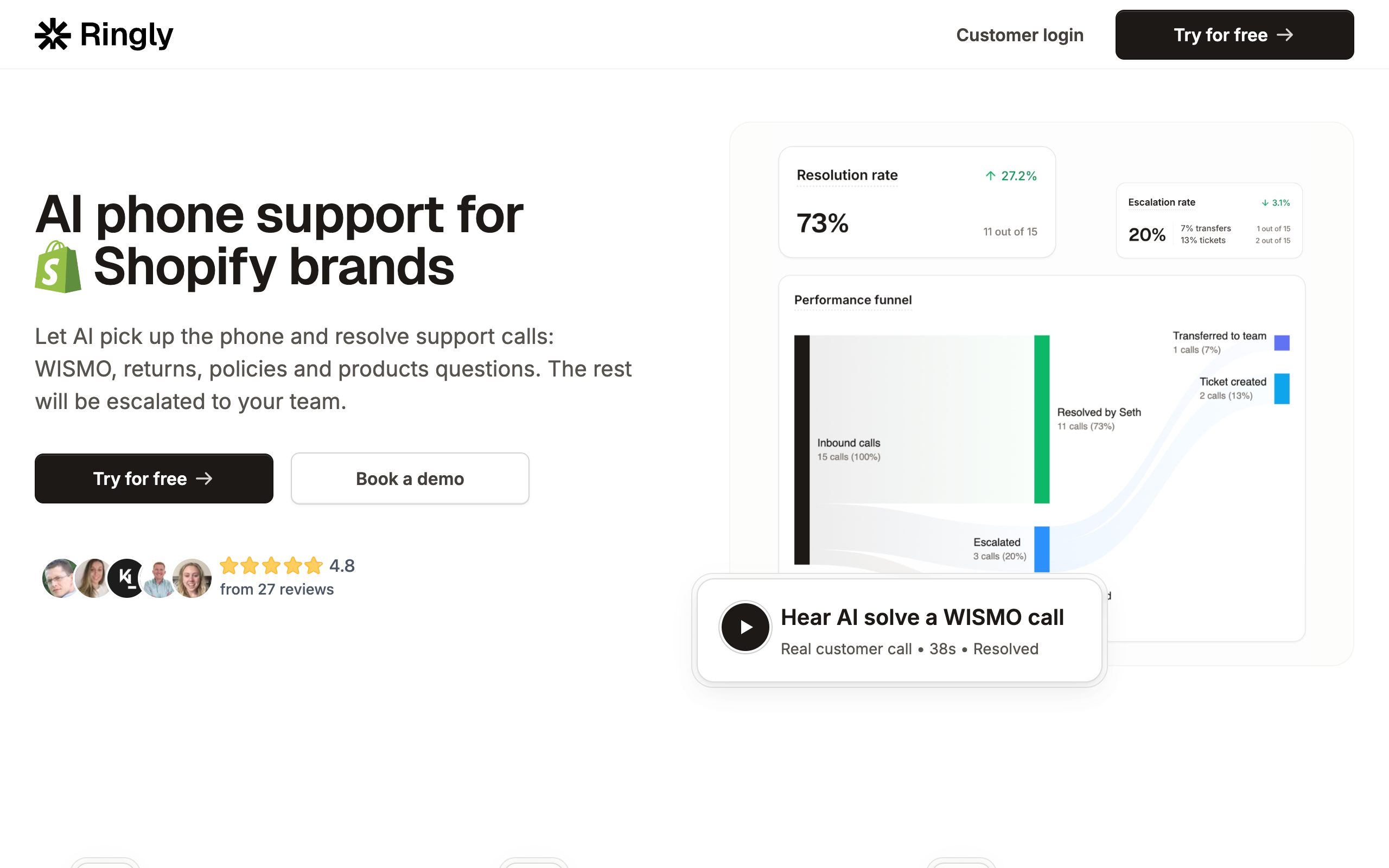
For example, across more than Shopify stores using the platform, the AI has an average resolution rate of 73%, meaning it handles the entire call from start to finish without needing help from a person.
the AI can also handle the entire post-purchase conversation, including processing returns and exchanges or answering common questions about your products.
It acts as a true front-line agent, freeing up your human team for other tasks.
Of course, a concern with AI is what happens if it gives the wrong answer.
the AI is designed to recognize its limits. Instead of guessing, it will politely explain that it can't find the information and will seamlessly escalate the call to a human agent. This ensures your customers always get the help they need.
Shipping inquiries make up a huge share of support calls. Our 2026 ecommerce shipping statistics show just how significant the volume is.
Final thoughts on reducing WISMO calls
WISMO calls are a costly problem that can point to gaps in your post-purchase experience.
They're fueled by customer anxiety in the time between clicking "buy" and the package arriving at their door.
We've seen how common solutions like emails, tracking pages, and chatbots all have a place but don't always offer a complete fix.
They often fail to help the customers who are most anxious and just want the reassurance of a phone call.
To truly solve the WISMO problem, you need an automated solution that covers all your bases, especially the phone. This is about more than just cutting support costs. It's about building customer trust by delivering a transparent and responsive experience every single time.
As e-commerce keeps growing, AI phone support is becoming a valuable tool for any brand that wants to scale efficiently and keep its customers happy.
Automating WISMO call responses
Automating repetitive order status questions can free up your support team for more complex issues.
With Ringly.io, you can automate these calls and provide instant, 24/7 support to every customer.
You can try Ringly.io, as you get your last 3 months refunded if Seth resolves under 65% of calls in 90 days.
See how our AI phone rep can transform your customer support by starting your free 14-day trial today.