
The short version.
- Who: ecommerce brands on Shopify, mostly small-to-mid DTC stores in fashion, beauty, and retail, plus a growing list of big names.
- How many: 15,000+ brands, roughly 17% of the helpdesk market, including Steve Madden, Glossier, and Princess Polly.
- The catch: Gorgias owns email, chat, and social. The phone line is the channel it was never built to answer.
If you run a Shopify DTC store, there's a real chance Gorgias is already in your support stack or on your shortlist. It's the helpdesk most ecommerce brands reach for first, and the question "who actually uses it" usually means one of two things: am I the kind of brand it's built for, and does it cover everything I need.
I'll answer both with real data and real brand names. I run Ringly, where we handle AI phone support for 50+ Shopify brands, a lot of which run Gorgias for email and chat. So I see the profile of a Gorgias brand up close, and I see the one channel it leaves open.
Most of the pages ranking for this question are scraped firmographic tables. Useful for a headcount, useless if you're trying to decide whether Gorgias fits a brand like yours. This is the version that answers that.
If you're a founder or Head of CX at a $10M-$100M Shopify brand and your phone still rings with the same questions over and over, the support stack you pick matters more than the logo on it. Book a 30-min call and we'll show you what your call line is doing while your team works the inbox.
The short answer: who uses Gorgias
Gorgias is a customer support platform built specifically for ecommerce. It pulls email, live chat, social messages, SMS, and WhatsApp into one inbox, and it ties every conversation to the customer's Shopify order. That focus tells you who it's for.
The typical Gorgias brand is a Shopify or Shopify Plus DTC store that runs support across several channels and wants order context in every ticket. Not a generic SaaS company, not a B2B wholesaler, not a marketplace seller. An online brand that ships physical products and fields a steady stream of "where's my order" and "can I return this" questions.
Here's the profile at a glance:
| Attribute | The typical Gorgias user |
|---|---|
| Platform | Shopify or Shopify Plus |
| Business model | DTC ecommerce, physical products |
| Company size | Mostly small-to-mid (under 100 employees) |
| Top verticals | Fashion, beauty, retail |
| Channels they run | Email, chat, social, SMS, WhatsApp |
| Pricing model | Per-ticket (scales with volume) |
Gorgias serves 15,000+ brands and holds about 17.48% of the helpdesk tools market, the largest single share in the category according to 6sense. So when people ask who uses it, the honest answer is: a very large slice of serious Shopify DTC brands.
The numbers: company size, industry, and geography
The firmographic data is where most "who uses Gorgias" pages stop. It's worth seeing once, then moving past.
The center of gravity is the small-to-mid DTC store, not the enterprise. Around 82.7% of Gorgias customers have fewer than 100 employees, per appsruntheworld. The single most common bucket is a brand with 1-10 employees doing $1M-$10M a year, according to enlyft.
By industry, three verticals lead:
- Fashion: the single biggest category (around 224 tracked companies).
- Retail: second.
- Ecommerce (general): third.
Adoption spans 21+ industries, but apparel and beauty brands are overrepresented because that's where high ticket volume meets repeat-purchase economics.
Geography is concentrated in English-speaking markets. The United States makes up roughly 59% of Gorgias customers, Australia about 11.5%, and the United Kingdom about 11.4% (6sense). Canada and a long tail of other countries round it out.
That said, Gorgias has been moving upmarket. The customer base now includes large brands alongside the small ones, which brings us to the names.
The brands that use Gorgias, by vertical
The recognizable names tell you more than the percentages. The brands on Gorgias skew toward high-volume, repeat-purchase categories where support touches revenue directly. Here's a real cross-section, grouped by vertical, with the result each one reports in Gorgias's own case studies.
| Brand | Vertical | Reported result |
|---|---|---|
| Glossier, Bare Minerals, Boody | Beauty / body basics | Bare Minerals: zero returns from AI-influenced sales |
| Steve Madden, Princess Polly, Tommy John | Fashion / apparel | Tommy John: $106k in sales in 2 months |
| SuitShop, Pepper, Cabau Lifestyle | Apparel | Pepper: 54% support automation |
| Orthofeet | Footwear / health | 56% automation in under 2 months |
| Arc'teryx | Outdoor / sporting goods | 23x ROI on the AI Agent |
| Caitlyn Minimalist | Jewelry | 11.3% lift in average order value |
| Dr. Bronner's | Body care / wellness | $100,000 saved per year |
| BruMate | Drinkware | High-growth DTC |
| Cartier France, Decathlon France, Pier 1 | Luxury / retail | Enterprise + legacy retail |
Sources: Gorgias's own published case studies, plus appsruntheworld and enlyft. Treat the case-study metrics as vendor-reported, not independently audited.
Two things stand out. First, the spread of verticals is wide, but the common thread is a brand selling physical products with enough order volume to justify a dedicated helpdesk. Second, the bigger names (Steve Madden, Glossier, Decathlon) signal that Gorgias is no longer just a tool for the small DTC shop. It's stretching into enterprise retail.
What none of those case studies talk about is the phone. And that's the gap worth understanding before you commit a stack.
"My customers also feel like it's a normal person. They feel like they can communicate if they have questions."
Claudia Droge, TechCraft Studio
Why these brands pick Gorgias
The reason is almost always the same: it was built for Shopify, not retrofitted onto it.
An agent inside Gorgias can look up an order, issue a refund, cancel a shipment, or create a discount code without ever leaving the helpdesk. That order context in every ticket is the thing generic tools like Zendesk or Freshdesk make you bolt on. For a DTC brand where most tickets are order-related, it removes the tab-switching that eats a support team's day. You can read more about how that integration works in our Gorgias and Shopify guide.
The other draws:
- Multi-channel inbox. Email, chat, social, SMS, and WhatsApp land in one place, so a brand isn't juggling five tools.
- Automation. Rules and macros handle the repetitive stuff, and the AI Agent deflects a chunk of tickets. See how it fits a store in our Gorgias helpdesk overview.
- Ecommerce-native reporting. It's built around the metrics a store cares about, not generic IT-helpdesk tickets.
It isn't perfect, and the brands who use it will tell you so. The most common gripe is the per-ticket pricing, which climbs as volume grows. As one store put it in a review, the bill scales right along with the business. Some larger brands also find the analytics and collaboration features thin once they outgrow the early stage, and opinions on the AI Agent are split between teams that love the deflection and teams that wish it sold more. We cover the real numbers in our Gorgias pricing breakdown.
None of that is a dealbreaker. For a Shopify DTC brand, Gorgias is a strong default for the inbox. The real question is what it doesn't touch.
The one channel Gorgias was not built for: the phone
Look back at the channel list every Gorgias page leads with: email, chat, social, SMS, WhatsApp. Notice what's missing, and notice that the brands using Gorgias almost all keep a visible phone number anyway.
That's the gap. Gorgias is a ticketing and chat helpdesk at its core. It centralizes the typed channels beautifully. The phone line, though, still routes to a human rep or to voicemail, and at a DTC brand the phone is rarely the channel anyone is staffed to win. Higher-AOV stores feel it most: at a $250 AOV, somewhere between 12% and 18% of orders generate a phone call, versus around 3% at a $40 AOV.
The questions on those calls are the same ones flooding the inbox. WISMO ("where's my order") alone is 30-40% of support tickets and 50%+ at peak, per Salesforce. The difference is that a missed email waits in a queue. A missed call walks. 85% of callers who can't reach a person never call back, and 62% switch to a competitor, according to a 2026 PCN study. You can dig into the call-specific version of this problem in our piece on WISMO calls.
This is where Ringly fits, and it's worth being precise: Ringly is not a Gorgias replacement. It's the AI phone support layer that sits in front of your phone line and escalates cleanly to Gorgias when a call needs a human. Your inbox stays exactly where it is.
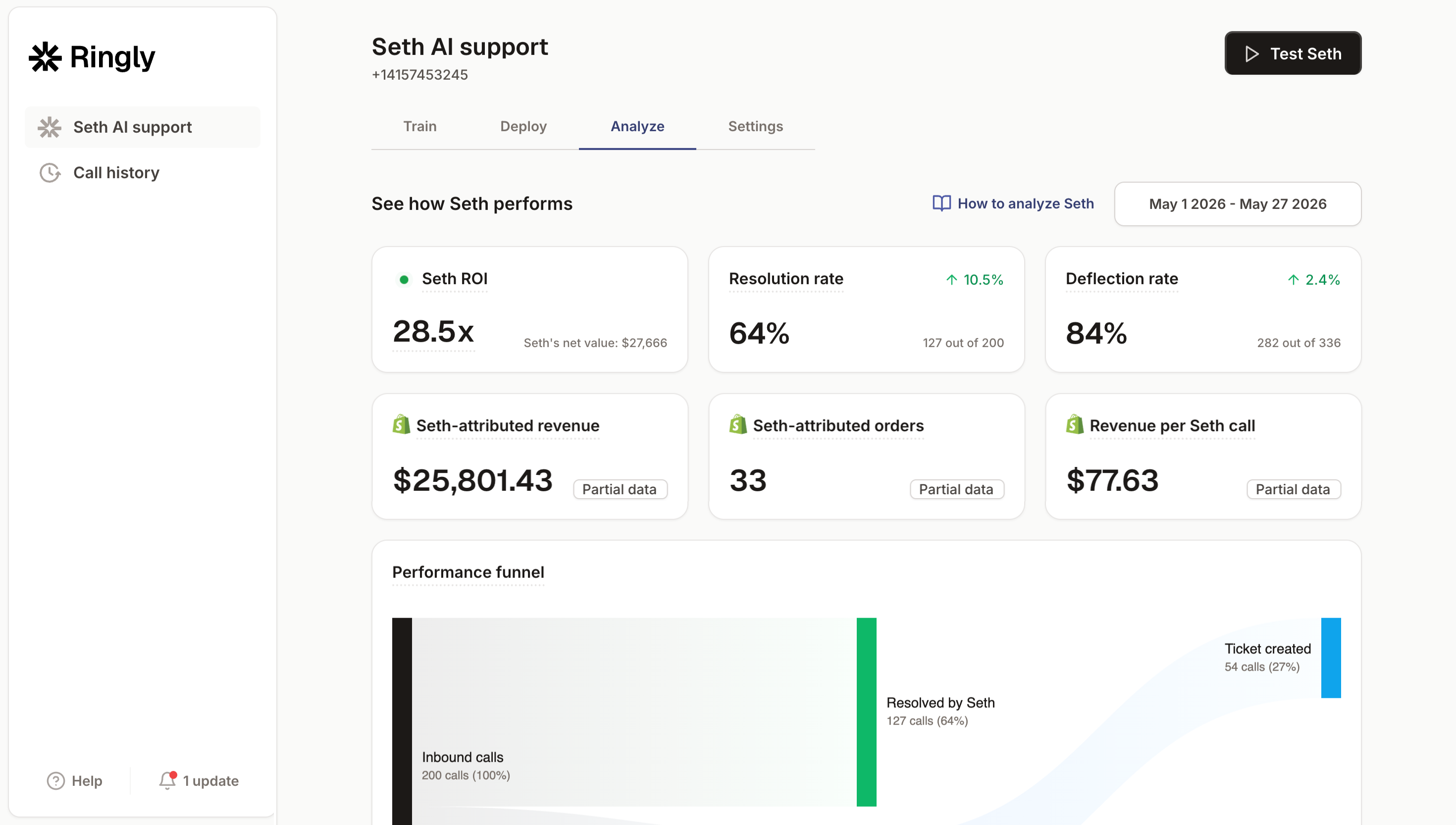
Across 50+ Shopify brands, the AI resolves about 73% of inbound calls on its own, at roughly $0.42 per resolved call versus the $7-$16 a human BPO charges. It finds orders in Shopify, handles returns and product questions, and hands the rest to your team. WashCo, a Shopify brand we launched, recovered $22,664 in attributed revenue in its first 7 days on the phone. That's revenue that was previously hitting voicemail. For more on the broader picture, see our overview of ecommerce phone support.
If you run a Shopify brand and the phone is the channel nobody owns, book a 30-min call and we'll review your missed calls live.
The point isn't that Gorgias is the wrong choice. For most Shopify DTC brands it's the right inbox. It's that the brands who use it well usually pair it with something that owns the call line, because the phone is where a Shopify Plus brand quietly leaks revenue. The same logic shows up across ecommerce customer service generally and in vertical-heavy categories like fashion and apparel and beauty and skincare, where higher AOV drives more phone calls.
Frequently asked questions
Is Gorgias only for Shopify stores? No, but Shopify is where it shines. Gorgias works with other platforms, yet its order context, native actions, and reporting are built around Shopify and Shopify Plus first. Most of its 15,000+ brands are Shopify DTC stores.
What size company uses Gorgias? Mostly small-to-mid DTC brands. Around 82.7% have fewer than 100 employees, and the most common profile is a $1M-$10M store. It also serves large brands like Steve Madden and Decathlon France as it moves upmarket.
Which big brands use Gorgias? Recognizable names include Steve Madden, Glossier, Princess Polly, BruMate, Arc'teryx, Dr. Bronner's, Tommy John, and Cartier France. The bulk of the base is still smaller DTC stores, but the marquee names have grown.
Does Gorgias handle phone calls? Not as its core. Gorgias is built for email, chat, social, SMS, and WhatsApp. It has a basic voice option, but the brands that use it well typically pair it with a dedicated phone layer like Ringly, which handles inbound calls and escalates to the helpdesk.
How much does Gorgias cost? Self-serve plans start around $10/mo (Starter, 50 tickets) and run to $900/mo (Advanced, 5,000 tickets), with per-ticket overages near $0.36-$0.40. The AI Agent is an add-on at roughly $1 per resolved conversation. Bigger contracts are sales-led.
Why do DTC brands pick Gorgias over Zendesk? The Shopify integration. Agents resolve order-related tickets without leaving the helpdesk, which is exactly what a product-shipping brand needs. Generic tools like Zendesk require more setup to reach the same order context.
Talk to us

If you run a $10M-$100M Shopify brand on Gorgias and the phone is the channel nobody owns, a 30-min call shows what those calls are worth. We'll pull what your call line is doing today and map how the phone routes through to your existing helpdesk, not around it.
The 3-layer guarantee.
- Live in 14 days or it's free until launched.
- 65% resolution in 90 days or we refund the last 3 months of subscription fees.
- We keep working free until we hit it.
Ruben (Ringly co-founder) takes these calls personally.