
This comparison in 30 seconds.
- Pick: Gorgias wins for almost every Shopify DTC brand. Salesforce Service Cloud only earns its price when you're consolidating onto a wider Salesforce estate or carrying non-Shopify complexity.
- Cost: Gorgias bills by ticket and double-charges AI resolutions. Salesforce bills by seat plus a five-figure implementation. The sticker price hides the real bill on both.
- Built for Founders, COOs, and Heads of CX at $10M-$100M Shopify brands with a visible phone number and a paid helpdesk.
Most brands searching "Salesforce Service Cloud vs Gorgias" aren't choosing a CRM from scratch. They're on Gorgias, they've outgrown the easy version of it, and a board member or a new ops hire just asked whether it's time to move up to Salesforce. That's the real question, and it has a cleaner answer than the spec grids suggest.
If you run customer experience at a Shopify brand doing $10M-$100M, you already know the Monday queue: a few hundred tickets stacked since Friday, the same WISMO questions over and over, and a phone line that mostly rolls to voicemail. The tool you pick decides how you handle the tickets. It does not decide who answers the phone. Book a 30-min call and we'll map your actual call volume against what either platform leaves on the table.
The quick comparison
Here's the short version before the deep dive. The third row is the part neither vendor will put on their comparison page.
| Tool | Pricing model | Shopify fit | Best for | Verdict |
|---|---|---|---|---|
| Gorgias | Per ticket, unlimited seats, AI billed per resolution | Native, built around Shopify | $1M-$50M ecommerce brands | The default Shopify helpdesk |
| Salesforce Service Cloud | Per user per month + implementation | Third-party connector, no first-party Shopify app | Multi-channel / multi-brand orgs already on Salesforce | Powerful, heavy, rarely worth it for one store |
| Ringly (phone layer) | Flat monthly, ~$0.42 per resolved call | Native Shopify, escalates into either helpdesk | Brands losing inbound calls after-hours | Answers the line both leave open |
Both Gorgias and Salesforce are strong at what they do, which is managing tickets across email, chat, and social. The reason most of this article is about cost and about the phone is that those are the two places the decision actually gets made, and the two places the SERP keeps skipping.
How I compared them
I'm Ruben, co-founder of Ringly. We run AI phone support for 50+ Shopify brands, so I evaluate helpdesk tools constantly, not as a critic, as a buyer who has to plug into them.
For this comparison I priced both platforms against a real $30M Shopify store's volume and ran the same five-task workflow through each:
- Setup from zero. I connected each one to a Shopify store and timed how long it took to see live order data inside a ticket.
- WISMO at volume. I pushed the same "where's my order" pattern through both and checked how many clicks it took an agent to resolve.
- Real cost at peak. I modeled a Black Friday month, not a quiet one, including ticket overages and AI charges.
- Integration depth. I checked what breaks when Shopify is the system of record and the helpdesk is not.
- The after-hours test. I called the support line each platform routes to at 11 p.m. on a Tuesday. Neither one answered. Both sent me to a queue.
That last test is the one nobody in the comparison results runs, and it's the one that changed how I'd advise a brand here. The numbers below come from running the workflows, not from reading the marketing pages.
Gorgias at a glance
Best for: $1M-$50M Shopify and ecommerce brands that want order context inside the ticket and a setup measured in hours, not weeks.
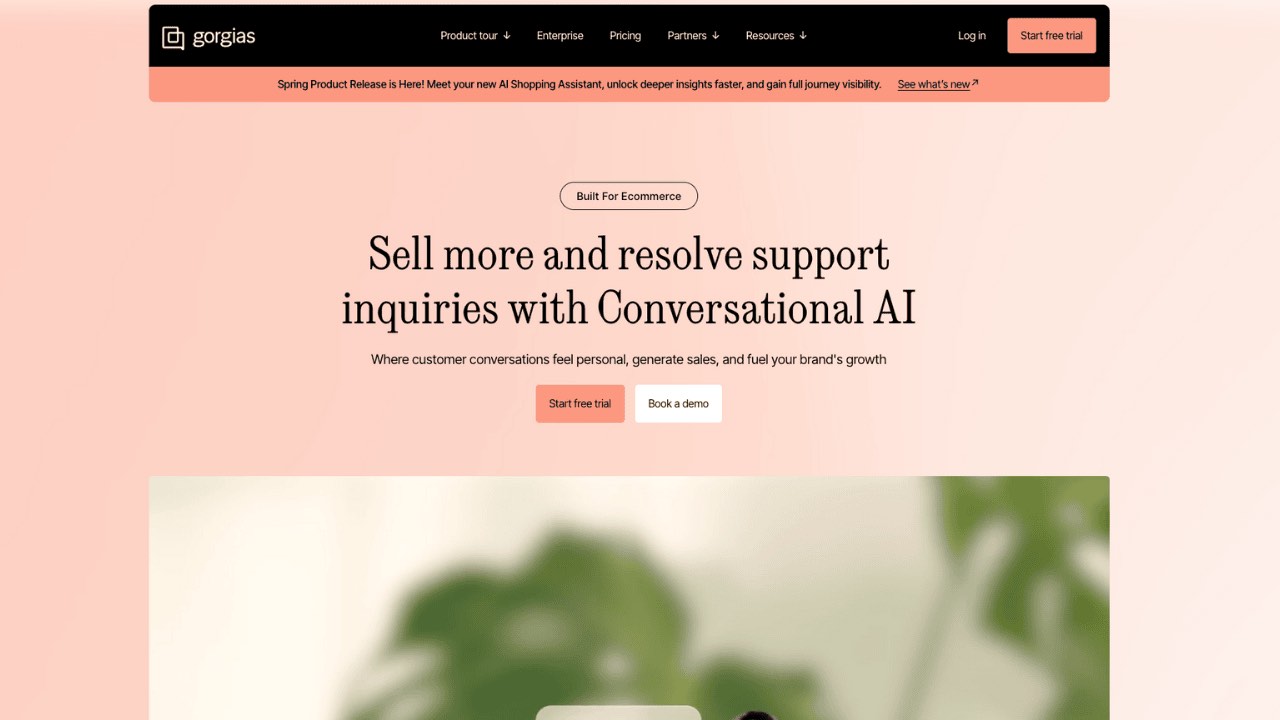
Gorgias is the most-installed helpdesk among Shopify DTC brands, and the reason is simple. It was built around Shopify from the start, so the customer profile, their latest orders, the cart, and your connected apps all show up in the ticket sidebar. An agent can edit or refund an order without leaving the conversation. That depth is why most brands in our pool run it.
Pricing
| Plan | Monthly | Tickets/mo | Overage |
|---|---|---|---|
| Starter | $10 | 50 | $0.40/ticket |
| Basic | $60 | 300 | $40 per 100 |
| Pro | $360 | 2,000 | $36 per 100 |
| Advanced | $900 | 5,000 | $36 per 100 |
| Enterprise | Custom | 5,000+ | $32 per 100 |
Gorgias prices by ticket volume, not by seat, so you can add unlimited users on Basic and up. The AI Agent is billed separately at $1.00 per resolved conversation on monthly plans, $0.90 on annual, with overages at $1.50, according to Gorgias pricing for 2026.
What works
- Native Shopify depth. Order actions live inside the ticket with 35+ Shopify variables. No other helpdesk matches this for ecommerce.
- Fast setup. You're live in hours, no developer required, no admin to hire.
- Unlimited seats. Headcount doesn't change your bill, which is rare in this category.
- Strong reviews. Gorgias holds a 4.6 out of 5 on G2 across 547 reviews, with ease of use and Shopify integration the most-cited praise.
What doesn't
- AI double-billing. Every AI-resolved conversation counts as both a ticket and an AI charge, so you pay twice for the same interaction.
- Peak-season spikes. Model a Black Friday month and a Pro-plan brand can see a large jump from ticket and AI overages stacking together.
- Phone is an add-on. Voice and SMS sit outside the core product, so the phone line is never really first-class.
Why it wins for most Shopify brands
For a single Shopify store under $50M, Gorgias is the right call almost every time. The Shopify-native ticket context saves real agent time, and the setup cost is close to zero. The one thing to watch is the per-resolution AI math during your busy months.
Salesforce Service Cloud at a glance
Best for: larger or multi-brand organizations already standardizing on Salesforce, or teams with complexity that a Shopify-only helpdesk can't model.
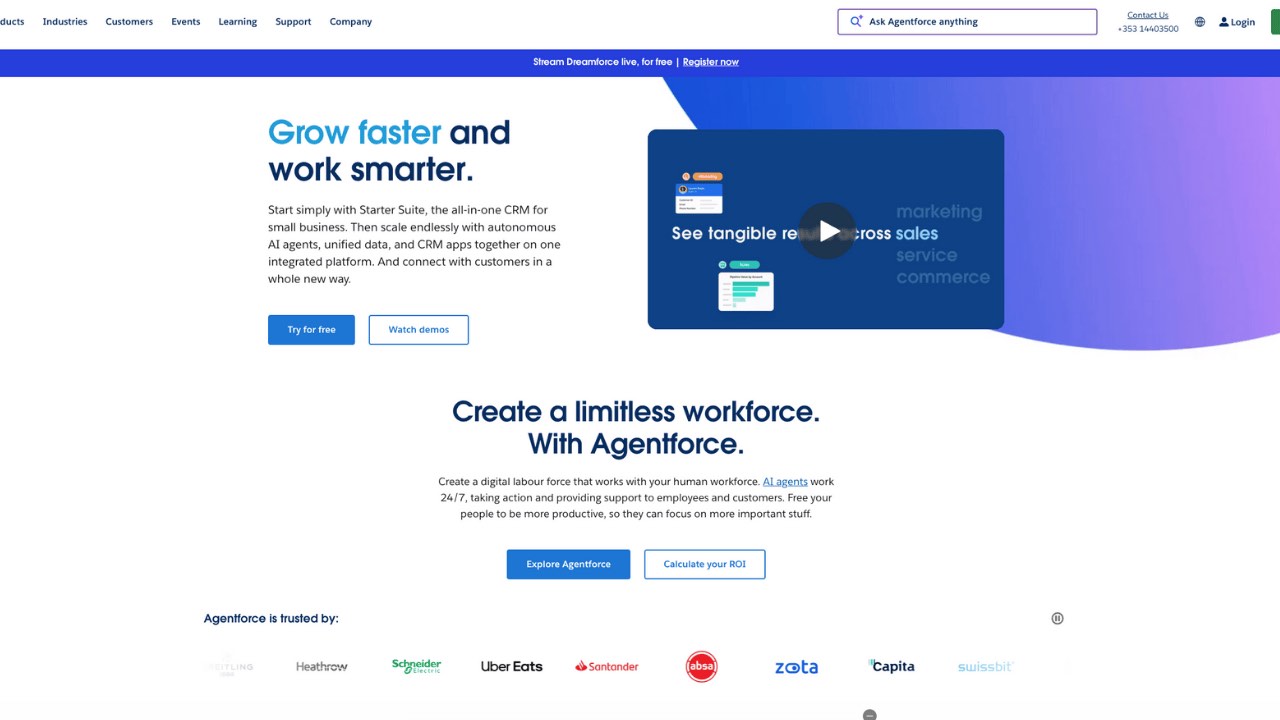
Salesforce Service Cloud, now branded as Agentforce Service, is enterprise CRM-grade customer service. It does case management, omni-channel routing, a knowledge base, and a 360-degree customer view that pulls from the wider Salesforce estate of sales, marketing, and analytics. It is the most customizable option here by a wide margin, and it is industry-agnostic in a way Gorgias is not.
The catch is what that power costs you to stand up and to keep running.
Pricing
| Edition | Per user / month (billed annually) |
|---|---|
| Starter Suite | $25 |
| Pro Suite | $100 |
| Enterprise | $165 |
| Unlimited | $330 |
| Agentforce / Einstein | ~$500 |
Service Cloud prices per seat, not per ticket, and Salesforce raised most Enterprise and Unlimited pricing roughly 6% in August 2025, per Salesforce pricing breakdowns for 2026. Add-ons for digital engagement, AI, and voice often roughly double the effective per-agent cost.
What works
- Deep customization. If you can describe a workflow, Salesforce can model it, across service, sales, and marketing in one place.
- The 360 view. Every interaction in one record, with SLA enforcement and reporting that holds up at scale.
- Cross-industry. It isn't tied to ecommerce, so it fits a holdco or a brand with non-Shopify lines of business.
- Solid reviews. Service Cloud holds a 4.5 out of 5 on G2, with the 360 view and SLA control the top praise.
What doesn't
- Implementation cost. Standing it up runs roughly $8K to $25K for a small single-channel team and $25K to $80K for a mid-market team of 11-50 agents, per Salesforce implementation cost data. Enterprise programs start at $150K.
- No first-party Shopify integration. Connecting Shopify means an unofficial third-party app, where Gorgias has it native.
- Admin headcount. Most teams need a certified Salesforce admin on payroll to run it, on top of the license.
- Overkill for one store. A steep learning curve and a cluttered interface make it a poor fit for a single Shopify brand that just wants tickets handled.
Why it rarely wins for a single Shopify store
Salesforce Service Cloud is genuinely better than Gorgias at scale and at complexity. But "better at enterprise scale" is not the same as "right for your $30M Shopify brand." Unless you're consolidating onto Salesforce across departments, the implementation bill and the admin you have to hire usually outweigh the upside. If you want to keep both, here's how to connect Gorgias and Salesforce.
Feature by feature, where it actually matters
Spec sheets list 40 rows and pretend they all weigh the same. For a Shopify operator, four of them decide the whole thing.
| What you care about | Gorgias | Salesforce Service Cloud |
|---|---|---|
| Shopify order data in the ticket | Native, edit and refund in place | Third-party connector, read-only without dev work |
| Time to first live ticket | Hours, self-serve | 6-12 weeks with an implementation partner |
| Who runs it day to day | Your existing CS lead | A certified admin you usually hire |
| Reporting depth | Strong for ecommerce | Deeper, cross-department, at a cost |
The pattern is consistent. Gorgias trades ceiling for speed, and for a single Shopify store that trade is almost always right. Salesforce gives you a higher ceiling you pay for in setup time and headcount, and you only get the value back if you're using the rest of the Salesforce estate.
There's one nuance worth naming. If your brand is genuinely multi-channel beyond ecommerce, think wholesale accounts, a B2B portal, field service, then Salesforce's case management starts to earn its keep in ways a Shopify-first helpdesk can't match. That's the real fork in the road, and it has nothing to do with star ratings. It's about whether your support problem is a Shopify problem or a whole-company problem. For most brands reading this, it's the former, and our Shopify helpdesk app rundown covers the field.
What each really costs at a $30M Shopify store
The starting prices are a trap. Here's the all-in picture for a brand running a 6-person CS team and real ticket volume.
| Line item | Gorgias | Salesforce Service Cloud |
|---|---|---|
| Base subscription | $360-$900/mo (by ticket volume) | ~$165/user × 6 = ~$990/mo |
| AI / automation | $0.90-$1.50 per resolution, double-billed as tickets | Agentforce add-on, often doubles per-seat cost |
| Implementation | Near zero, self-serve | $8K-$80K up front |
| Ongoing admin | None required | Certified admin, often a full salary line |
| Time to live | Hours | 6-12 weeks single-cloud |
Read that table as an operator and the decision gets obvious for most brands. Gorgias has a variable-cost risk you manage by watching your AI usage at peak. Salesforce has a fixed-cost reality you sign up for before a single ticket gets answered. For a single Shopify store, the variable risk is almost always the cheaper problem.
But notice what's missing from both columns. Neither line item answers your phone. Both tools assume the customer is typing. The customer who calls at 8 p.m. because they don't trust the website with a $280 order is not in either spreadsheet.
If you want, book a 30-min call and we'll do this math live against your real ticket and call numbers.
The channel both of them leave open: the phone
Here's the part that doesn't show up in any "Service Cloud vs Gorgias" grid. Both are text-channel tools at heart. Email, chat, social, tickets. The phone is an add-on in Gorgias and a separate configuration in Salesforce, and in practice that means after-hours calls roll to voicemail in both.
That's a revenue problem, not a support footnote. WISMO alone is 30-40% of tickets and over 50% at peak, and the same repetitive questions hit your phone line. When nobody picks up, those callers don't wait. They buy somewhere else.
The math gets worse at higher order values. A brand with a $250 average order sees roughly 12-18% of orders generate a phone call, versus about 3% at a $40 order value. So the bigger your basket, the more your phone rings, and the more a dropped call costs you. That's exactly the brand profile choosing between Gorgias and Salesforce in the first place, which is why the phone channel is the one to fix before you spend another dollar on either ticketing tool. Our guide to 24/7 ecommerce phone support walks through the coverage gap in detail.
Ringly.io is AI phone support for Shopify brands, and it sits in front of whichever helpdesk you pick. Instead of growing your support headcount every time call volume goes up, the AI takes the routine inbound calls so your team can focus on the work that actually moves revenue.
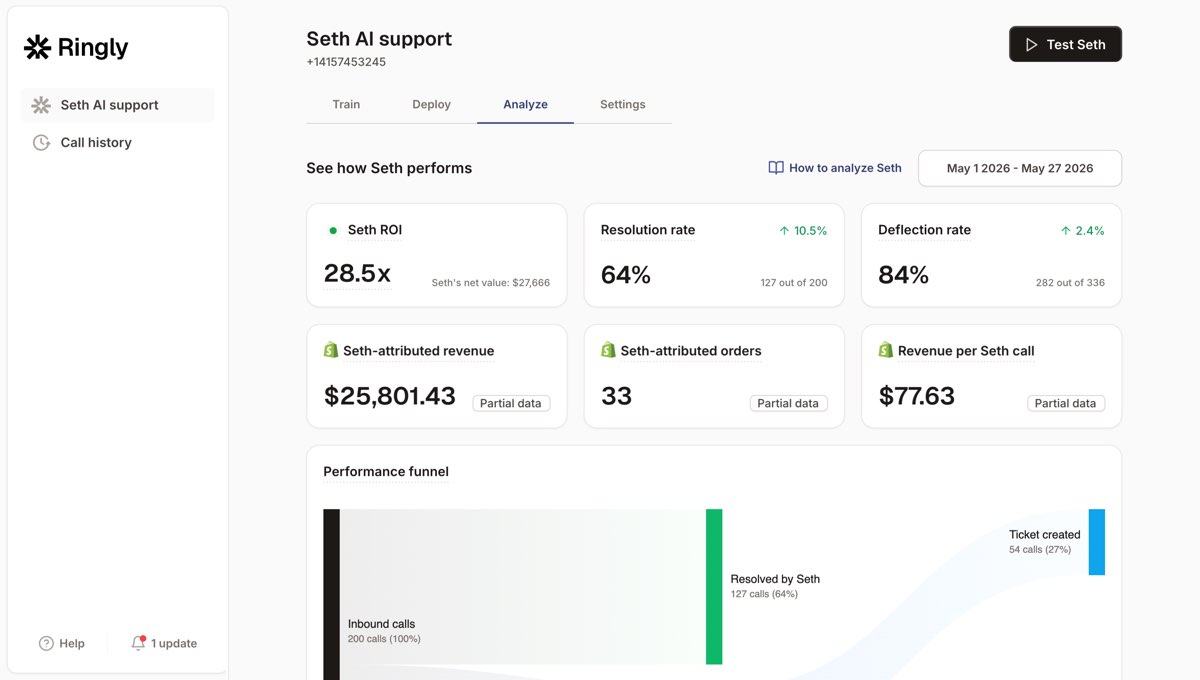
The AI answers inbound calls 24/7. It finds orders in your Shopify store, processes returns and exchanges, answers product questions from your knowledge base, and rescues abandoned carts with outbound follow-up. Across 50+ brands the AI resolves 73% of calls autonomously at roughly $0.42 per resolved call. Calls that need a human escalate cleanly into Gorgias, Richpanel, Reamaze, or whatever helpdesk you already run. So this isn't a replacement for either tool in this comparison. It's the layer that answers the line they both leave ringing.
The proof is in the revenue, not the ticket count. WashCo, a Shopify brand we launched, recovered $22,664 in its first 7 days on the phone. TechCraft Studio now handles 88% of its calls without a human.
"My customers also feel like it's a normal person. They feel like they can communicate if they have questions."
Claudia Droge, TechCraft Studio
Plans are Grow at $349/mo and Pro at $799/mo, with Enterprise by call. Live in under an hour. And it's backed by a 65% resolution guarantee: if the AI resolves under 65% of your calls in 90 days, we refund the last 3 months.
How to choose
The decision is less about features and more about your shape. Here's the honest framework.
- Choose Gorgias if you're a Shopify-first brand doing $1M-$50M and you want order context inside the ticket without hiring anyone to run the tool. This is most brands. See where it sits against the field in our Gorgias alternatives guide.
- Choose Salesforce Service Cloud if you're consolidating service, sales, and marketing onto Salesforce, you have multi-brand or non-Shopify complexity, and you have the budget for implementation plus an admin. If you're weighing other enterprise routes, compare Salesforce Service Cloud alternatives.
- Add Ringly if you have a visible phone number and you're losing calls after-hours, regardless of which helpdesk you keep. It plugs into either.
- Still on the fence between Gorgias and a different helpdesk? Our Intercom vs Gorgias and Gorgias vs Richpanel breakdowns cover the adjacent calls.
For most readers here, the answer is "stay on Gorgias, skip Salesforce, and fix the phone." That's not a tool problem you solve by spending more on tickets. It's a phone support problem you solve by answering the calls you're already getting.
Frequently asked questions
Is Gorgias better than Salesforce Service Cloud for Shopify? For a single Shopify store, yes, almost always. Gorgias is native to Shopify, sets up in hours, and needs no admin to run, while Salesforce requires a third-party connector and a five-figure implementation. Salesforce only pulls ahead when you're standardizing across departments or carrying non-Shopify complexity.
Does Salesforce Service Cloud integrate with Shopify? Not with a first-party app. You connect the two through an unofficial third-party integration, which adds setup work and a maintenance dependency. Gorgias, by contrast, was built around Shopify and shows order data inside the ticket natively.
How much does Gorgias actually cost with AI? The base plan is what you see, but AI resolutions are billed separately at $0.90 to $1.50 each and also count as tickets, so you pay twice per AI conversation. Model a peak month, not a quiet one, before you commit. Our full Gorgias pricing breakdown shows the seasonal math.
Can I use Gorgias and Salesforce together? Yes, some larger brands run Gorgias for ecommerce support and Salesforce as the wider CRM. It's more tooling to maintain, so only do it if the broader Salesforce estate is already in place. Here's how the Gorgias and Salesforce connection works.
Which one handles inbound phone calls? Neither does it well as a core feature. Voice is an add-on in Gorgias and a separate configuration in Salesforce, so after-hours calls usually go to voicemail. An AI phone agent that escalates into your helpdesk is how brands close that gap.
Should a $30M Shopify brand move from Gorgias to Salesforce? Usually no. The move makes sense only if you're consolidating onto Salesforce across the business. For most $10M-$100M Shopify brands, the implementation cost and admin headcount outweigh the gains, and the money is better spent fixing the phone channel both tools ignore. See our take on Shopify Plus customer service.
Talk to us

If you run a $10M-$100M Shopify brand and you've narrowed it down to Gorgias or Salesforce, the fastest win isn't the helpdesk. It's the phone line both of them leave open after 6 p.m. A 30-min call is the quickest way to see what that's costing you.
The 3-layer guarantee.
- Live in 14 days or it's free until launched.
- 65% resolution in 90 days or we refund the last 3 months of subscription fees.
- We keep working free until we hit it.
Ruben (Ringly co-founder) takes these calls personally.