
The 30-second version.
- Gorgias text support is two-way SMS and MMS that lands in your helpdesk inbox as tickets, right next to email and chat. It is a support channel, not a marketing-blast tool.
- It is "included on every plan," but that means available, not free. You pay a per-ticket add-on on top of your base plan, roughly $0.80 a ticket at low volume down to about $0.41 at high volume.
- Built for $10M-$100M Shopify brands running Gorgias plus a phone line. Text handles the slow, opt-in stuff well. It does not touch the live, after-hours calls, and that is where most of the lost revenue hides.
Turning on text in Gorgias is one of the easiest things you'll do all quarter. A few clicks, a phone number, and customers can text your store. The part nobody puts on the product page is what it costs once volume climbs, and the one support job text quietly can't do.
I set up the SMS channel on a live Gorgias instance, registered the number, and then ran the exact same "where's my order" thread twice: once over text, once over the phone. The text customer waited. The phone customer wanted an answer right then, and would not have switched to texting to get it. That gap is the whole story of this post.
If you run customer experience at a Shopify brand doing $10M-$100M and you're weighing whether text deserves a real slot in your support stack, here's the honest read on what it does, what it costs, and the call volume it leaves on the floor. Want us to look at your missed-call numbers with you? Book a 30-min call and we'll do the math live.
What Gorgias text support actually is
Gorgias text support is two-way SMS and MMS, handled inside the same Gorgias inbox your team already lives in. Every new text from a customer opens a ticket, sitting alongside your email and chat tickets. Your reps don't bounce between apps. They answer a text the same way they answer an email.
The single most useful thing about it is that text never becomes a separate silo: every message is a ticket with full Shopify context attached. Dynamic templates can pull a customer's order, subscription, or shipping status straight from Shopify, Recharge, and the rest of your stack, so an agent answers a "where's my order" text without leaving the conversation. Macros work the same way they do on email. Conversation history follows the customer across channels, so a text today and an email next week read as one thread.
One distinction matters before you turn anything on. Native Gorgias text is a support channel, not a marketing engine. If you want to blast a Black Friday promo to 40,000 numbers, that's Klaviyo, Attentive, or Postscript. Gorgias handles inbound and one-to-one outbound replies, the conversational side. Mixing the two up is the most common reason brands feel disappointed after switching it on.
Why does anyone bother with the channel at all? Reach. SMS open rates sit around 98%, and most texts get read within three minutes, versus roughly 20% for email (Omnisend's 2026 SMS data). For a quick shipping nudge or a returns update, nothing else gets seen that fast. If you want the deeper cost-and-gaps breakdown specifically, we wrote a companion piece on what Gorgias SMS covers and what it misses. This post is the wider "how to run it and where it ends" guide. For the rest of the platform, the Gorgias features overview and our breakdown of the Gorgias helpdesk cover the basics.
How to set up text in Gorgias, and the step nobody mentions
Setup itself is short. You need a phone number first, then you attach the channel.
- Get or port a number. In Settings, go to Account, then Phone numbers. Create a fresh number or port an existing one you already advertise.
- Add the channel. Go to Settings, then Channels, then SMS. Hit "Add SMS" in the top right, give the integration a title, pick your number from the dropdown, and confirm.
- Pick your country. Gorgias text works for US, Canada, and UK phone numbers. If you're outside those, this channel isn't available to you yet.
That's the part the docs make look like a five-minute job. Here's the part they bury.
For US numbers, you have to register before you can send outbound texts, and that registration is the thing that actually delays your go-live. Local numbers go through A2P 10DLC registration; toll-free numbers go through their own verification. Both are carrier-side compliance steps, and they can take anywhere from a day to a couple of weeks depending on how clean your business info is. Plenty of teams flip the channel on, assume they're live, and then wonder why outbound texts aren't sending. They're stuck in the registration queue.
Opt-outs are handled for you. Gorgias runs SMS through Twilio, which manages the legal opt-out language automatically. If a customer texts "Stop," "Unsubscribe," or "Cancel," you can't message them again until they reply "Start." You don't have to build that logic, but you do have to respect it, because a customer who opted out is gone from the channel until they come back on their own. If you're wiring text into the rest of your stack, the Gorgias API and the Gorgias-Klaviyo integration are where most teams start.
What text support is genuinely good at
Text shines on one specific shape of conversation: the slow, opt-in, low-stakes thread. The customer isn't in a panic. They're fine waiting a few minutes for a reply, and they'd rather tap out a sentence than sit on hold or write a paragraph of email.
That makes it a near-perfect fit for the boring, high-volume stuff:
- Order status. A "text TRACK for your order" auto-reply can hand back a tracking link in about two seconds. WISMO, the "where's my order" question, runs 30-40% of your tickets in a normal week and over 50% at peak (Salesforce). Wire the TRACK keyword to your store's order lookup and the single most common ticket in your queue starts answering itself. Our guides on WISMO calls and WISMO automation for Shopify go deeper on this.
- Shipping and returns nudges. Proactive "your order shipped" or "your return was received" texts cut the follow-up tickets before they're created.
- Photo and video evidence. MMS means a customer can text a picture of a damaged item instead of describing it over three emails.
- Keyword self-service. "TRACK," "RETURN," and similar keywords pull from your store and answer instantly, no rep needed.
A useful way to scope it: text is best when the customer would have waited anyway. Nobody is anxious about a shipping confirmation. Nobody needs a returns-status update in the next ten seconds. Those are exactly the threads where a slight delay costs you nothing, and where a templated reply pulling live Shopify data feels personal because it has the customer's actual order in it. Set up the keyword flows, point them at your store, and let the patient half of your queue serve itself.
Run the same five keyword flows for a month and you'll watch your routine ticket count drop without adding a single rep. That deflection is real, and it's the strongest argument for the channel. Recovering revenue with fast, automated answers is the whole game here. WashCo, a Shopify brand we launched, recovered $22,664 in its first 7 days once the routine inbound stopped going to voicemail. The lesson generalizes: when the easy stuff answers itself, your team and your phone line are freed up for the work that actually needs a person. For the broader playbook, our ecommerce customer service guide covers the rest of the channels.
What Gorgias text actually costs
Here's where the "included on every plan" line gets slippery. Available is not the same as bundled.
Two-way text is an add-on, billed per ticket, on top of whatever base plan you're on. The rate is tiered by volume: roughly $0.80 per ticket when you're sending a little, dropping toward $0.41 per ticket at high volume. Phone runs the same way, billed separately per ticket. The exact rates live behind the in-app Billing and Usage page rather than the public pricing page, so the honest move is to ask for your SMS and phone rates in writing during your trial, before you sign an annual deal.
Two things to keep in mind on the math:
- It scales with volume, and it doesn't remove the labor. A per-ticket text cost still assumes a rep is reading and replying to most of those tickets. Automation deflects some, but the bill grows as your volume grows. Our notes on Gorgias pricing and the Gorgias CFO view get into the per-ticket model in detail.
- The bigger leak usually isn't text. It's the phone. Text deflects the patient customers. It does nothing for the impatient ones who pick up the phone after hours, hit voicemail, and leave.
If your real problem is call volume your reps can't cover, text won't fix it. Book a 30-min call and we'll pull your last week of missed calls so you can see the number.
Where text ends and the phone begins
Text is asynchronous and opt-in by design. The customer texts when it suits them, and they accept that an answer might land in a few minutes. That model is great for the patient half of your queue and useless for the other half.
Because here's the thing about a phone call: it's synchronous and it's loaded with intent. Someone who dials your number wants an answer in this conversation, not the next one. They are not going to hang up and start a text thread instead. They'll wait on hold, and if no one picks up, they're gone.
The numbers on that are brutal. 80% of voicemail-routed callers hang up without leaving a message (Eden). 85% of callers who can't reach a person never call back, and 62% switch to a competitor (PCN's 2026 missed-call study). No text auto-reply catches those people, because they never sent a text. They called, got nothing, and moved on.
This is the line I watched in my own test. Same question, two channels. The text customer was happy to wait. The phone customer wanted to talk to someone now, and an older demographic, a phone-orders crowd, or anyone with an urgent change is firmly in that second group. That's revenue text structurally can't reach.
It also helps to picture the actual moment. It's 9pm, a customer wants to change the address on an order that ships tomorrow, and they call because they don't trust a text to get there in time. Your reps logged off at six. The call rolls to voicemail, and per the numbers above, four out of five of those callers won't even leave one. By morning the order has shipped to the wrong address and you're eating a reship and a refund. No text keyword in your Gorgias inbox ever saw that customer, because they never texted. They picked up the phone, the way a lot of people still do when something actually matters to them. If after-hours coverage is the gap, an after-hours answering service or proper 24/7 ecommerce phone support is the missing piece, not another text keyword. And if the founder's cell has quietly become the phone support line, that's the same gap showing up a different way.
The worry with answering those calls automatically is always voice quality. It's worth hearing what customers actually say once it's running well.
"My customers also feel like it's a normal person. They feel like they can communicate if they have questions."
Claudia Droge, TechCraft Studio
How AI phone support fits alongside Gorgias text
Ringly.io is AI phone support for Shopify brands. Keep your current phone number, your helpdesk, and your workflows. Add an AI that handles the routine calls so your team can focus on the work that actually moves revenue.
The AI answers inbound calls 24/7. It finds orders in your Shopify store, processes returns and exchanges, answers product questions from your knowledge base, and rescues abandoned carts with outbound follow-up. Across 50+ brands, it resolves 73% of calls autonomously at roughly $0.42 per resolved call, versus $7 to $16 a call for human BPO. Calls that need a human escalate cleanly into Gorgias, Richpanel, Reamaze, or whatever helpdesk you already run, so the call becomes a ticket with full context, exactly like a text does.
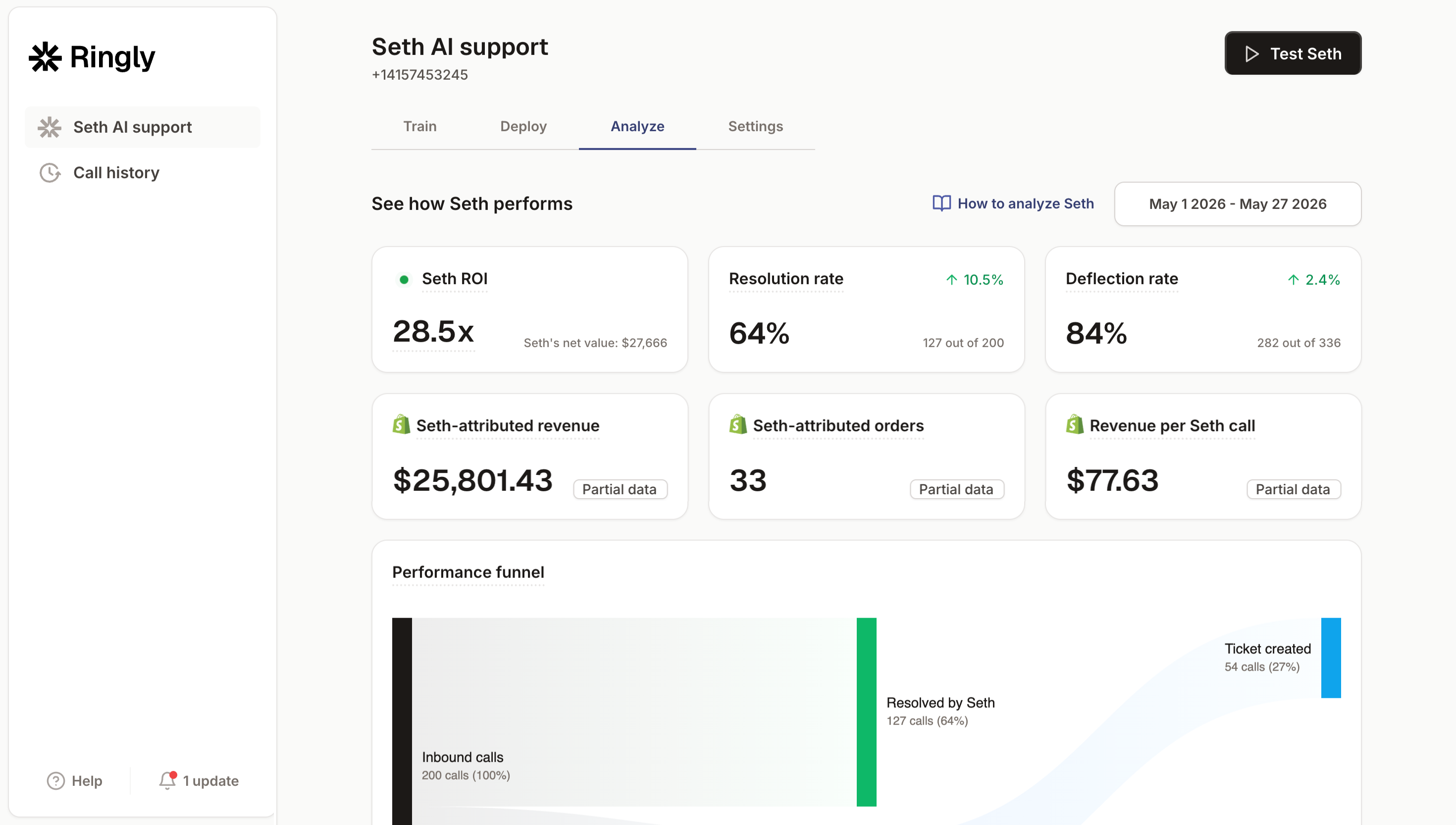
That's the clean division of labor. Text handles the patient, opt-in threads inside Gorgias. The AI phone agent catches the synchronous, after-hours, high-intent calls text can't, and feeds anything complex back into the same inbox. You're not replacing Gorgias text. You're closing the hole it leaves on the phone line.
Plans run Grow at $349/mo (1,000 minutes), Pro at $799/mo (2,500 minutes), and Enterprise custom, with a 14-day free trial on Pro and a 65% resolution guarantee. For the wider picture, see our guides on ecommerce phone support, Shopify voice agents, and AI phone agents for Shopify.
Frequently asked questions
Is Gorgias text or SMS free? No. Text is available on every Gorgias plan, but it's a per-ticket add-on billed on top of your base plan, not bundled into your seat cost. Rates are tiered by volume, roughly $0.80 per ticket at low volume down to about $0.41 at high volume, and the exact numbers sit in the in-app Billing and Usage page.
What countries does Gorgias text support work in? US, Canada, and UK phone numbers. If your number is registered outside those three, the native SMS channel isn't available to you yet.
Can I send marketing texts from Gorgias? Not really. Native Gorgias text is built for inbound support and one-to-one replies, not bulk promotional campaigns. For marketing blasts you'd use a dedicated SMS tool like Klaviyo, Attentive, or Postscript and keep Gorgias for the conversational side.
Why do I have to register my US number before sending texts? Carrier compliance. US local numbers go through A2P 10DLC registration and toll-free numbers go through their own verification. It gates outbound texting and can take a day to a couple of weeks, so register early rather than on launch day.
Does Gorgias text support MMS? Yes. You can send and receive images and video, which is handy when a customer needs to show a damaged item instead of describing it.
Will Gorgias text replace my phone line? No. Text is asynchronous and opt-in, so it can't serve customers who call and want a live answer. The after-hours caller who hits voicemail won't switch to texting, which is why most brands pair Gorgias text with AI phone support rather than choosing one.
How does Ringly work with Gorgias? Ringly is AI phone support that sits in front of your existing setup. It answers inbound calls 24/7, resolves the routine ones, and escalates anything complex into Gorgias as a ticket with full context, so your phone calls land in the same inbox as your texts and emails.
Talk to us

If you run a $10M-$100M Shopify brand on Gorgias and your phone line goes quiet after hours, a 30-min call is the fastest way to see what those missed calls are costing you. We'll pull your numbers and show you where text ends and the phone takes over.
The 3-layer guarantee.
- Live in 14 days or it's free until launched.
- 65% resolution in 90 days or we refund the last 3 months of subscription fees.
- We keep working free until we hit 65%.
Ruben (Ringly co-founder) takes these calls personally.