
The whole job of the Gorgias Shopify integration is to put your store's order data inside the ticket, so a rep can refund, cancel, or look up an order without opening Shopify admin in another tab. That sounds small. It isn't. It's the difference between a 4-minute reply and a 90-second one across every WISMO ticket you handle.
This is the documentation I wish existed when I set it up. I connected a test Shopify store to Gorgias and pushed a real order through the ticket sidebar to confirm each action does what the docs claim, then wrote down the exact paths, the real limits nobody mentions, and the one channel the integration quietly leaves manual. If you run customer experience at a $10M-$100M Shopify brand on Gorgias, this is the reference you can hand your team. And if you want to see where it stops, book a 30-min call and we'll show you the part most teams patch with people.
Most setup guides on this query are either the dry official docs or a thin rehash that ends in a sales pitch. This one is built for the operator actually wiring Gorgias into Shopify at a $10M+ brand: every step verified, every limit named, and an honest note on the phone calls the integration doesn't touch. If you'd rather talk it through, book a 30-min call and we'll map your stack.
In this guide:
What the Gorgias Shopify integration actually does
At its core, the integration pulls your Shopify customer and order data into Gorgias and surfaces it in the ticket sidebar. When a customer emails, chats, or messages on social, their profile, recent orders, and cart load next to the conversation. The rep reads the question and the order context in one glance.
The integration's real value is collapsing the tab-switch: order data lives inside the ticket, not behind a separate Shopify tab. That one move is why Gorgias became the default helpdesk for Shopify brands. According to eesel's 2026 write-up citing Gorgias's own numbers, Gorgias powers roughly 40% of the top 1,500 Shopify brands and serves 17,000+ stores. On the Shopify App Store the listing sits around 4.3 out of 5 across hundreds of reviews.
What gets wired in:
- Customer and order sync: profiles, order history, and cart data flow from Shopify into Gorgias and refresh as orders change.
- Three channels get the context: email, chat, and social conversations all show the same order sidebar.
- One-click order actions: refund, cancel, edit, duplicate, and create orders straight from the ticket (covered in detail below).
- Shopify data in your automations: macros and rules can read order status, tracking, and customer spend.
If you already run Gorgias, none of this replaces your workflow. It sits on top of the Gorgias helpdesk you have and feeds it Shopify data. For the wider feature tour, our complete Gorgias Shopify guide covers the parts this doc skips.
How to connect your Shopify store to Gorgias
Connecting the store takes a few minutes. I ran this on a fresh Shopify store to confirm the path, and the flow below matches the official Gorgias documentation as of mid-2026.
- Open the Gorgias App Store. In Gorgias, go to Settings → App Store → All Apps → Shopify.
- Add Shopify. Click Add Shopify. Gorgias redirects you to the Shopify App Store listing.
- Install on your store. Click Add app to authorize the install on your Shopify store. Shopify walks you through the access it grants Gorgias (orders, customers, and the actions you'll run from the sidebar).
- Connect your Gorgias account. You'll see two options. If you already have a Gorgias account, type your subdomain and click Find My Account. If you're new, click Create Your Account to spin one up.
- Confirm the sync. Open any ticket from a known customer. Their profile and recent orders should load in the right-hand sidebar within a minute.
That's the whole connection. There's no developer step here: it's an app-store install plus an account link, which is the reason most teams have it live the same afternoon they start. If the sidebar stays empty after a few minutes, jump to the sync fix below before you assume something is broken.
One note for Shopify Plus brands: if you want chat on the checkout page and you still run checkout.liquid, the install code lives at Settings → Channels → Chat → Installation. Newer checkout extensibility doesn't support chat on the checkout page yet, per the Gorgias docs.
The order actions you get inside a ticket
This is the part that earns the integration its keep. Once a store is connected, the sidebar isn't just a read-only order view. You can act on the order without leaving the ticket. Every action below runs from the customer sidebar, and each one carries a limit the marketing pages don't mention, so read the fine print before you train your team on it.
Here's the quick reference, then the detail.
| Action | What it does | The limit to know |
|---|---|---|
| Refund | Refunds line items and/or shipping, with restock + notify | One payment gateway per order only |
| Cancel | Cancels the order, sets refund + restock | Same single-gateway refund rule applies |
| Edit order | Changes items on an existing order | Unfulfilled orders, within 60 days, store currency |
| Duplicate | Recreates an order for reships/replacements | 100% discount applied by default, shipping set to 0 |
| Create order | Builds a new order from scratch | Notes only allowed on newly created orders |
| Draft order | Saves an unpaid draft for later | Shows as "Draft Order D#123" in the sidebar |
Refund an order
Click Refund and Gorgias opens the refund modal. Refund quantity defaults to 0 so nobody fat-fingers a full return, and shipping is auto-set to 0. You set the quantity, add a custom refund amount if needed, write a reason for your team's record, toggle whether to restock the items, and choose whether to notify the customer. The one hard limit, per the Gorgias Shopify Actions docs: you can only refund an order paid through a single payment gateway. Split-tender orders won't refund from the sidebar.
Cancel an order
Cancel works like refund with the cancellation layered on top. You set the quantity to refund, adjust the shipping refund, pick a cancellation reason, decide on restock, and notify the customer. It's the action your team will reach for most on duplicate orders and "I ordered the wrong size" calls that come in before fulfillment.
Edit an order
Edit order lets a rep change the items on an order straight from the widget, but only for unfulfilled orders placed within the last 60 days, in your store currency. Past 60 days or already fulfilled, and you're back in Shopify admin. It's a real constraint worth telling your team about, because the most common "can you just change my order" requests often arrive after the package has shipped.
Duplicate an order
Duplicate is the reship workflow. It opens a modal that looks like Create Order with two defaults baked in: a 100% global discount (so the reship is free) and a shipping price of zero. Gorgias auto-pulls available shipping rates from the Shopify API. You can't add notes on a duplicate, which is the one difference from a fresh order. This is how you reship a damaged item without manually rebuilding the cart.
Create an order or a draft order
Create order builds an order from nothing: search existing products or add custom line items, apply line-item or global discounts, set quantities, add notes, tags, shipping, and taxes, then mark it Paid or Pending and email the invoice. Notes are only possible when you're creating a new order. If you'd rather save it for later, use + Create Order → Create Draft Order, and it appears as "Draft Order D#123" in the sidebar until it's paid.
Two smaller actions round it out. You can edit the shipping address from the sidebar (handy for the "I moved" call), and you can insert product links into a reply, which render as product cards in chat and as hyperlinks in email and social.
Macros, rules, and revenue reporting with Shopify data
The sidebar is the visible half. The quieter win is that your Shopify data becomes available to the automations you already run in Gorgias.
- Macros with dynamic Shopify variables: a macro can pull the customer's live order status and tracking number into a templated reply, so a WISMO answer writes itself instead of a rep copy-pasting a tracking link.
- Rules that read order data: a rule can auto-tag tickets by Shopify spend, so a customer over a threshold gets routed as a VIP without anyone reading the order manually.
- Revenue reporting: Gorgias reporting ties support to sales with metrics like tickets converted, conversion rate, and total sales from support, so CS stops being a pure cost line on the P&L.
- Self-serve order management in chat: customers can track and manage orders inside the chat widget, which trims the routine questions before they ever reach a rep.
The Shopify variables are what turn Gorgias from a shared inbox into a store-aware helpdesk: the same order data that loads in the sidebar also drives your macros, your routing, and your reporting. If your team is still pasting tracking links by hand, the macro setup is the first afternoon of cleanup worth doing. The knowledge base handles the rest of your repeatable answers.
Multi-store, permissions, and fixing sync issues
A few real-world edges will trip up a brand running this at scale. Here's what to know before they catch you.
- Multi-store is supported, with a catch. You can connect multiple Shopify accounts to one Gorgias dashboard, and each store keeps its own rules, macros, signatures, and chat. Gorgias recommends a separate account per legal entity rather than cramming distinct companies into one. The catch, per the Gorgias Shopify FAQs: rules that read Shopify conditions like "Shopify Customer" or "Shopify Last Order" won't fire correctly for a customer who has ordered across multiple connected stores. Plan your automations around that.
- The sidebar shows the 10 most recent orders. Even if a loyal customer has 40 orders, the widget surfaces the latest 10. For most tickets that's plenty, but it's worth knowing before a rep insists an order "isn't there."
- When data stops syncing, resync the permissions. This is the single most common break. Go to Settings → Installed apps → Shopify → your Shopify integration and click Update App Permissions to resync. If it keeps dropping, re-integrate from scratch so Shopify re-grants every permission, and try it in an incognito window to rule out a stale session.
- Address changes don't always sync on their own. Gorgias listens for order created, deleted, paid, partially fulfilled, and updated events. A standalone shipping-address change doesn't trigger a sync. The address updates when the next "order updated" event fires, for example on fulfillment.
The integration is low-maintenance until it isn't: budget for the occasional permission resync the same way you'd budget for any app that depends on a third-party token. For deeper plumbing questions, the Gorgias API and Gorgias features references go a layer below this guide.
The one channel the integration doesn't automate: the phone
Here's the gap nobody puts in the setup doc. The Gorgias Shopify integration wires order data into email, chat, and social. It does not automate the phone. Gorgias's AI Agent runs on text channels only, and the Gorgias Voice add-on has no AI on calls, so a human still has to pick up every inbound call. There are mobile and dialing limits on top of that, per the Gorgias Voice docs.
For a $10M-$100M brand, that's the channel where the after-hours calls and the seasonal spike land, and it's still 100% manual. Your reps got a faster email queue. The phone backlog didn't move.
This isn't a Gorgias problem. It's a channel problem. Phone is a different shape than text, and most tools that try to bolt voice on treat it like another inbox. It isn't.
Ringly.io: AI phone support for Shopify brands
Ringly is AI phone support for Shopify brands. The phone shouldn't be a tax on your support team. Instead of hiring a night shift every time call volume climbs, the AI takes the routine inbound calls so your reps stay on the work that needs a human.
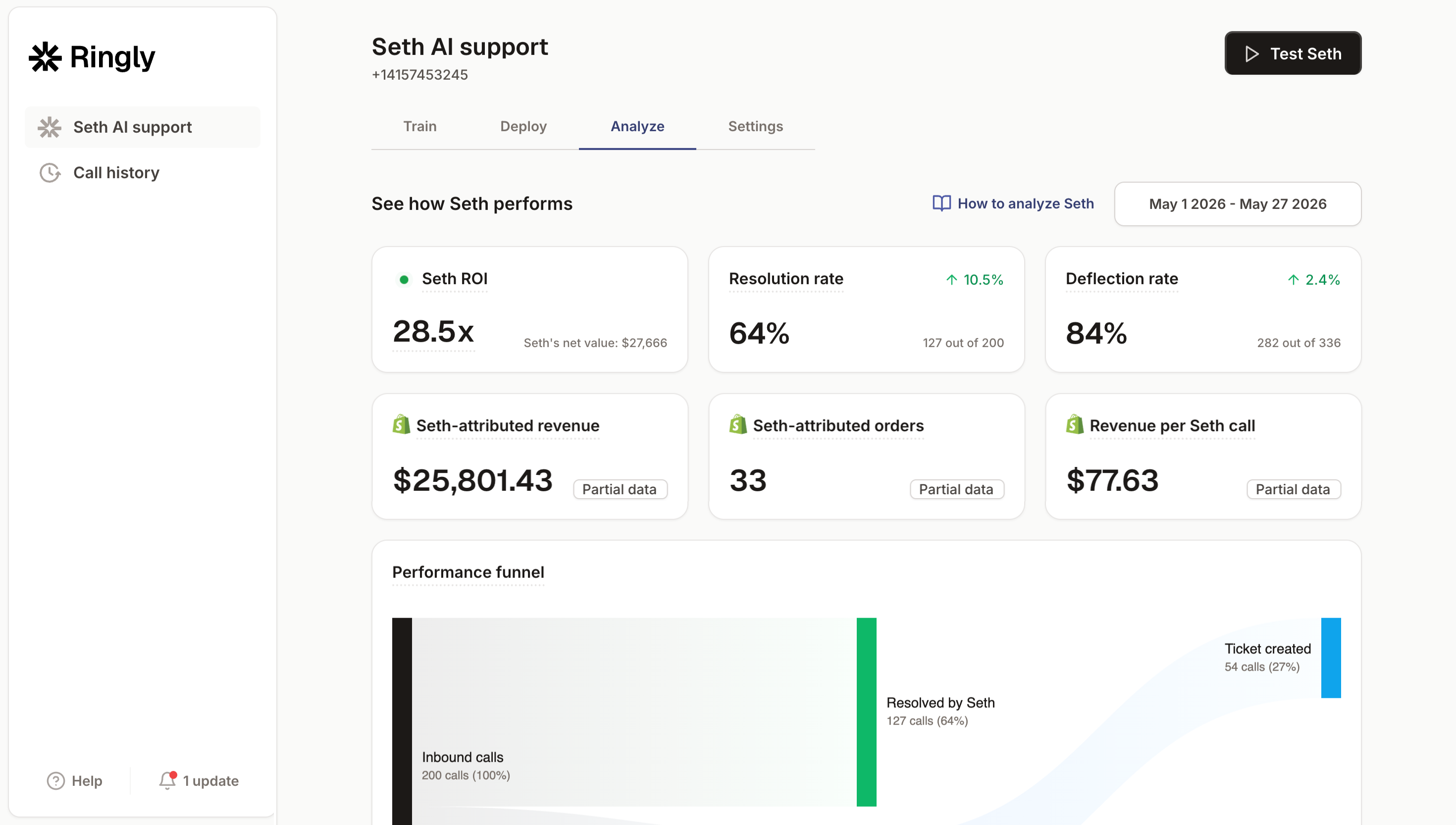
The AI answers inbound calls 24/7. It finds orders in your Shopify store, checks order status, processes returns, and answers product questions from your knowledge base. Across 50+ brands, the AI resolves 73% of calls autonomously at roughly $0.42 per resolved call. The calls that need a person escalate cleanly into the same Gorgias workflow you just wired up, via a smart call transfer. It sits in front of the helpdesk, it doesn't replace it.
WashCo, a Shopify brand we launched, recovered $22,664 in its first 7 days on the phone.
Run the math the way your CFO will. A 6-rep CS team at $4,000 loaded per rep is $24,000 a month. Move the routine 70% of calls (order status, returns, the same questions over and over) to the AI at roughly $5,000 a month, and you net around $19,000 a month back, about $228,000 a year. Your team keeps the 30% that actually needs them.
If your phone line still rings a human after you've automated everything else, book a 30-min call and we'll do the math live on your real call volume. For the bigger picture on the channel, our guides on ecommerce phone support, WISMO calls, and 24/7 ecommerce phone support go deeper, and the AI phone agent for Shopify page shows how the handoff works.
Frequently asked questions
Is the Gorgias Shopify integration free?
The Shopify app install itself is free, and the integration is included with your Gorgias plan. You pay for Gorgias, which is ticket-based pricing, plus a per-resolution fee if you use the AI Agent. There's no separate charge for connecting the store.
Can I refund or cancel a Shopify order from inside Gorgias?
Yes. Both run from the ticket sidebar with options for quantity, shipping, restock, reason, and notifying the customer. The one limit is that you can only refund an order paid through a single payment gateway, so split-tender orders still need Shopify admin.
Why did my Shopify data stop syncing in Gorgias?
This is almost always a permissions drop. Go to Settings, Installed apps, Shopify, your Shopify integration, and click Update App Permissions to resync. If it keeps happening, re-integrate the store from scratch and open Gorgias in an incognito window.
Can I connect multiple Shopify stores to one Gorgias account?
Yes, you can connect multiple Shopify stores to one dashboard, each with its own rules, macros, and signatures. The caveat: rules that read Shopify conditions won't fire correctly for a customer who has ordered across more than one connected store. Gorgias recommends a separate account per legal entity.
Why does the sidebar only show some of a customer's orders?
The Gorgias sidebar displays the 10 most recent orders for a customer, even if they've placed more. It's a display limit, not a sync failure. The full order history still lives in Shopify.
Can I edit a Shopify order from Gorgias?
Yes, but only for unfulfilled orders placed within the last 60 days, in your store currency. Once an order is fulfilled or older than 60 days, you'll need to make the change in Shopify admin.
Does Gorgias handle inbound phone calls?
Not automatically. Gorgias's AI Agent works on email, chat, and social only, and the Voice add-on still needs a human to answer every call. Inbound phone is the one channel the Shopify integration leaves manual, which is where an AI phone agent like Ringly fits in front of your helpdesk.
Talk to us

If you've wired Gorgias into Shopify and the email queue moves fast but the phone still rings a human after hours, that's the gap we close. A 30-min call is the fastest way to see what the phone line is costing you on your real call volume.
The 3-layer guarantee.
- Live in 14 days or it's free until launched.
- 65% resolution in 90 days or we refund the last 3 months of subscription fees.
- We keep working free until we hit 65%.
Ruben (Ringly co-founder) takes these calls personally.