


The short version.
- Gorgias's shared inbox earns its 4.6 on G2 and Capterra. It also earns its 2.5 on Trustpilot. Both are true, for different reasons, and this post explains the gap.
- Reviewers love the Shopify actions inside the ticket and the per-ticket pricing. They complain about the bill at scale, the rigidity, and one thing the inbox quietly can't do: answer the phone after hours.
- Written for founders, COOs, and Heads of CX at $10M-$100M Shopify brands running Gorgias with a visible phone number.
Gorgias is one of the highest-rated helpdesks on the Shopify App Store, and the reviews back it up most of the time. It sits at 4.6 on G2 and 4.6 on Capterra across 134 verified reviews. Then you open Trustpilot and it's a 2.5, with 35% of reviewers leaving a single star. Same product, two very different stories.
I read through more than 150 Gorgias reviews across G2, Capterra, Trustpilot, and the Shopify App Store, then mapped what reviewers said against the real call logs of 50+ Shopify brands we run phone support for. The shared inbox is genuinely good. The gap is the phone.
If you're running a $10M-$100M Shopify brand and the same five questions keep landing in your shared inbox while your phone line rolls to voicemail after 6 p.m., the inbox isn't your problem. The after-hours coverage is. Book a 30-min call and we'll show you what your missed calls are actually worth.
The scores at a glance
Here's where Gorgias's shared inbox actually sits across the four review sources that matter, and what each one is really measuring.
| Source | Score | Reviews | What it's measuring |
|---|---|---|---|
| G2 | 4.6 / 5 | hundreds | day-to-day product use |
| Capterra | 4.6 / 5 | 134 | ease of use, support quality |
| Shopify App Store | 4.2 / 5 | 600+ | install + integration experience |
| Trustpilot | 2.5 / 5 | ~146 | billing, sales, cancellation |
The pattern is the whole story. People who rate the product they use every day give it a 4.6. People who land on Trustpilot are usually there to talk about a bill or a cancellation, and that crowd gives it a 2.5. Keep that split in mind for the rest of this post.
What the Gorgias shared inbox actually is
The shared inbox is the core of Gorgias. It pulls every customer conversation into one place: email, live chat, SMS, and social, threaded by customer so your team isn't hopping between five tabs to answer one person.
The thing that makes it a Shopify helpdesk and not just an inbox is that you can take Shopify actions inside the ticket. Refund, cancel, edit, and check order status without leaving the conversation. That single feature is why most Shopify brands pick it over a general-purpose tool, and it's the most-praised thing in the reviews by a wide margin.
On top of the inbox, Gorgias layers automation: macros, rules, and intent detection that auto-close the repetitive tickets and route VIPs to a human. Some teams report automating around half their interactions. For written support, that's a real number, and the Gorgias Shopify integration is the reason it works as well as it does.
How I read the reviews
I'm Ruben, co-founder of Ringly. We run AI phone support for 50+ Shopify brands, which means I evaluate helpdesk tools constantly, not as a critic, as a buyer who has to make them work next to a phone line.
For this post I went through more than 150 Gorgias reviews and sorted what reviewers said into five buckets:
- What gets praised. I pulled the features reviewers mention unprompted, in their own words, across all four sources.
- What gets complained about. I separated the day-to-day product gripes from the billing and sales complaints, because they're different animals.
- The billing reality. I cross-checked the real pricing tiers against the overage and AI Agent fees that show up in the angry reviews.
- The phone. I read every review that mentioned calls, voicemail, or the Voice add-on, then compared it against what after-hours call volume actually looks like in our customers' logs.
- What nobody mentions. The quiet gap. Reviewers rate what they use. Almost none of them rate what happens to the calls that never reach a human.
I don't sell a Gorgias alternative. Ringly sits in front of a helpdesk like Gorgias and answers the phone, so I'm reading these reviews for the one thing the inbox doesn't cover, not to talk you out of it.
What reviewers praise about the shared inbox
The positive reviews are consistent, and they're consistent for good reasons.
Shopify actions inside the ticket. This is the headline. One Capterra reviewer put it plainly: "You can see order history, issue refunds, and edit orders directly inside a ticket without switching tabs." For a brand drowning in WISMO and the same questions over and over, that context-in-place is the difference between a 4-minute ticket and a 90-second one. More on the WISMO load below.
Per-ticket pricing, not per-seat. Reviewers like that they don't pay per agent. As one Capterra review said, "charging per ticket instead of per user allowed nearly everyone in our company to use it freely without worrying about seat limits." Your whole team can live in the inbox without the seat math.
Real consolidation. Email, chat, SMS, and social in one threaded view cuts the channel-switching that eats a support team's day. Pair that with the automation and some teams genuinely route half their written volume without a human touching it.
The Shopify-native depth shows up everywhere. It's a solid Shopify helpdesk, and the feature set keeps growing every couple of weeks. None of that is in dispute.
What reviewers complain about
Now the other column. The complaints cluster in three places, and the first one explains most of the Trustpilot tail.
The bill grows faster than you expect. Gorgias charges per ticket, not per seat, which is great until the volume climbs. A Pro plan is $360/mo for 2,000 tickets, but a Zipchat teardown showed how a $360 plan becomes roughly $960 once you turn on the AI Agent at scale, because the AI Agent costs $1 per resolved conversation on top of your base ticket cost. Add the Voice add-on at $1.20 per voice ticket and the seasonal-spike overages, and the number on the invoice stops looking like the number on the pricing page. That's the per-resolution pricing reviewers keep flagging.
The Trustpilot reviews are mostly about billing, not the product. This is the 2.5. The angry reviews aren't "the inbox is bad." They're about money. One reviewer wrote that they were "billed $12K on a yearly plan that we had asked them to downgrade to monthly." Another said the company would "hound you to sign up and conveniently out of reach when you need help." A third got charged for a high-value package during a trial and couldn't downgrade in time, calling it "$540 for nothing we used." The product is a 4.6; the billing and cancellation experience is what drags the Trustpilot average to a 2.5.
It's rigid in the small ways that add up. Reviewers note the rules builder "can get complicated fast if you're running a lot of automations," that you can't always save filtered inbox views the way you want, and that merged tickets can't be unmerged. None of these are dealbreakers on their own. Together they're the texture of a tool that's powerful but not very bendable.
So is the 4.6 real or is the 2.5? Both are. The 4.6 is what the product does on a normal Tuesday. The 2.5 is what happens when you try to change your plan or read your invoice. If you go in expecting a strong inbox and a billing relationship you have to watch closely, the reviews stop contradicting each other.
The one thing the shared inbox can't do: answer the phone
Here's the gap almost no reviewer rates, because you don't review the thing that never reached you.
The Gorgias shared inbox is built for written tickets. Email, chat, SMS, social. Gorgias does sell a Voice product, but it's a human-answered phone product: it routes calls, builds IVR menus, transcribes, and logs voicemails. A person still has to be at a desk to pick up. After 6 p.m., on the weekend, during a launch spike, the calls roll to voicemail or get missed. And a few reviewers who bought the add-on said it "never worked, the phone didn't ring to them, glitched a lot."
The missed call is the most expensive ticket your shared inbox never sees. According to PCN's 2026 study, 85% of callers who can't reach a person never call back, and 62% switch to a competitor. Voicemail doesn't save you either: research from Eden found 80% of voicemail-routed callers hang up without leaving a message. So the after-hours caller with a "where's my order" question doesn't become a ticket in your beautiful threaded inbox. They become a sale at someone else's store.
For an older or higher-AOV customer base, this hurts more, because those buyers call instead of chat. It's the same blind spot you'll find in honest Gorgias AI reviews: strong on chat, quiet on the phone. Your shared inbox can be a 4.6 and your phone line can still be leaking revenue every night, which is why an after-hours answering layer matters. If that sounds like your store, book a 30-min call and we'll pull what your after-hours calls are costing you.
What the gap costs, and how to close it without replacing Gorgias
You don't need a new helpdesk. You need something answering the phone when no one's at the desk, and handing the hard calls back to the inbox you already run.
That's where Ringly.io comes in. Ringly is AI phone support for Shopify brands. Keep your current phone number, your Gorgias inbox, and your workflows. Add an AI that handles the routine inbound calls so your team can focus on the work that actually moves revenue.
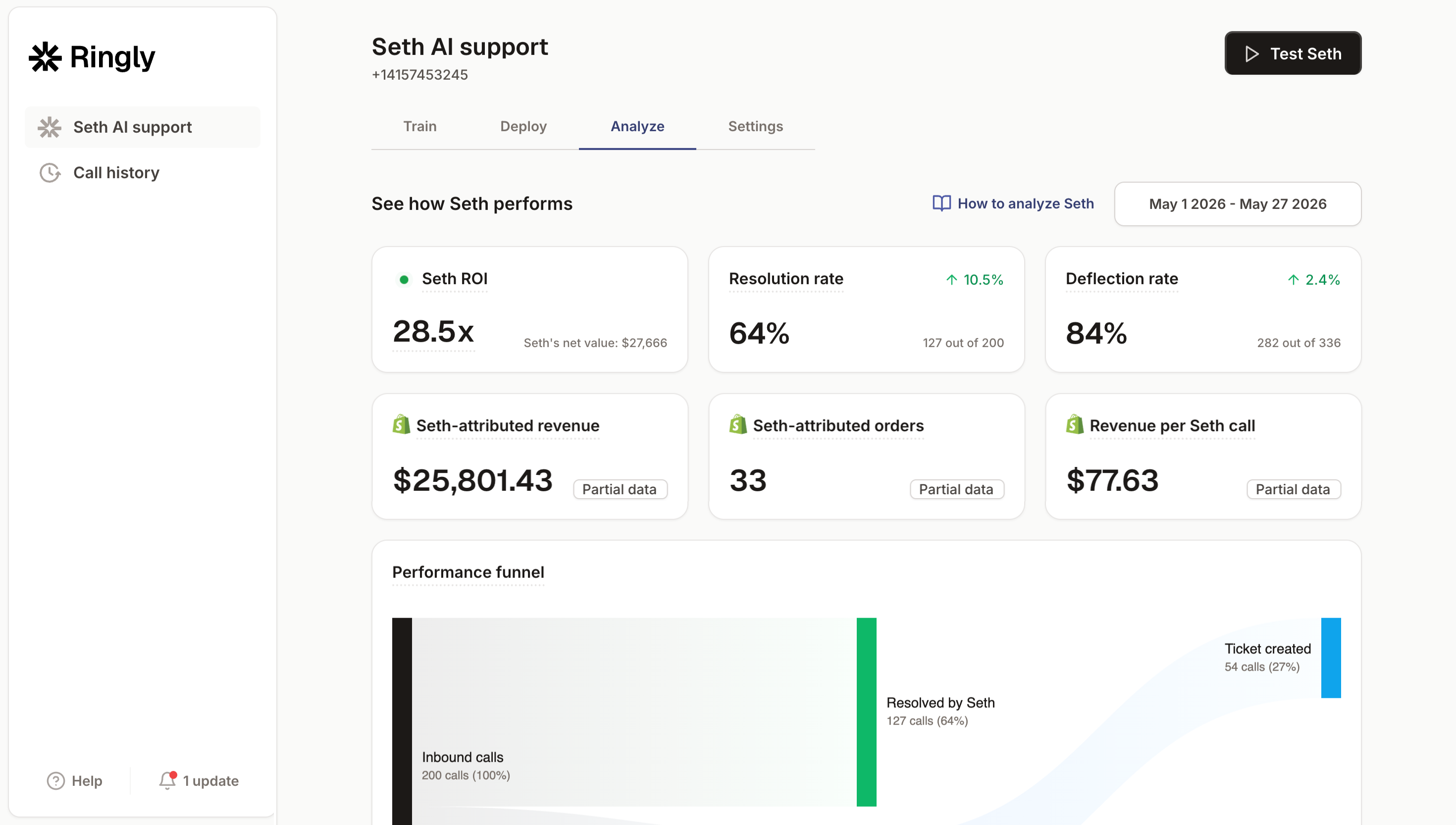
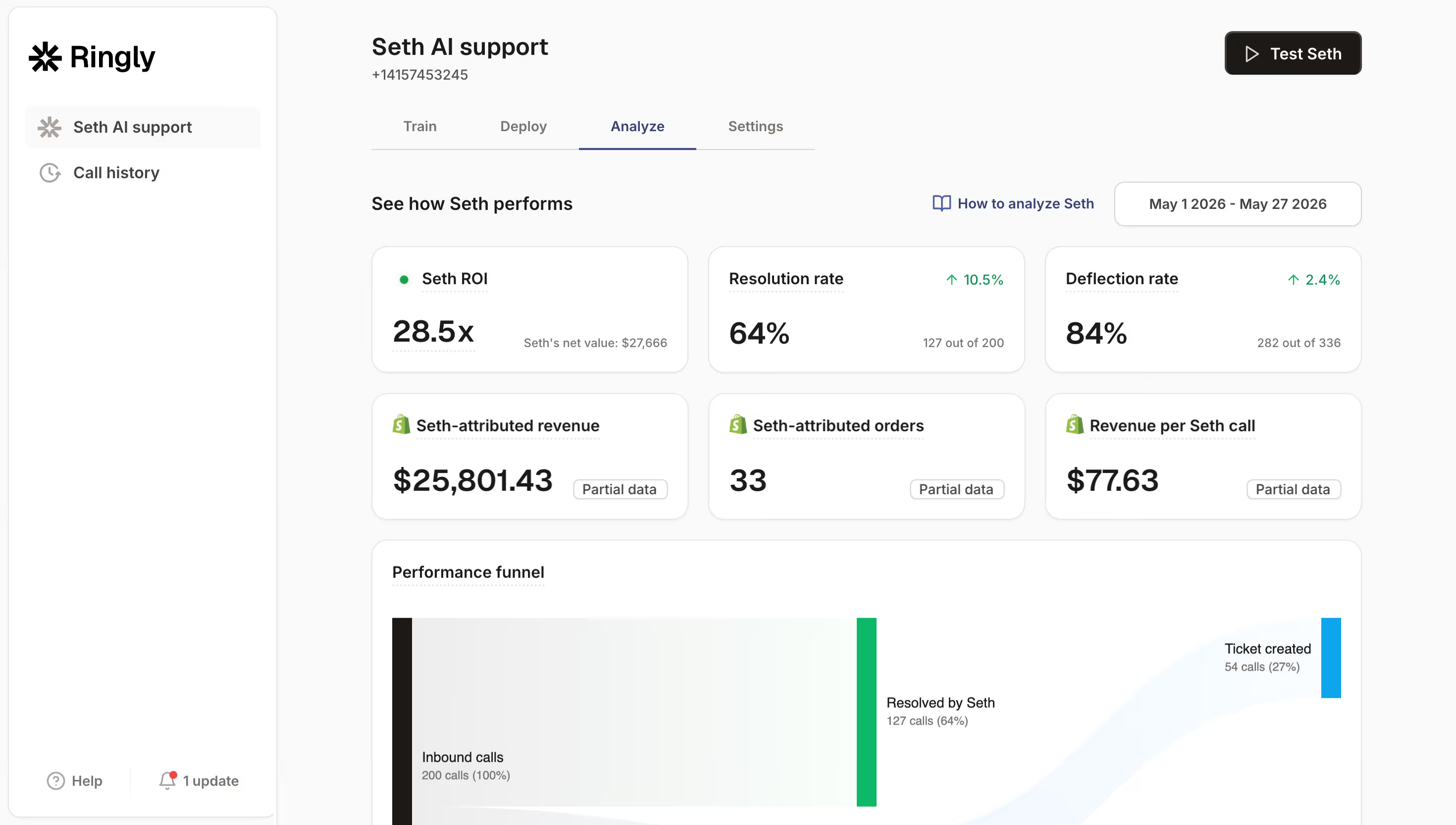
The AI answers inbound calls 24/7. It finds orders in your Shopify store, processes returns and exchanges, answers product questions from your knowledge base, and rescues abandoned carts with outbound follow-up. Across 50+ brands, it resolves 73% of calls autonomously at roughly $0.42 per resolved call. The calls that need a human escalate cleanly into Gorgias, Richpanel, Reamaze, or whatever helpdesk you already run. It sits in front of the inbox, not on top of it.
The math is the easy part. Take a typical $50M Shopify brand running a 6-rep CS team:
| Line item | Today | With Ringly |
|---|---|---|
| 6 reps at $4K loaded per rep | $24,000/mo | n/a |
| Ringly (~$5K/mo) | n/a | $5,000/mo |
| Net monthly CS spend | $24,000/mo | $5,000/mo |
| Monthly savings | n/a | $19,000/mo |
| Annual savings | n/a | $228,000/yr |
That's roughly 70% of repeatable calls (order status, returns, the same five questions over and over) routed to the AI. The other 30%, the genuinely complex ones, still go to your team. WashCo, a Shopify brand we launched, recovered $22,664 in its first 7 days on the phone.
"My customers also feel like it's a normal person. They feel like they can communicate if they have questions."
Claudia Droge, TechCraft Studio
And the voice quality is the part skeptics worry about most, which is why the single most repeated thing customers say after a call is that it doesn't sound like AI. You can see how this fits a full ecommerce call center setup, and how it checks order status without a human in the loop.
Should you keep the Gorgias shared inbox?
Honest answer: probably yes. The inbox isn't the problem. Here's the clean way to decide what to do.
Keep the Gorgias shared inbox if:
- 40% or more of your tickets need a Shopify action (refund, cancel, edit, track). That's where the per-ticket price earns itself.
- Your team lives in written channels and the automation is carrying real volume.
- You can watch the billing closely and you're fine managing overages and the AI Agent fee.
Add a phone layer in front of it if:
- Your phone goes to voicemail after hours and you don't know what you're losing.
- Your customers call instead of chat (older or higher-AOV buyers usually do).
- You're tempted to hire your next rep just to cover the phone, when scaling without hiring would cover it cheaper.
The shared inbox handles the written queue well. It was never built to pick up the phone at 11 p.m. Those are two different jobs, and you can solve the second one without touching the first. If you want help mapping it, book a 30-min call to compare us to your current setup. We'll do the math live.
Frequently asked questions
Is the Gorgias shared inbox good?
Yes, for written support. It's rated 4.6 on G2 and Capterra, and reviewers consistently praise the Shopify actions inside the ticket and the per-ticket pricing. The weak spots are the bill at scale and real-time phone coverage, not the inbox itself.
Why is Gorgias rated 4.6 on G2 but 2.5 on Trustpilot?
Different crowds rate different things. G2 and Capterra reviewers rate the day-to-day product, which is strong. Trustpilot reviewers mostly show up to complain about billing, overages, or a cancellation that went badly, which drags that average to a 2.5.
Does the Gorgias shared inbox handle phone calls?
Not on its own. Gorgias sells a Voice add-on, but it's human-answered, so someone has to be at a desk to pick up. After hours and on weekends, calls roll to voicemail or get missed.
How much does the Gorgias shared inbox cost at scale?
The Pro plan is $360/mo for 2,000 tickets, but the real bill climbs with overages ($0.36 to $0.40 per extra ticket), the AI Agent fee ($1 per resolved conversation), and the Voice add-on (from $1.20 per voice ticket). One teardown showed a $360 plan reaching roughly $960 at scale.
Can I add AI phone support without replacing Gorgias?
Yes. That's the normal setup. An AI phone agent like Ringly sits in front of your phone line, resolves the routine calls 24/7, and escalates the rest into your existing Gorgias inbox. You keep your number, your inbox, and your workflows.
What do reviewers complain about most?
Billing surprises (overages and the AI Agent fee), rigidity (a complex rules builder, limited saved views, no unmerging), and the phone add-on not working reliably. The product itself rarely gets blamed in the negative reviews.
Is Gorgias worth it for a $10M+ Shopify brand?
For the written queue, usually yes, as long as you watch the billing. For the phone, you'll want a 24/7 layer in front of it, because the missed after-hours call is the one ticket the shared inbox never even sees.
Talk to us

If you run a $10M-$100M Shopify brand on Gorgias and your phone line goes quiet after 6 p.m., a 30-min call is the fastest way to see what you're missing. We'll keep your inbox exactly where it is and put an AI phone agent in front of it.
The 3-layer guarantee.
- Live in 14 days or it's free until launched.
- 65% resolution in 90 days or we refund the last 3 months of subscription fees.
- We keep working free until we hit 65%.
Ruben (Ringly co-founder) takes these calls personally.