
Your Gorgias inbox is the cheapest keyword research your store will ever run.
- Three moves turn a support operation into an organic-traffic engine: fix where your help content earns SEO credit, mine your tickets for the questions people actually search, and structure the answers so AI search cites you.
- Across the 50+ Shopify brands we run phone support for, the same five to ten questions are 70-80% of all contact volume. That short list is a ready-made keyword cluster.
- Written for founders, COOs, and Heads of CX at $10M-$100M Shopify brands already on Gorgias with a visible phone line.
You bought Gorgias to close tickets faster. It does that. But it's also quietly producing the best SEO raw material your store owns, and most brands route every bit of that value to the wrong place or throw it away.
Here's the disconnect. Your SEO person is paying for keyword tools to guess what customers want. Meanwhile your support team reads the literal questions, in customers' own words, all day. The same brand runs two teams looking for the same answer, and they never compare notes.
This is the playbook to close that gap. If you run customer experience at a $10M-$100M Shopify brand and you're tired of watching the same questions over and over land in the queue, this turns that repetition into ranking pages and AI-search citations instead of pure cost. Want a second set of eyes on where your support data is leaking value? Book a 30-min call and we'll look at it with you.
Here are the three moves, at a glance, before we go deep on each.
| Move | What it fixes | Effort |
|---|---|---|
| 1. Reclaim your Help Center | SEO credit leaking to a Gorgias subdomain you don't own | Low (config) |
| 2. Mine your ticket data | Guessing at keywords your customers already type to you | Medium (export + cluster) |
| 3. Structure for AI search | Great answers that never get cited in AI Overviews | Low (schema) |
Why your support content is an SEO asset you're not counting
Start with the size of the prize. Roughly 43% of ecommerce traffic comes from organic Google search, according to Wolfgang Digital data cited in Gorgias's own Shopify SEO guide. For most DTC brands, that's the single largest channel that doesn't bill you per click. So anything that quietly feeds it is worth finding.
Now look at where search is actually going. About 64.82% of Google searches now end without a click, and on queries that trigger an AI Overview that number jumps to roughly 83% (digitalapplied 2026 data). That sounds like bad news, and for thin content it is. But here's the part that matters for you specifically: pure product and category queries trigger AI Overviews only about 3.2-4% of the time. The queries that DO fire AI Overviews are the informational, support-shaped ones. "Can I return this after 30 days." "Does this ship to Canada." "How do I cancel."
Your AI-search exposure as a Shopify brand is concentrated almost entirely in support content, which means your support team is sitting on the most AI-citable asset your store has. Most operators are optimizing product pages for a battle that's barely happening and ignoring the support content that's in the actual fight.
We see how concentrated this is from the other side. We read the ticket and call logs across the 50+ Shopify brands we run phone support for, and the pattern is the same everywhere: five to ten questions account for 70-80% of all contact volume. Order status, returns, fit and sizing, shipping windows, subscription changes. That is not a long tail. That is a tight, high-intent keyword cluster your customers are handing you for free, and a good knowledge base for customer service is already half-built around it. The same instinct that makes a page rank, answering a real question clearly, is what makes a ticket close. This is also why broad ecommerce SEO advice underperforms for support-led brands: it skips the dataset you already own.
The catch is that Gorgias does not hand you any of this as SEO by default. You have to set it up on purpose. That's move one.
Move 1: stop leaking equity from your Gorgias Help Center
The Gorgias Help Center is a genuinely good knowledge base. The problem is where it lives.
By default, your Gorgias help desk publishes the Help Center on a separate domain, something like yourbrand.gorgias.help. Per the Gorgias docs, you can leave that subdomain auto-assigned or set your own. Either way, any links those articles earn and any rankings they pick up accrue to that domain, not to your store. You're building authority for an address you don't own and can't fully control.
Every help article you write on the default Gorgias subdomain is a backlink and a ranking you're handing to a domain that will never sell a product. That's the leak.
You have two clean decisions to make, and you should make them deliberately:
- Decision A, custom domain. Point the Help Center at a subdomain you control, like help.yourbrand.com, using the Gorgias custom-domain feature. Now the authority lives in your brand's namespace instead of a generic Gorgias address. This is the right move if you want the Help Center to be a public, ranking SEO asset.
- Decision B, indexed or internal. Decide whether the Help Center should be found by Google at all. Gorgias lets you add a noindex tag across the whole Help Center via its Extra HTML feature. Use that ONLY for internal or deflection-only knowledge bases. If the content is customer-facing and well-written, leave it indexable so it can rank and get cited.
Most brands have done neither. The Help Center sits on a random subdomain, half-indexed, earning equity nobody benefits from. Pick a lane.
A few mechanical notes while you're in there. Keep your help-article title tags in the 50-60 character range and meta descriptions around 155 characters, the same on-page basics that apply to the rest of your store. And if you publish the same FAQ answer in two places, on the Help Center and on a product page, set a canonical so Google knows which one to rank. A misaligned canonical pointing off your domain is its own quiet leak. The features knowledge base page covers how the same content feeds a voice agent, which becomes relevant in move three.
Move 2: mine your ticket data into content you already own
This is the move nobody outside your building can run, because nobody else has your tickets.
Open Gorgias and pull your most common ticket reasons and the verbatim phrasing customers use. The platform surfaces recurring questions in its reporting, so you're not reading every ticket by hand. You're looking for two things: which questions repeat, and the exact words people use to ask them. That phrasing is your keyword data, and it's better than any tool's, because it's the language of people who already came to your store.
The biggest single content cluster for almost every Shopify brand is WISMO, the "where's my order" question. Salesforce pegs it at 30-40% of tickets and 50%+ at peak, which alone justifies a strong, indexable order-status and shipping-timeline page that answers the question before someone has to ask it. We've written more on the mechanics of WISMO calls and on WISMO tickets, and the takeaway is the same: the demand is already there, you're just answering it one ticket at a time instead of one page at a time.
Once you have the list, cluster it. And cluster by meaning, not by volume. Five connected questions belong on one strong page, not five thin ones competing with each other. "How long does shipping take," "do you ship internationally," and "can I change my address after ordering" are one shipping page, not three orphans.
Then turn each cluster into one of three outputs:
- Product-page FAQ blocks. The pre-purchase questions ("does this run small," "is it dishwasher safe") belong directly on the product page. They lift conversion and they answer the pre-purchase product questions that search engines reward.
- Dedicated FAQ and policy pages. Returns, warranty, shipping, sizing. One indexable page per cluster, written in the customer's words.
- Blog topics. The "how do I" and "what's the difference between" questions become guides. These pull top-of-funnel traffic that your product pages never will.
This is the cheapest, highest-confidence content roadmap you'll ever build, because every topic on it is something a paying or near-paying customer already asked. It's also the fastest way to take pressure off the queue, which is the whole point of good ecommerce customer service.
Move 3: structure your answers so AI search cites you
Writing the answer is half the job. The other half is making it machine-readable.
Wrap your FAQ and how-to content in FAQPage and HowTo schema (the JSON-LD markup). According to the knowledge base SEO guide from helpcenter.io, FAQPage schema makes content eligible for expandable rich snippets, and these structured answers are exactly what Google's AI features pull from when they generate an overview. Given that support-shaped queries are where AI Overviews fire hardest, this is your citation surface. No schema, no citation.
Schema is how you get quoted in the answer box instead of buried on page two of a result almost nobody clicks. And remember the zero-click reality: if 83% of AI-Overview searches end without a click, being the cited source in that overview is often the only visibility you get. Skip it and you're invisible in the fastest-growing slice of search.
Two guardrails. First, schema only helps if the content genuinely answers the query; marking up a thin or evasive answer does nothing and can get ignored. Second, put the marked-up answers on indexable pages on your own domain, which loops straight back to move one. Schema on a noindexed Gorgias subdomain helps no one. If you're trying to reduce customer service ticket volume and rank at the same time, this is the structure that does both, and it pairs naturally with any self-service support software you already run.
The deflection vs discoverability loop
Here's why these three moves are one system, not three projects.
The same FAQ answer does two jobs at once. It deflects a ticket, which saves your CS team a reply. And it ranks or gets cited, which earns you a visitor who never costs you a click. One content asset, two lines on the P&L. Support is where customers tell you, in their own words, what they came to buy and what stopped them. That is acquisition data wearing a support costume.
A returns FAQ that closes 200 tickets a month is also the page answering "can I return [your product]" for every shopper who hasn't bought yet. Deflection and discoverability aren't competing goals. They're the same content measured twice.
That changes the math on your support spend. Take a typical $50M Shopify brand running a 6-rep CS team:
| Line item | Today | With an AI agent |
|---|---|---|
| 6 reps x $4K loaded per rep | $24,000/mo | n/a |
| AI phone support (~$5K/mo) | n/a | $5,000/mo |
| Net monthly CS spend | $24,000/mo | $5,000/mo |
| Monthly savings | n/a | $19,000/mo |
| Annual savings | n/a | $228,000/yr |
That's roughly 70% of repeatable calls (order status, returns, the same five things over and over) handled autonomously, while the genuinely complex 30% still go to your team. The content you build from move two is what makes both the AI and the search engine smarter at the same time. WashCo, a Shopify brand we launched, recovered $22,664 in its first 7 days on the phone, which is the clearest version of support paying you back instead of just costing you.
If you want to see what this loop looks like against your actual numbers, book a 30-min call and we'll do the math live on your support volume.
The channel your loop is missing: the phone
There's a hole in everything above, and it's the channel you can hear but can't search.
Gorgias captures your chat and email as text. Every one of those tickets is minable, clusterable, and ready to become content. Your phone calls are not. By default, a phone call leaves no searchable transcript, which means the largest and often highest-intent question cluster, the one people care enough to call about, never reaches your SEO loop at all. You're mining the channels you can read and ignoring the one you can't.
Ringly.io is AI phone support for Shopify brands. Instead of hiring and training a phone team every time call volume climbs, the AI answers inbound calls 24/7: order status, returns, product questions, abandoned-cart rescue. Across 50+ brands it resolves 73% of calls autonomously at roughly $0.42 per resolved call. Calls that need a human escalate cleanly into Gorgias, Richpanel, Re:amaze, or whatever helpdesk you already run, so it sits in front of your stack instead of replacing it.
Because every call is answered, transcribed, and analyzed, the phone finally produces the same minable question dataset Gorgias gives you for chat and email. Now your content roadmap covers every channel, not just the typed ones.
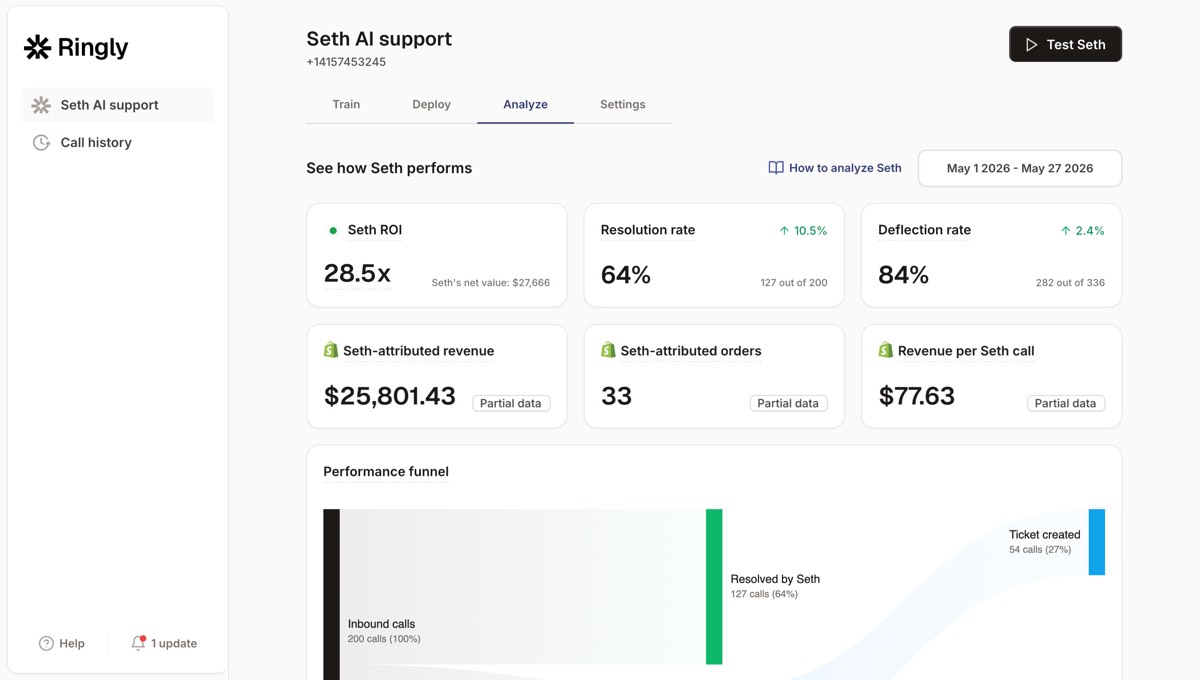
The AI call analysis view turns call patterns into the same recurring-question report you'd pull from Gorgias, and the check order status action closes the WISMO loop on the phone the same way WISMO automation on Shopify does for tickets. It pairs with your existing Gorgias AI agent rather than competing with it.
And the quality holds up where it counts. As Claudia Droge at TechCraft Studio put it:
"My customers also feel like it's a normal person. They feel like they can communicate if they have questions."
Claudia Droge, TechCraft Studio
Frequently asked questions
Does the Gorgias Help Center help my Shopify store's SEO? Only if you set it up to. By default it publishes on a separate Gorgias subdomain, so any rankings and links go to that domain instead of your store. Point it at a custom domain you control and keep it indexable if you want it to count as an SEO asset.
Should I make my Gorgias Help Center indexable or noindex? Index it if the content is customer-facing and answers real questions, because that's what ranks and gets cited. Noindex it (via Gorgias's Extra HTML feature) only if it's an internal or deflection-only knowledge base. The mistake is leaving it half-indexed by accident.
How do I find SEO keywords from my support tickets? Pull your most common ticket reasons in Gorgias reporting and note the exact words customers use. Cluster those questions by intent, not by volume, then build one strong page per cluster. It's keyword research you already own, free of any tool.
Does FAQ schema still work in 2026 with AI Overviews? Yes, and it matters more now. FAQPage and HowTo schema make your answers eligible for rich snippets and they're a primary source AI Overviews pull from. Since support-shaped queries trigger AI Overviews far more than product queries, schema is how you get cited.
Will answering questions in content cannibalize my support team's value? No, it redeploys it. Deflecting the repetitive 70-80% with content and AI frees your reps for the complex 30% that actually needs a human and builds loyalty. The same answer that closes a ticket also earns a visitor, so it pays twice.
How does Ringly fit a Gorgias and Shopify SEO setup? Ringly answers and transcribes your phone calls, which is the one channel Gorgias can't turn into searchable text. That gives you a minable question dataset for the phone, completing the content loop, and it escalates cleanly into Gorgias for anything a human should handle.
Talk to us

If you run a $10M-$100M Shopify brand on Gorgias, your support operation is already producing the raw material for cheaper acquisition. A 30-min call is the fastest way to see how much of it you're leaving on the table, especially on the phone.
The 3-layer guarantee.
- Live in 14 days or it's free until launched.
- 65% resolution in 90 days or we refund the last 3 months of subscription fees.
- We keep working free until we hit it.
Ruben (Ringly co-founder) takes these calls personally.