
This post in 30 seconds.
- A clear map of every AI feature inside the Gorgias live chat widget: the AI Agent (Support Agent plus Shopping Assistant), Order Management, Flows, dynamic discounts, and the older Rules and Macros layer.
- The real automation rate is 26% to 56% in documented case studies, not the 60% on the marketing page, and every AI-resolved chat hits your bill twice.
- Written for founders, COOs, and Heads of CX at $10M to $100M Shopify brands already running Gorgias and wondering if the chat AI closes the whole gap.
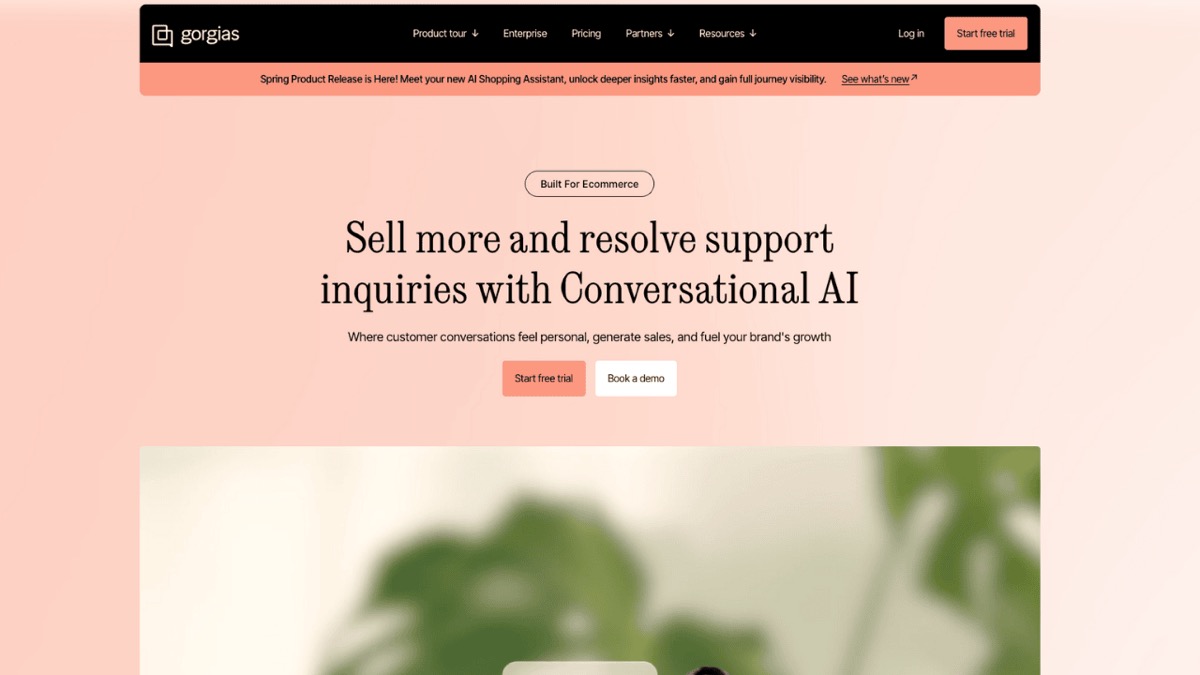
Gorgias built one of the better chat AI stacks for Shopify. If a shopper opens the chat bubble and asks “where’s my order,” the AI Agent can pull the order, drop a tracking link, and close the conversation without a rep touching it. That part is real, and it works.
The catch isn’t the quality. It’s the channel. Every feature below lives inside the chat widget. None of it picks up the phone. So the brand that turns on all of it still has an after-hours phone line going to voicemail, and the same questions over and over still land on a human the moment a customer dials instead of types.
This post walks through what the chat AI actually does, what it costs, and where the coverage stops.
Most Heads of CX at a $30M Shopify brand inherit a Gorgias instance, a chat widget, and a phone number nobody picks up after 6 p.m. We’ve launched AI phone agents for 50+ Shopify brands trying to close that second gap. Book a 30-min call and we’ll show you what your phone line is dropping after-hours.
The Gorgias live chat widget, and where AI plugs in
The chat widget is the floating bubble on your storefront. It sits in the same unified inbox as your email, SMS, and social channels, so a rep answers a chat the same way they answer a ticket. When a conversation opens, Gorgias surfaces the customer’s order history, cart, and subscription status right there in the thread.
The AI doesn’t replace the widget. It plugs into it as five separate layers, and you turn each one on by choice. Those layers are the AI Agent (which has two skill modes), Order Management self-serve, Flows, in-chat discounts and subscription edits, and the older Rules and Macros automation. Some of these are included in your plan. The AI Agent is usage-priced on top.
Here’s the part worth being honest about before you read the feature list. All five layers answer text in a box on your website. A customer who would rather call still gets your CS team, or your voicemail. For a deeper read on that split, we wrote up chat versus phone support for ecommerce separately.
Every chat AI feature at a glance
Before the deep dive, here’s the whole stack in one view. Skim it, then read the sections that matter to you.
| Feature | What it does in chat | Automation reality | Cost note |
|---|---|---|---|
| AI Agent (Support Agent) | Answers policy and FAQ questions from your help center and docs | 26% to 56% of conversations in case studies | ~$0.90 to $1.00 per resolved chat |
| AI Agent (Shopping Assistant) | Product recommendations, comparisons, discount strategy | Pre-sales lift, no public resolution number | Same per-resolution price |
| Order Management | WISMO self-serve, tracking links, issue reports | Up to 30% of chat ticket volume claimed | Refunds and cancels still need a rep |
| Flows | Button-driven guided journeys for common asks | Depends on setup quality | Automation Add-on only, max 4 shown at once |
| Rules and Macros | Auto-tagging and canned agent replies | Reliable but not AI resolution | Included in plan |
The two numbers to keep in mind: the documented automation rate runs 26% to 56%, and an AI-resolved chat counts as both an AI charge and a billable helpdesk ticket. More on that in the pricing section.
How I tested the Gorgias chat AI features
I’m Ruben, co-founder of Ringly. We run AI phone support for 50+ Shopify brands, so I evaluate Gorgias and every other Shopify support tool constantly, as a buyer who has to know exactly where each one stops.
For this write-up I set up the Gorgias chat AI the way a real $30M brand would and scored it against five things:
- Both skill modes in chat. I switched the AI Agent between Support Agent and Shopping Assistant and watched how each handled a real product question versus a policy question.
- The WISMO flow. I ran “where’s my order” through Order Management to see whether it pulled the order and dropped a tracking link without a rep.
- The refund path. I pushed a return request through to confirm what the AI can finish on its own and where it hands off.
- The Flows builder. I built a multi-step button journey for a pre-sales question and hit the limits (you can only show four flows at once).
- The bill. I traced what a single automated chat actually costs once the resolution fee and the ticket charge are both counted.
The thing none of the other write-ups test, because they only live in chat: I also picked up the phone. Every feature below answers a typed message. Not one of them answers an inbound call. That gap is the spine of this post, and it’s the reason I don’t take affiliate money on any of this. I only sell phone coverage.
The five AI features inside Gorgias chat, one by one
Gorgias chat AI is strongest on the routine, structured asks and weakest the moment a customer wants a human voice or a finished refund. Here’s each layer.
AI Agent: Support Agent and Shopping Assistant
The AI Agent is the headline feature, and it runs in two modes. Support Agent answers questions from your help center, policy pages, and knowledge base: return windows, shipping timelines, “do you ship to Canada,” that whole category. Shopping Assistant flips into pre-sales mode, recommending products, comparing two items, and applying discount strategy inside the conversation.
It’s genuinely good at the structured stuff. The honest number is that documented case studies land between 26% and 56% of conversations resolved, with one public example resolving 26% of tickets. The marketing page says up to 60%. Plan around the case-study range, not the ceiling. If you want the broader picture of every AI feature Gorgias ships, we cover the full Gorgias AI feature set in its own post.
Order Management self-serve
This is the WISMO workhorse. A shopper asks where their order is, and the AI pulls the status from Shopify and drops a tracking link with no human in the loop. Gorgias claims it can handle up to 30% of live chat ticket volume this way, which tracks, since WISMO is 30% to 40% of tickets in normal periods and over 50% at peak according to Salesforce.
The limit to know: the refund and cancellation buttons submit a request, they don’t execute. So a return that looks self-serve to the customer still drops into your queue for a rep to approve. It feels automated. It isn’t fully.
Flows, and the Quick Responses retirement
Flows are button-driven guided journeys. The customer taps an option, the chat walks them down a branch, and common pre-sales questions get answered without typing. If you remember Quick Responses, that feature was retired in 2024 (the phase-out started July 29, 2024) and Flows replaced it, so anything older you read about Quick Responses is stale.
Two real constraints. Flows are an Automation Add-on feature, not base. And you can only display four flows at once, though you can define more and rotate them in later. Getting the branches right is trial and error, which is the quiet cost of every rules-and-flows setup.
Dynamic discounts and subscription edits
The AI can generate a discount code inside a conversation, which is the lever Shopping Assistant uses to save a wavering pre-sales chat. It can also edit subscriptions against live Shopify and Recharge data, with a “show reasoning” panel that displays the steps it took. For a subscription-heavy brand, that’s the difference between a saved pause and a churned customer, at least on the chat channel.
“My customers also feel like it’s a normal person. They feel like they can communicate if they have questions.”
Claudia Droge, TechCraft Studio
Rules and Macros
The oldest layer, and still useful. Rules are if-this-then-that commands, like auto-tagging any message containing “tracking” as a shipping question. Macros are pre-written replies your reps fire for consistency. Neither is AI resolution, but both cut handle time, and they’re included in your plan rather than usage-priced. If you want to push chat automation further than the native tools go, there’s a roundup of the best AI chatbots for Gorgias worth a look.
What the chat AI costs, and the double-billing math
The chat widget itself comes with your plan, which runs from about $10/mo on Starter up to the $750 to $900 range on the higher tiers. The AI Agent is separate and usage-priced: roughly $0.90 per resolved conversation on an annual contract, $1.00 monthly, and around $1.50 for each resolution past your allowance.
Here’s the line item most brands miss: an AI-resolved chat counts as both an AI resolution charge and a billable helpdesk ticket, so a cleanly automated conversation hits your bill twice. A brand resolving 2,000 chats a month with the AI pays the resolution fees plus 2,000 tickets against plan. That’s the real unit cost, not the $1.00 sticker.
One more wrinkle. Gorgias only counts a resolution after 72 hours with no human contact, so your automation reporting lags about three days behind reality. We break down the full Gorgias pricing model if you want the per-tier numbers.
If the per-resolution math is starting to scare you off the chat channel, that’s the right instinct to check on a call. Book a 30-min call and we’ll do the cost math against your actual volume.
The channel Gorgias chat AI can’t touch: the phone
Every feature above answers a message typed into a box. The customer who picks up the phone instead, and at a brand with an older demographic that’s a big share of them, gets none of it. After 6 p.m. they get your voicemail.
That’s not a small leak. According to PCN’s 2026 missed-call study, 85% of callers who can’t reach a person never call back and 62% switch to a competitor. Businesses answer only 37.8% of inbound calls per AmbsCallCenter, and most of the rest roll to a voicemail nobody returns. Your chat AI can be resolving 56% of chats and you’re still dropping the majority of your phone volume.
This is where Ringly.io comes in. Ringly is AI phone support for Shopify brands. Your team wasn’t hired to answer the same call 50 times a day, and hiring a phone team scales linearly with call volume while the AI doesn’t.
The AI answers inbound calls 24/7. It finds orders in your Shopify store, processes returns and exchanges, answers product questions from your knowledge base, and rescues abandoned carts via outbound follow-up. Across 50+ brands, the AI resolves 73% of calls autonomously at roughly $0.42 per resolved call. Calls that need a human escalate cleanly to Gorgias, Richpanel, Reamaze, or whatever helpdesk you already run, so you keep your chat stack exactly as it is and just stop dropping the phone.
WashCo, a Shopify brand we launched, recovered $22,664 in its first 7 days on the phone. Plans: Grow $349/mo, Pro $799/mo, Enterprise custom. Live in under an hour, with a 65% resolution guarantee. For more on the phone side, see 24/7 ecommerce phone support and how to handle WISMO calls without a rep.
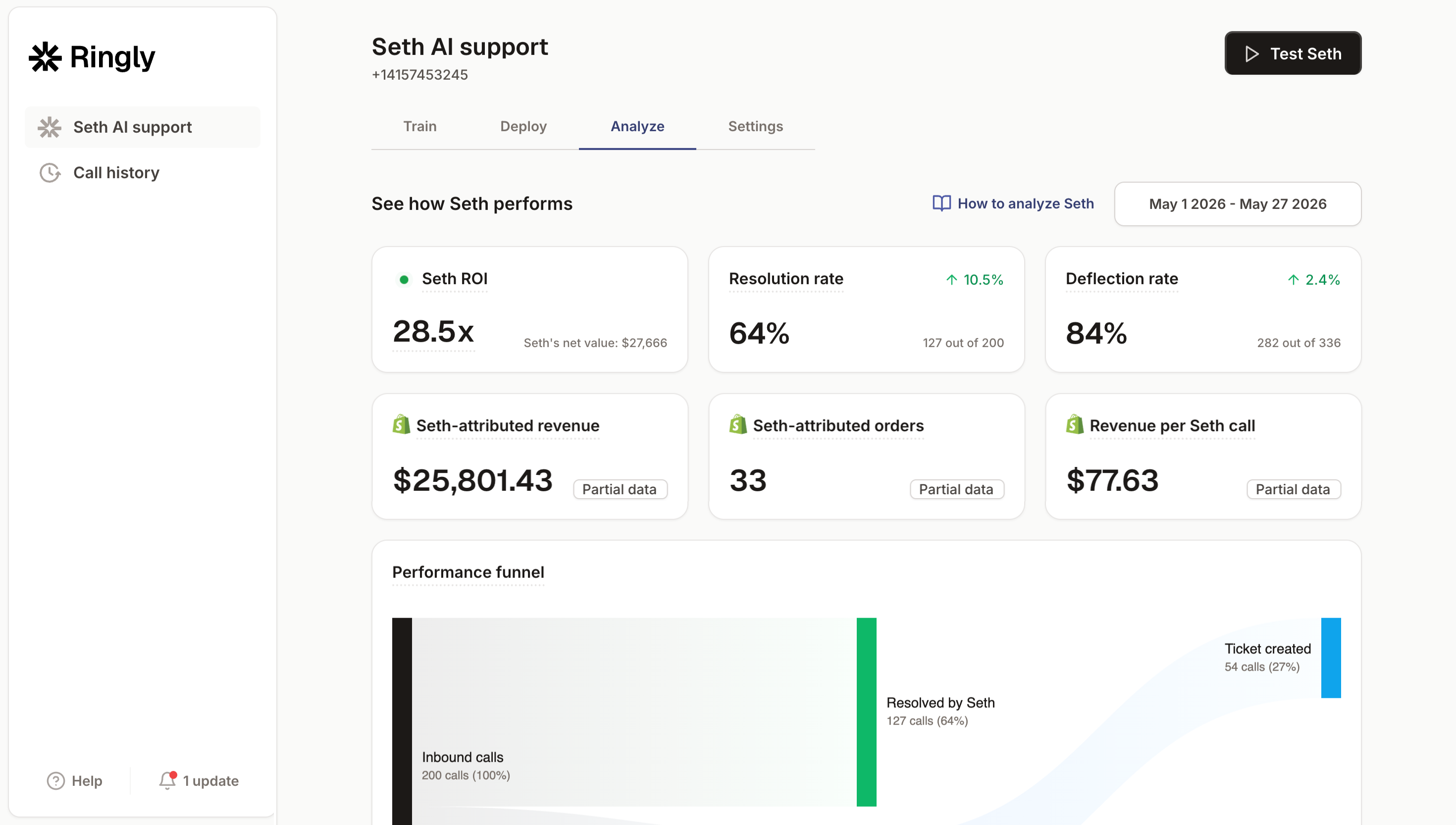
What this costs you today vs what it costs with Ringly
The chat AI saves you reps on the chat channel. The phone is where the unstaffed cost still sits. Take a typical $50M Shopify brand running a 6-rep CS team:
| Line item | Today | With Ringly |
|---|---|---|
| 6 reps × $4K loaded per rep | $24,000/mo | n/a |
| Ringly Enterprise (~$5K/mo) | n/a | $5,000/mo |
| Net monthly CS spend | $24,000/mo | $5,000/mo |
| Monthly savings | n/a | $19,000/mo |
| Annual savings | n/a | $228,000/yr |
That’s roughly 70% of repeatable calls (order status, returns, product questions, the same five things over and over) routed to the AI. The other 30%, the genuinely complex calls, still go to your CS team, who now have time to actually solve them.
Book a 30-min call and we’ll do the math live against your real call volume.
How to decide what to turn on
The chat AI is worth running. The question is which layers earn their cost and what you still cover another way.
- Turn on the AI Agent if more than 40% of your chats are structured Shopify actions (WISMO, returns, subscription edits). That’s where it pays for the per-resolution fee.
- Turn on Order Management if WISMO is eating your chat queue. Just remember refunds and cancels still need a rep to approve.
- Build Flows if you have a handful of repeatable pre-sales questions. Keep it to four live, and budget time for the trial and error.
- Keep a human on the emotional, complex, and judgment calls. The AI is a routing tool, not a replacement for your best reps.
- Cover the phone separately. Nothing in the chat stack answers an inbound call. That’s a different channel and it needs its own coverage, or it stays a leak.
If you’re choosing between tools entirely, our Gorgias alternatives breakdown and the Gorgias chat widget walkthrough go deeper on the chat side.
Frequently asked questions
What AI features does Gorgias live chat include? The AI Agent (Support Agent for policy questions and Shopping Assistant for pre-sales), Order Management self-serve for WISMO, Flows for guided button journeys, in-chat discounts and subscription edits, and the older Rules and Macros automation. The AI Agent is usage-priced; the rest is mostly included in your plan.
How much does the Gorgias chat AI Agent cost? About $0.90 per resolved conversation on an annual contract and $1.00 monthly, with extra resolutions around $1.50. Note that each AI-resolved chat also counts as a billable helpdesk ticket, so the conversation is charged twice.
What automation rate can I actually expect? Documented case studies show 26% to 56% of conversations resolved, with one public example at 26%. The marketing claim of up to 60% is the ceiling, not the typical result.
Does the Gorgias AI Agent work on platforms other than Shopify? No. The AI Agent is supported on Shopify only, not BigCommerce, Magento, or WooCommerce. The chat widget exists elsewhere, but the AI Agent layer does not.
Can the chat AI process a refund on its own? Not fully. Order Management lets a customer request a refund or cancellation through the chat, but those buttons submit a request that a rep still has to approve. Order status and tracking are fully self-serve; money movement is not.
What happened to Quick Responses? Gorgias retired Quick Responses in 2024, with the phase-out starting July 29, 2024, and replaced them with Flows. If you read older guides referencing Quick Responses, they’re out of date.
Does any of this handle phone calls? No. Every Gorgias chat AI feature answers typed messages in the widget. Inbound phone calls are a separate channel. Ringly.io adds AI phone support that resolves 73% of calls autonomously and escalates the rest to Gorgias.
Will customers know they’re talking to AI in chat? Often, since chat is a typed channel where people expect a bot. On the phone the bar is higher, and the most repeated thing our customers hear is “you don’t sound like AI.”
Talk to us

If you run a $10M to $100M Shopify brand and your chat AI is humming but your phone line still goes to voicemail after-hours, a 30-min call is the fastest way to see what that phone gap is costing you.
The 3-layer guarantee.
- Live in 14 days or it’s free until launched.
- 65% resolution in 90 days or we refund the last 3 months of subscription fees.
- We keep working free until we hit 65%.
Ruben (Ringly co-founder) takes these calls personally.