
A Gorgias knowledge base is the right build. It just only answers the customers who type.
- What the Gorgias knowledge base is, the exact 4-step setup, and how the AI Agent answers from it.
- How to write articles the AI can actually use, plus what it costs once the AI starts resolving tickets.
- Built for $10M-$100M Shopify brands running Gorgias with a visible phone number, where the same five questions show up on every channel, including the one the help center never sees.
If you run support at a Shopify brand doing $10M to $100M, you already know the rhythm. The same five questions, all day. Where's my order. Can I change my address. What's your return window. Your team answers them in Gorgias, again and again, and a good chunk of those tickets could answer themselves. That's what a knowledge base is for, and Gorgias has a solid one.
Most $20M+ Shopify brands build a Gorgias help center, point the AI Agent at it, and watch a real slice of repeat tickets disappear. We've launched AI phone agents for 50+ of those brands, and the one thing we see every time is that the help center fixes the typed channels and leaves the phone exactly where it was. Book a 30-min call and we'll show you what the phone side looks like once your knowledge base is working.
What the Gorgias knowledge base actually is
The Gorgias knowledge base lives inside its Help Center builder. It's a searchable set of articles: FAQs, how-to guides, return and shipping policies, troubleshooting steps. Customers browse it, search it, and solve their own problem without opening a ticket.
It does two jobs at once. The public help center is the storefront-facing portal, where a customer can read your return policy or check how shipping works at 11 p.m. without waiting on anyone. The internal knowledge base is the private version: team procedures, edge-case policies, the stuff your reps need but your customers shouldn't see.
The whole point is to take the questions that don't need a human off your team's plate. Gorgias says merchants using its self-service tools deflect up to 50% of tickets that don't actually need an agent. For a brand drowning in the same questions over and over, that's the difference between a 5-rep team that's underwater and one that has time to handle the calls that matter.
There's a second payoff most teams underrate. A public help center is indexable, so well-written articles can rank on Google for searches like "[your brand] return policy" or "[your brand] shipping time." Customers find the answer before they ever open a ticket, which quietly shrinks your inbound volume on top of the on-site deflection. It's the same logic as good ecommerce customer service: answer the question once, in a place people can find it, and you stop answering it by hand.
The catch, which we'll get to, is the word "tickets." A help center answers contacts that arrive as text. Email and chat. The customer who picks up the phone instead never opens it.
How to set up a Gorgias help center (the 4 steps)
Setup is genuinely quick. In Gorgias, go to Settings, then Channels, then Help center, then the Manage tab, and click Create help center in the top right. From there it's four steps, per the Gorgias docs.
- Step 1, the basics. Set your brand name, subdomain, default language, and platform type. If you're on Shopify, connect your store here so the AI Agent can pull order data later.
- Step 2, branding. Upload your logo (under 500KB, they recommend 1640x624px), pick an accent color by hex code, choose a font, and choose a layout (a single page or the card layout).
- Step 3, articles. Start from Gorgias's suggested templates. There are 20+ ready-made article templates covering the usual ground, so you're not staring at a blank page. Edit them now or save them to customize later.
- Step 4, turn on AI Agent features. Switch on flows, Shopify article recommendations, or order management, depending on your plan and store type.
When you're ready, flip "Set Help Center live" in the Publish and track tab. You can embed it on your site automatically or with a code snippet.
One thing that trips people up: you can't create a help center during a free trial. You need a paid plan first.
If you'd rather not write every article from scratch, Gorgias can suggest them for you. Its AI studies your real ticket history and proposes articles to answer your most frequent questions, so the help center you build maps to the questions your customers actually ask, not the ones you assume they ask.
Articles, Guidance, and how the AI Agent answers
Building the help center is half the job. The other half is connecting it to the Gorgias AI Agent so it can answer questions on its own.
The AI Agent pulls from five knowledge sources: your Help Center articles, your Shopify store data (orders, products, customer info), custom Guidance documents, uploaded files, and connected URLs. It stitches those together to answer a customer.
Here's the part that matters for trust. The AI Agent only answers from verified content in those sources. If the answer isn't in your knowledge, it won't make one up. It stays quiet and hands the conversation to a human instead. On top of that, every response runs through a second AI model that checks it against a confidence threshold before it ever sends. Low confidence, no send. That's the grounding discipline that keeps an AI from inventing a refund policy you don't have.
Articles and Guidance do different jobs, and most brands only use the first one. An article is static: one answer, the same for everyone. Guidance is conditional. It can branch, telling the AI to take different steps based on whether the customer is a VIP, whether they have loyalty points, or where they're located. If you've ever needed the AI to treat a wholesale buyer differently from a one-time shopper, Guidance is where that logic lives.
When it works, it works. Gorgias says the AI Agent autonomously handles over 30% of customer email inquiries using help center content. That's real load off your reps, and a big part of how brands scale customer service without hiring. The two ingredients are a knowledge base that's actually complete and articles written so the AI can read them, which is the next thing most people get wrong.
How to write articles the AI can actually answer from
A help center full of vague articles is worse than no help center, because the AI tries to answer from it and gets it wrong. A few rules from Gorgias's own playbook make the difference.
- One question per article. Don't cram shipping, returns, and sizing into a single "FAQ" page. One article, one question. It helps the AI figure out which article answers what.
- Publish them. Articles have to be Published, not sitting in Draft, for the AI to access them. Unlisted works too, so you can keep an article off the public help center but still let the AI use it.
- Be specific. Put real product names, real shipping timeframes, and real links (to your tracking portal, your returns portal, your loyalty page) in the article. Generic statements give the AI nothing to work with.
- Don't write "contact us at our email" inside an article. It sounds helpful, but it confuses the AI about what to do next. Let the escalation logic handle handoffs, not the article body.
- Use logical categories. Group articles into Shipping and Tracking, Orders and Payment, Product Information, Accounts. Clean categories help both the customer and the AI find the right answer fast.
The same discipline that makes a good knowledge base for customer service applies here. Specific, single-purpose, well-organized articles. The better your knowledge base, the more the AI can resolve without a human, and the more that same knowledge can do for you on other channels, which is the point I keep coming back to.
What a Gorgias knowledge base costs
The knowledge base itself is included in every Gorgias plan. Building a help center doesn't cost extra. What costs money is the AI Agent that answers from it, because that's a separate add-on billed per resolution.
Here's the shape of it, pulled from current Gorgias pricing breakdowns (Lindy, eesel):
| Plan | Price/mo | Included tickets | Help Center / KB |
|---|---|---|---|
| Starter | $10 | 50 | Included |
| Basic | $60 | 300 | Included |
| Pro | $360 | 2,000 | Included |
| Advanced | $900 | 5,000 | Included |
| Enterprise | Custom | Custom | Included |
The AI Agent add-on is billed separately, per fully resolved conversation: $1.00 per resolution on Starter, $0.90 on every other plan, and $1.50 per interaction once you blow past your included resolutions. Worth knowing: when the AI resolves a ticket, you pay both the helpdesk ticket fee and the AI automation fee on the same ticket.
So the knowledge base is free to build, and answering from it at volume is not. That math is fine when the AI is clearing tickets you'd otherwise pay a rep to handle. It's just not the whole support bill, because none of it touches the phone.
The channel your knowledge base doesn't cover
Everything above is the right move. Build the help center, connect the AI Agent, write clean articles. You'll take a real bite out of the typed channels.
Then the phone rings.
A help center answers contacts that arrive as text. The customer who would have read your shipping article, the one who's a little older or in a hurry or just prefers to talk, doesn't open your help center. They dial the number on your site. After 6 p.m. that call rolls to voicemail, and 80% of voicemail-routed callers hang up without leaving a message. The answer they wanted was sitting in your knowledge base the whole time. It just had no way to reach a phone.
I went through call logs from Shopify brands running our phone agent and counted how many calls asked a question that was already answered, word for word, in the brand's Gorgias help center. It was most of them. Where's my order, what's your return window, do you ship to Canada. The knowledge existed. The channel didn't.
The numbers on this are rough. Businesses answer only 37.8% of inbound calls; the rest go to voicemail or nowhere. And 85% of callers who can't reach a person never call back, with 62% switching to a competitor. Your help center quietly handles the email version of "where's my order." The phone version becomes a missed WISMO call and, often, a lost customer.
Here's what the un-answered phone channel actually costs a typical brand:
| Line item | Today | With an AI phone agent |
|---|---|---|
| 6 reps × $4K loaded per rep | $24,000/mo | n/a |
| AI phone support (~$5K/mo) | n/a | $5,000/mo |
| Net monthly CS spend | $24,000/mo | $5,000/mo |
| Monthly savings | n/a | $19,000/mo |
| Annual savings | n/a | $228,000/yr |
That's roughly 70% of repeatable calls (order status, returns, the same five things) handled by the AI, with the genuinely complex calls still going to your team. If your help center answers email all day but your phone rolls to voicemail at 6 p.m., that gap is the thing worth fixing next. Book a 30-min call and we'll do the math on your actual call volume.
Point the same knowledge at the phone: Ringly.io
Best for: Shopify brands that already run Gorgias and want the phone line answered without hiring a night shift.
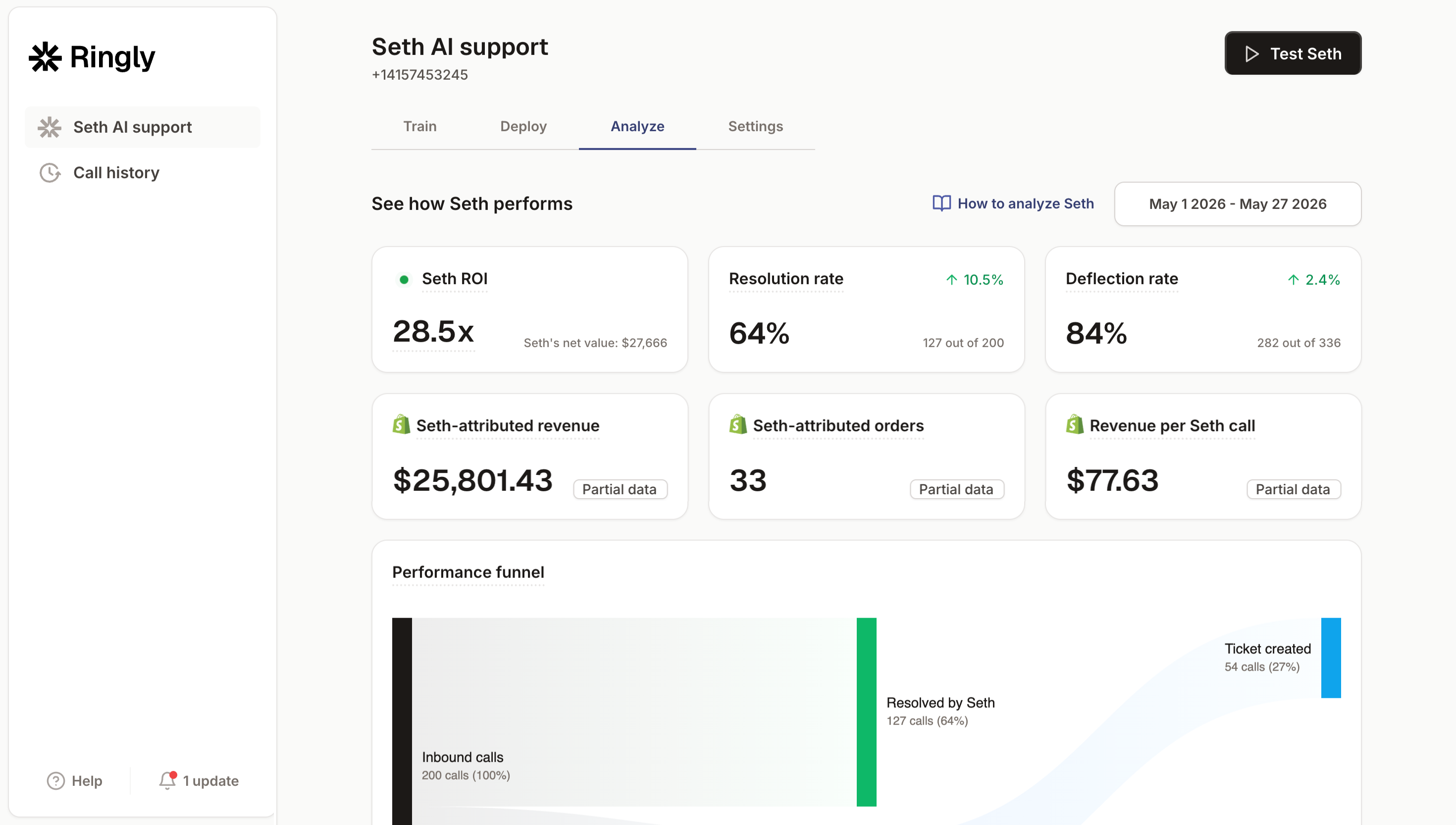
Ringly.io is AI phone support for Shopify brands. It's not a Gorgias replacement, and it doesn't ask you to rebuild anything. It reads the same kind of knowledge your help center already holds (your policies, your products, your shipping rules), answers inbound calls 24/7, finds orders in your Shopify store, handles returns, and escalates the calls that need a human straight into Gorgias. Your stack stays exactly as it is. The phone line just stops going to voicemail.
Across 50+ brands, the AI resolves 73% of inbound calls on its own at roughly $0.42 per resolved call, versus $7 to $16 a call for human BPO. WashCo, a Shopify brand we launched, recovered $22,664 in attributed revenue in its first 7 days on the phone, mostly from calls that used to hit voicemail. The point isn't to shrink your team. It's to give the phone the same self-service answer your help center already gives email, so your reps spend their time on the calls that actually need a person.
"My customers also feel like it's a normal person. They feel like they can communicate if they have questions."
Claudia Droge, TechCraft Studio
The other thing worth saying: a phone agent needs the exact same article discipline you just built for the help center. Specific facts, clean policies, one clear answer per topic. The work you put into your Gorgias knowledge base is the work that makes a phone agent good. You're not starting over. You're using the knowledge you already have on the one channel the help center can't reach. It's the same idea behind running 24/7 phone support without an after-hours answering service or a bigger team. If you want the deeper version, here's how the AI customer support phone agent for Shopify fits next to a helpdesk.
Frequently asked questions
Is the Gorgias knowledge base free? The Help Center and knowledge base are included in every Gorgias plan, from Starter at $10/mo up to Advanced at $900/mo. Building and publishing articles costs nothing extra. The AI Agent that answers from the knowledge base is a separate add-on, billed per resolved conversation.
Does the Gorgias AI Agent use the knowledge base to answer? Yes. The AI Agent pulls from your Help Center articles, Shopify data, Guidance documents, uploaded files, and connected URLs. It only answers from that verified knowledge, and if the answer isn't there, it hands off to a human instead of guessing.
What's the difference between a public and an internal knowledge base? The public help center is customer-facing: shoppers browse it to find policies and solve problems on their own. The internal knowledge base is private, holding team procedures and edge-case policies your reps need but customers shouldn't see. Gorgias supports both.
How many help center articles do I need? Start with the questions that drive the most repeat tickets, usually shipping, order status, returns, and product basics. Gorgias ships 20+ article templates and can suggest more based on your real ticket history. Most brands cover the bulk of their volume with 20 to 40 well-written articles.
Can customers find my Gorgias help center on Google? Yes. Published help center articles are indexable, so a well-organized help center can pull in search traffic for questions like "[brand] return policy." Keep articles specific and single-purpose and they tend to rank for long-tail support queries.
Does a Gorgias knowledge base help with phone support? Not directly. The knowledge base feeds typed channels, email and chat, through the AI Agent. Phone callers never open your help center, so the answers in it don't reach them unless you add a separate phone layer that reads the same knowledge and answers calls.
How is Guidance different from a help center article? An article is static: one answer for everyone. Guidance is conditional and can branch, telling the AI to act differently based on VIP status, loyalty points, or location. Use articles for facts and Guidance for the "it depends" logic.
Talk to us

If you run a $10M-$100M Shopify brand, the hard part is usually already done: a real Gorgias knowledge base that takes the routine tickets off your team. The fastest next win is pointing that same knowledge at the phone line so callers get the answer your help center already has.
The 3-layer guarantee.
- Live in 14 days or it's free until launched.
- 65% resolution in 90 days or we refund the last 3 months of subscription fees.
- We keep working free until we hit 65%.
Ruben (Ringly co-founder) takes these calls personally.