
This post in 30 seconds.
- Nine concrete Gorgias optimizations you can ship this week: macros, intent auto-tagging, rules, routing, tiered SLAs, views, self-service, follow-ups, and the right reporting.
- The lever most guides skip: the unanswered phone line that quietly turns into your next pile of tickets. Cutting it at the source beats optimizing it after the fact.
- Built for COOs and Heads of CX at $10M-$100M Shopify brands running Gorgias with a visible phone number.
If you run support at a growing Shopify brand, your Gorgias instance probably started clean and got messy. More macros nobody uses, tags that mean three different things, an SLA that fires on everything so it effectively fires on nothing. Meanwhile the queue keeps refilling with the same questions over and over.
This is a working playbook, not a feature tour. Every lever below is something you can configure in an afternoon, plus one upstream move that stops a chunk of tickets from ever being created. If you are weighing the whole stack, our broader guide to ecommerce customer service sets the context, and the one on Shopify Plus customer service covers the higher-volume end.
Most Heads of CX at a $25M Shopify brand inherit a Gorgias instance, a phone line nobody picks up after 6pm, and a founder who wants the WISMO ticket count down by next quarter. We have set up phone agents for 50+ Shopify brands trying to dig out of exactly that. Book a 30-min call and we will do the math on your queue live.
The 9 optimization levers at a glance
Skim this, then jump to the lever you need. The first eight tune the tickets you already have. The ninth, further down, is about the tickets you should never get.
| Lever | What it fixes | Effort |
|---|---|---|
| Macros | Slow, inconsistent replies | Low |
| Intent auto-tagging | Manual tagging, messy reporting | Low |
| Rules and automation | Repetitive replies eating rep time | Medium |
| Routing and assignment | Wrong ticket, wrong rep | Medium |
| Tiered SLAs | Everything urgent, so nothing is | Low |
| Views and queues | Reps hunting instead of working | Low |
| Self-service and tracking | WISMO flooding the inbox | Medium |
| Snooze and follow-up | Tickets that stall and reopen | Low |
| Reporting | Optimizing the wrong number | Medium |
How I pressure-tested this
I am Ruben, co-founder of Ringly. Over the last few weeks I rebuilt the Gorgias setup for a Shopify brand we work with, then logged where their tickets actually came from for a full week before changing anything.
Here is what I did, so you know these are not blog-post theories:
- Audited the macro library. I pulled their 40-odd macros, found the 9 reps actually used, and archived the rest.
- Traced every tag. I mapped which tags fired automatically versus by hand, and which ones nobody reported on.
- Counted the repeat reasons. I sorted a week of tickets by reason and found the top five made up most of the volume.
- Followed the source channel. I checked where each ticket originated, not just its subject line.
That last step is the one that mattered. The single biggest untouched source was not chat or email. It was the phone line rolling to voicemail, then a customer emailing in angry an hour later. More on that below.
Lever 1: rebuild your macros around your top five reasons
Macros are canned replies that auto-fill customer data, label the ticket, and can trigger an order action like a refund or an address edit without leaving Gorgias, thanks to its two-way Shopify sync (Gorgias).
The mistake is library bloat. Forty macros means reps cannot find the right one, so they free-type, which kills consistency. If you are still building your library, our rundown of how Gorgias macros actually work covers the setup.
Build one tight macro per top reason, attach a tag and an action to each, and archive everything else. Start with your five most common ticket reasons. For each, write the macro with dynamic variables (name, order ID, tracking link), set it to apply the matching tag, and where it makes sense, wire the order action right into the reply.
- Variables over guesswork: pull order ID and tracking automatically so reps never copy-paste from Shopify.
- One action per macro: a refund macro refunds; a reshipment macro creates the order. No twelve-step combo macros.
- Name them by reason, not by team: "WISMO with tracking" beats "CS macro 3."
Lever 2: stop tagging by hand and let intents do it
Gorgias automatically analyzes every incoming message for intent and sentiment. It detects 24 distinct intents, from Order/Cancel and Refund/Status to Shipping/Status, Subscription/Cancel, and Product/Question, plus three sentiments: positive, negative, and neutral (Gorgias docs).
If your team still tags by hand, you are paying reps to do work the system already did.
Use intents and sentiment as rule conditions. A Shipping/Status intent gets a WISMO tag and an auto-reply with tracking. A negative sentiment on a VIP gets flagged and bumped up the queue. The tags become clean, which makes every downstream report and SLA honest. If you want the broader context on what a Gorgias AI agent can and cannot do on tickets, we cover that separately.
Lever 3: turn on rules that deflect, not just reply
Rules automate the repetitive stuff: tagging by subscription status, replying to non-responders, closing thank-you messages. Gorgias's automation can resolve roughly a third of repetitive, low-complexity tickets with no human touch (eesel).
The trap is automating replies that should have been deflected. An auto-reply that says "we received your message" still leaves the ticket open.
Aim a rule at each of your top repeat reasons that resolves it, not one that just acknowledges it. For a Shipping/Status intent, the rule should send the tracking and close, not promise a human will follow up. Reserve the human queue for the genuinely complex 30%.
Lever 4: route by topic, sentiment, and capacity
Gorgias can assign tickets by channel, AI-detected topic, customer sentiment, and agent capacity. Most teams set this once and forget it.
Tighten it. Negative-sentiment and VIP tickets go to your senior reps. Returns and exchanges go to whoever owns that flow. Everything routine round-robins across the team so no one rep drowns while another idles. A clean customer service escalation process makes this routing actually hold up under a spike.
- Sentiment routing: angry customers reach your best people first.
- Topic routing: the returns specialist is not answering WISMO.
- Capacity routing: load balances so the queue does not pool on one rep.
Lever 5: tier your SLAs so urgent actually means urgent
An SLA that treats every ticket as equally urgent is just stress with a timer. Gorgias now lets you set different SLA targets by priority level, market, customer tier, or any tag and field combination (Gorgias updates).
Set a tight first-response target for VIPs and negative-sentiment tickets. Give routine WISMO a relaxed lane, especially if a rule is already auto-answering it. Run a dual queue: one for tickets about to breach, one for everything else priority-tagged.
Lever 6: give every rep a clean view, not the firehose
The default shared inbox makes reps hunt. Build a view per macro-able reason so they can batch the same work instead of context-switching ticket to ticket.
One view for returns, one for WISMO, one for product questions, one for VIP. A rep who spends an hour in the returns view, using the returns macro, is faster and more consistent than one bouncing between five reason types.
Lever 7: cut WISMO at the source with self-service
WISMO, the "where's my order" question, runs 30-40% of ecommerce support tickets in normal periods and climbs higher during the seasonal spike (Salesforce). It is the single biggest slice of most Gorgias queues.
You will never macro your way out of 40% of your volume. You deflect it.
Ship an order-tracking page and an auto-reply that fires on the Shipping/Status intent so the customer gets tracking before a rep ever sees the ticket. Pair that with proactive shipping-delay messages, since a heads-up before the customer wonders prevents the ticket entirely. For the deeper playbook, our guide on WISMO automation for Shopify walks through the full setup, and order-status tracking on Shopify covers the storefront side.
Lever 8: snooze, then follow up automatically
Tickets waiting on the customer should not clutter the live queue. Snooze them. Then let a rule follow up with non-responders so they do not silently go cold and reopen as a fresh angry thread next week.
This is small and boring and it quietly recovers hours. A stalled ticket that auto-nudges on day two closes itself far more often than one sitting unread.
Lever 9: measure the numbers that move money
If you only watch ticket count, you will optimize for closing fast, not resolving well. Track first response time, resolution time, the share of volume your rules deflected, CSAT, and revenue influenced by support (Gorgias). Most brands see meaningful efficiency gains within three months of a real cleanup. Our breakdown of the support metrics worth tracking goes deeper on which to put on the founder dashboard.
The lever the optimizations miss: your phone queue
Here is what that source-channel audit turned up. After tuning macros, intents, rules, routing, and SLAs, the queue still refilled. The reason was upstream of Gorgias entirely.
Customers were calling. After-hours, during the lunch gap, in the middle of a launch spike. The phone rolled to voicemail, the voicemails we never return piled up, and an hour later the same customer was in the inbox, now annoyed, as a brand-new ticket. Every one of those started as a call you could have answered. Those WISMO calls are the same volume you just spent an afternoon tagging, arriving through a channel nobody staffed.
The best ticket optimization is the ticket that never gets created. You can route and tag a WISMO ticket perfectly, or you can answer the call before it becomes one.
That is the slot an AI phone agent fills. Ringly.io is AI phone support for Shopify brands. It answers inbound calls 24/7, checks order status in your store, handles returns and product questions from your knowledge base, and only escalates into Gorgias as a ticket when a human is genuinely needed. Round-the-clock coverage like this is why brands add 24/7 ecommerce phone support without growing the team. Across 50+ brands it resolves 73% of calls on its own at roughly $0.42 per resolved call, and the calls that do escalate land in Gorgias cleanly, so your reps keep one inbox.
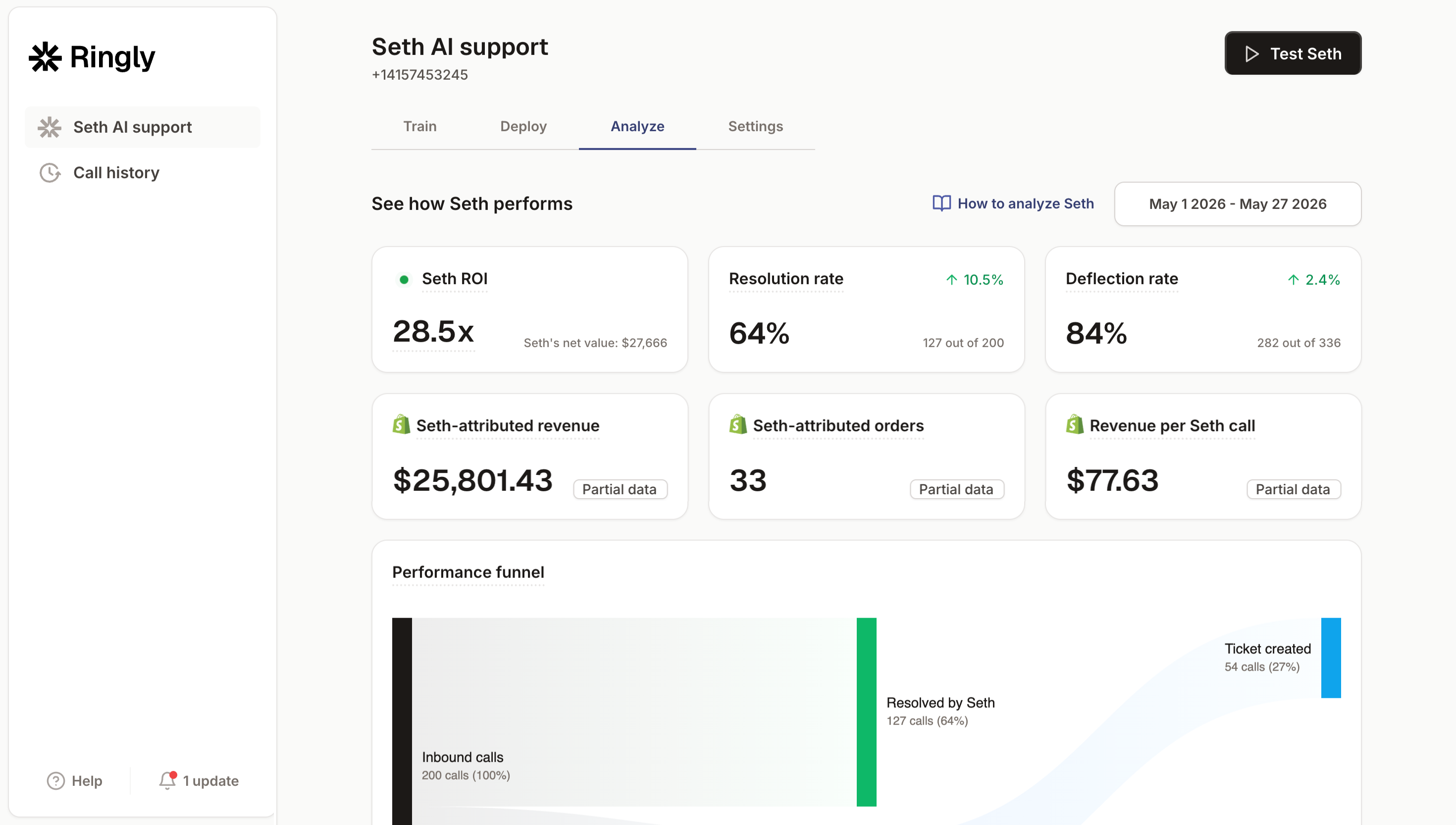
It is not theoretical. WashCo, a Shopify brand we launched, recovered $22,664 in its first 7 days on the phone. The voice quality is the part operators do not expect.
"My customers also feel like it's a normal person. They feel like they can communicate if they have questions."
Claudia Droge, TechCraft Studio
The point is not to replace your Gorgias helpdesk. It is to stop feeding it calls that did not need a human. If your phone goes to voicemail after hours, book a 30-min call and we will show you what that channel is leaving on the table.
What the phone slice actually costs you
Run the math on just the calls, separate from your chat and email volume. Take a $50M Shopify brand with a 6-rep CS team:
| Line item | Today | With an AI phone agent |
|---|---|---|
| 6 reps x $4K loaded per rep | $24,000/mo | n/a |
| AI phone support (~$5K/mo) | n/a | $5,000/mo |
| Net monthly CS spend | $24,000/mo | $5,000/mo |
| Monthly savings | n/a | $19,000/mo |
| Annual savings | n/a | $228,000/yr |
That is roughly 70% of repeatable calls (order status, returns, the same five questions over and over) handled without a rep. The other 30%, the genuinely complex calls, still reach your team, who now have the time to actually solve them. Exact pricing is set on a call, but that is the savings shape we see across 50+ Shopify brands. If you want to pressure-test it against your own numbers, book a 30-min call and we will compare it to your current setup live. For the in-house versus outsourced angle, see our take on scaling support without hiring.
Frequently asked questions
Does optimizing Gorgias reduce ticket volume or just make it faster? Both, but they are different levers. Macros, routing, and SLAs make existing tickets move faster. Real volume cuts come from self-service deflection and from removing the source channel, like answering the phone calls that turn into tickets.
What is the fastest Gorgias optimization to ship this week? Rebuild your macros around your top five ticket reasons and turn on intent auto-tagging. Both take an afternoon and immediately speed up replies while cleaning your reporting.
How does Gorgias auto-tagging work? Gorgias auto-detects 24 customer intents and three sentiments on every incoming message. You use those as conditions in rules to tag, prioritize, route, and auto-reply, so reps stop tagging by hand.
How do I cut WISMO tickets specifically? Ship an order-tracking page, fire an auto-reply on the Shipping/Status intent, and send proactive shipping-delay messages. Then close the phone gap, since unanswered "where's my order" calls become WISMO tickets too.
Does Ringly replace my Gorgias helpdesk? No. Ringly sits in front of the phone channel, resolves the routine calls, and escalates the ones that need a human into Gorgias as a ticket. You keep your current number, helpdesk, and workflows.
What should I actually measure after optimizing? First response time, resolution time, the share of volume your rules deflected, CSAT, and revenue influenced by support. Ticket count alone pushes reps to close fast instead of resolving well.
How much can the phone slice realistically save? For a 6-rep team, the math on the call volume alone lands around $19,000 a month, since roughly 70% of inbound calls are repeatable order-status, return, and product questions an AI phone agent can resolve on its own.
Talk to us

If you run a $10M-$100M Shopify brand on Gorgias and your phone still rolls to voicemail, a 30-min call is the fastest way to see how much of your queue starts as an unanswered call.
The 3-layer guarantee.
- Live in 14 days or it's free until launched.
- 65% resolution in 90 days or we refund the last 3 months of subscription fees.
- We keep working free until we hit 65%.
Ruben (Ringly co-founder) takes these calls personally.