
This post in 30 seconds.
- The real Gorgias case studies, with named brands and verified numbers: Orthofeet 56% automation, Arc'teryx 23x ROI, Dr. Bronner's $100,000 saved a year.
- Read together, every one of them proves the same thing, and points at the same blind spot.
- Built for founders and CX leads at $10M-$100M Shopify brands running Gorgias with a phone number still on the site.
If you are evaluating Gorgias, you have already seen the logos. What you actually want is the numbers behind them, the ones that tell you whether this works on a store like yours. So I pulled the published case studies, lined up the real metrics next to the brands, and then looked for the one thing they all share.
Most of these are real, and most of them are good. But there is a pattern hiding in the wins, and a channel where the wins quietly stop. If you run customer experience at a $20M-$80M Shopify brand and your phone number still rings to a person (or to voicemail after 6 p.m.), that channel is the part of this post worth reading. We have launched AI phone agents for 50+ Shopify brands sitting in exactly that spot. Book a 30-min call and we will compare it to your current setup, math included.
The Gorgias case studies, with the real numbers
Here are the named brands Gorgias publishes, with the metrics they actually report. I have linked the strongest three to the source so you can check them yourself. The wins are real, and they cluster hard around one type of work: the repeatable text ticket.
| Brand | Vertical | Reported result |
|---|---|---|
| Orthofeet | Footwear / health | 56% automation rate in under 2 months (goal was 30% in 30 days) |
| Arc'teryx | Outdoor | 23x ROI on the AI Agent, conversion 4% to 7% |
| Dr. Bronner's | Personal care | $100,000 saved per year, 48% automation, 74% faster resolution |
| Pepper | Apparel | 54% automation rate, 19% conversation-to-conversion |
| Cocorico | Retail | 48% of tickets automated |
| Boody | Apparel | 99% response-time reduction, 10% more sales via support |
| Tommy John | Apparel | $106k in sales in two months via support |
| Caitlyn Minimalist | Jewelry | 11.3% uplift in average order value |
A few are worth slowing down on.
Arc'teryx is the headline case. The AI Agent returned 23x ROI, and the Shopping Assistant pushed conversion from 4% to 7%. Their CX advisor Nathan Larner put it plainly: "Shoppers aren't stuck waiting on an agent anymore."
Dr. Bronner's is the one a CFO will like. They report $100,000 saved per year, 48% of interactions automated in a recent month, and resolution time down 74%, with CSAT up 11 points. That is a clean, boring, repeatable-ticket win, which is exactly why it is believable.
Pepper sits in the same place: a 54% automation rate plus a 19% conversation-to-conversion number, which is the part most CX teams forget to measure. Support is not just a cost center in these stories, it moves revenue. Boody's case study makes the same point from the other side, with a 99% response-time reduction and a 10% lift in sales attributed to support. None of these are outlier vanity stats. They are what happens when the bulk of your inbound is the same handful of questions and a tool finally answers them without a person.
One thing to keep straight: a couple of these numbers (Arc'teryx's conversion lift, Caitlyn Minimalist's 11.3% AOV uplift) come from the Shopping Assistant, which is a pre-sale product-discovery tool, not the support AI Agent. They are real, but they answer a different question than "how much of my support queue can I automate." When you read a Gorgias case study, separate the deflection number from the revenue number. They come from different products and they scale differently in your store.
One caveat worth knowing before you anchor on the marketing number. Gorgias advertises "up to 60%" automation, but a third-party review of the published case studies found the real range lands closer to 26% to 56%. The case-study brands above are at the top of that band, not the middle of it. Plan for the 30s and 40s, and treat the 50s as upside.
For what it is worth, the reviews back the platform up. Gorgias holds 4.6/5 on G2 (547+ reviews) and 4.7/5 on Capterra (600+ reviews). If you want the unfiltered version of what users like and complain about, our honest Gorgias review goes deeper than this table.
What the case studies have in common
Line the wins up and the shape is obvious. Every Gorgias case-study number is a text-channel number: chat, email, and on-site messaging, where the question is the same five things over and over.
Order status. Returns. Sizing. "Where's my order." Discount eligibility. That is the work the AI Agent is good at, and that is the work in every case study above. Dr. Bronner's automated 48% of interactions because most interactions were repeatable text. Orthofeet hit 56% for the same reason. The pattern is not "Gorgias is magic," it is "automation pays where the work repeats."
Here is how I read these, so you know it is not a press release. I went through the published case studies one by one, wrote down the channel each metric came from, and looked for the through-line. Every quantified result traced back to a text channel. Then I went and checked Gorgias's own Voice documentation to confirm what the case studies were quietly leaving out. More on that next.
The honest read: if your CS load is mostly repeatable email and chat, the case studies are a fair preview of what you would get, somewhere in the 30-50% range once you account for the marketed-vs-real gap. Gorgias is genuinely good at this, and we are not going to pretend otherwise. If you are weighing it against other tools, our Gorgias AI features breakdown covers which ones to turn on and what they cost.
So before you treat any of these numbers as your own forecast, run them through three quick filters:
- Channel mix. What percent of your inbound is text versus phone? The case studies only speak to the text half. If 30% of your volume is calls, 30% of your queue has no case study behind it.
- Question mix. Automation rate tracks how repeatable your tickets are. A brand with 70% order-status and returns questions will land near the top of the band. A brand with heavy custom or technical questions will land lower, no matter what the marketing says.
- Cost shape. Gorgias bills per billable ticket, so a high volume of low-value inquiries can push the bill up even as automation rises. Model the worst month, not the average one. The Gorgias Sidekick alternatives breakdown gets into where that bill tends to climb.
The channel the numbers stop at: the phone
Now the part the case studies do not advertise.
Gorgias has a Voice add-on, but the native voice channel is human-only: a person has to pick up every single call. The AI Agent automates text. It does not answer your phone. Which means not one of those automation numbers, Orthofeet's 56%, Dr. Bronner's 48%, includes a single call.
So the phone queue is still doing what it always did. It rings during the day and pulls a rep off tickets. It rolls to voicemail after 6 p.m. And the calls you miss do not wait around. 85% of callers who can't reach a person never call back, and 62% switch to a competitor (PCN, 2026). Most businesses answer only 37.8% of inbound calls in the first place.
That is the gap. Your text channel has a case study. Your phone channel has a voicemail box. And WISMO calls, the exact repeatable work the AI Agent crushes in chat, are still hitting your phone line unautomated, where they cost a human every time.
"My customers also feel like it's a normal person. They feel like they can communicate if they have questions."
Claudia Droge, TechCraft Studio
The objection here is fair: nobody wants a phone bot that embarrasses the brand on Twitter. The most repeated thing customers say after talking to our agent is "you don't sound like AI," which is the only review that matters on a voice channel.
What this costs you, and what the phone channel is worth
Put the phone gap in money terms, because that is the decision.
Take a typical $50M Shopify brand running a 6-rep CS team. A good chunk of those reps exist to answer the phone and the WISMO tickets the phone generates.
| Line item | Today | With an AI phone agent |
|---|---|---|
| 6 reps × $4K loaded per rep | $24,000/mo | n/a |
| AI phone agent (illustrative) | n/a | $5,000/mo |
| Net monthly CS spend | $24,000/mo | $5,000/mo |
| Monthly savings | n/a | $19,000/mo |
| Annual savings | n/a | $228,000/yr |
That is roughly 70% of repeatable calls, the same order-status and returns questions in the case studies, routed off your reps. The other 30%, the genuinely complex calls, still go to your team, who now have time to actually solve them. For the longer version of this math, see our guide on reducing Shopify support cost.
WashCo, a Shopify brand we launched, recovered $22,664 in its first 7 days on the phone. That is the phone-channel mirror of a Dr. Bronner's number, just on the channel Gorgias case studies skip.
If your phone line is the part of this you keep putting off, book a 30-min call and we will run your numbers live.
How Ringly extends the case-study pattern to the phone
Ringly is AI phone support for Shopify brands. It takes the exact repeatable work the Gorgias case studies prove out in chat, and runs it on the channel those case studies do not cover: the phone.
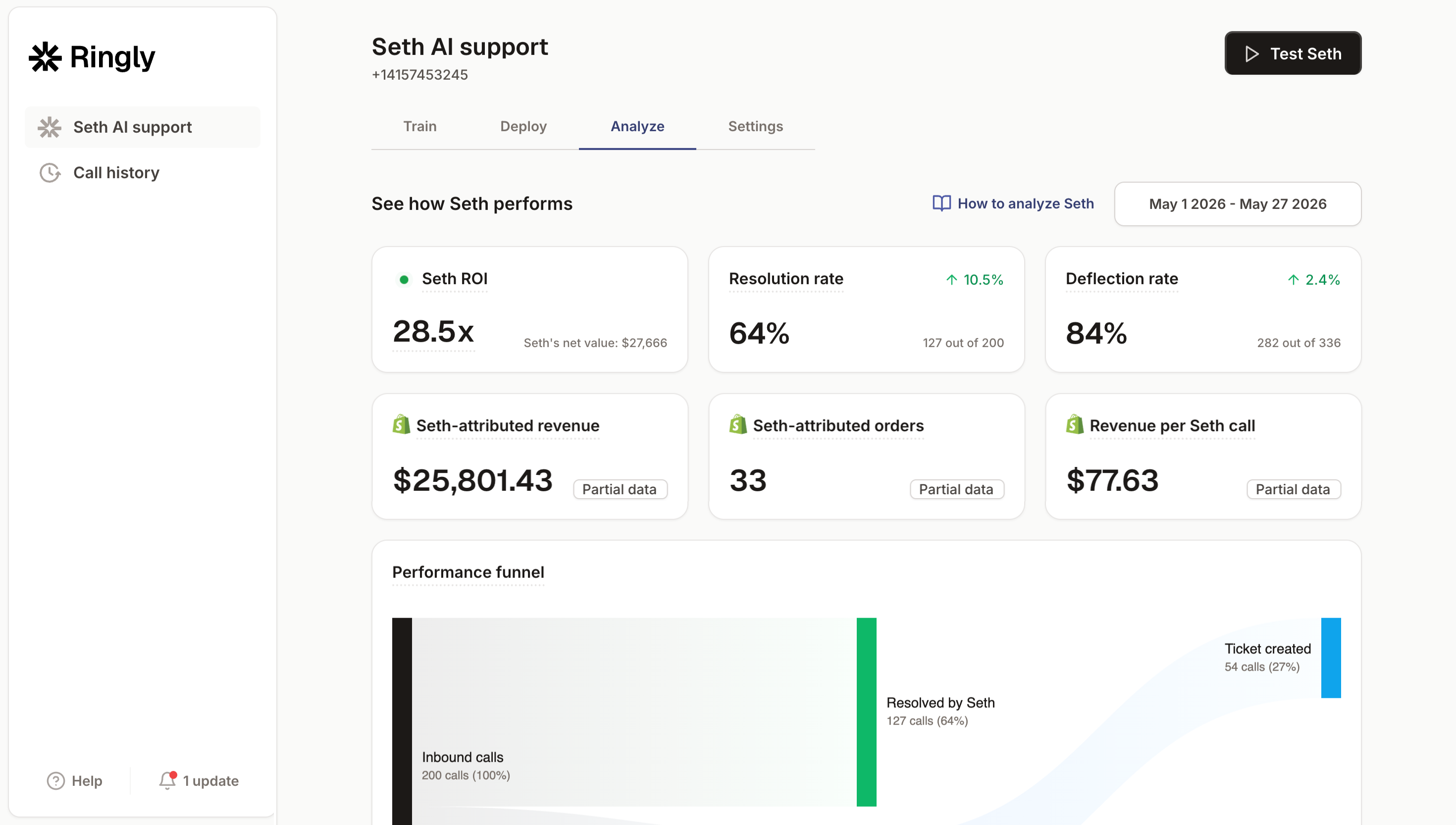
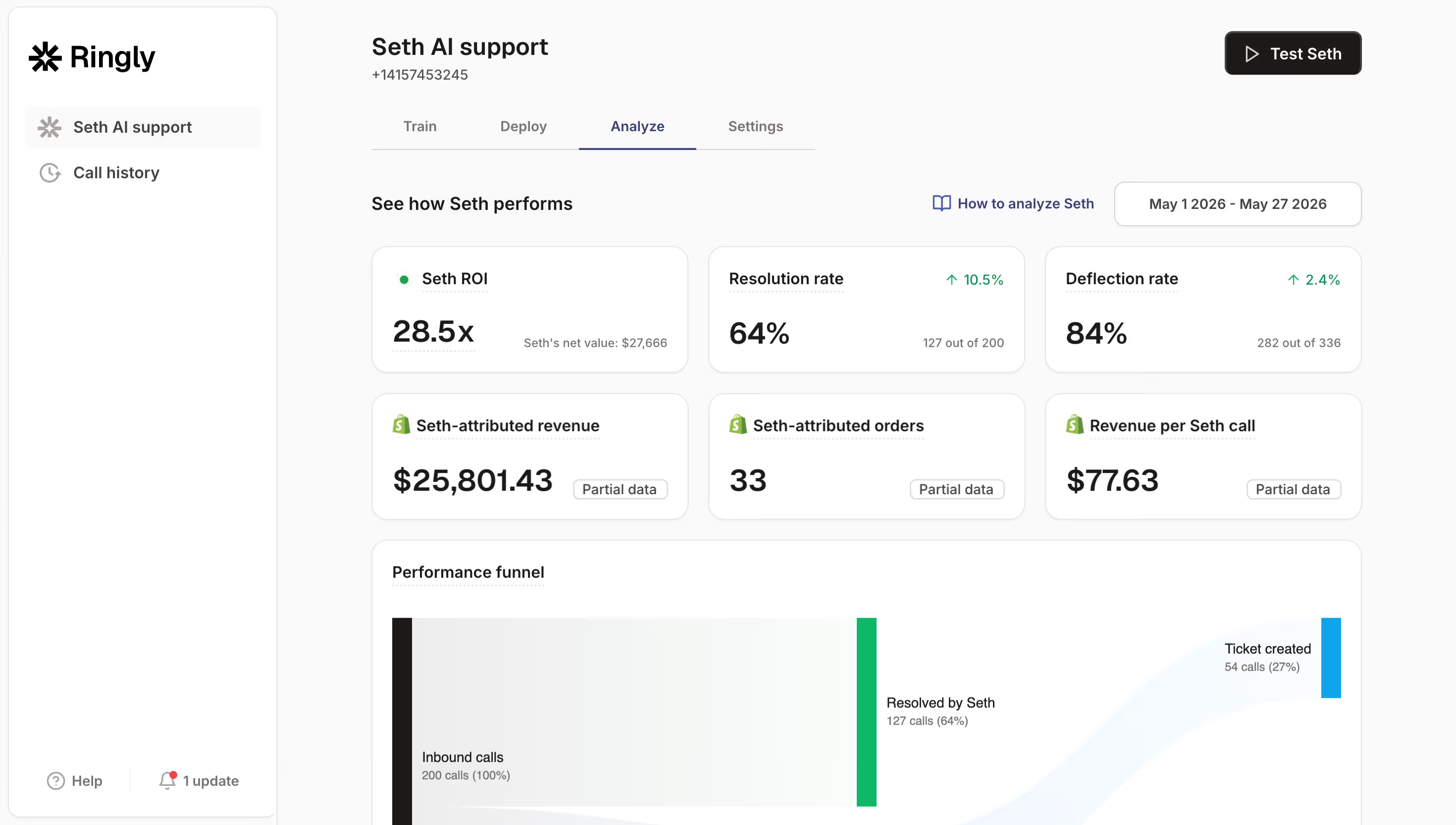
Ringly does not replace Gorgias. It sits in front of your phone line and escalates cleanly into the helpdesk you already run. The AI answers inbound calls 24/7. It finds orders in your Shopify store, processes returns and exchanges, answers product questions from your knowledge base, and hands the hard calls to a human with the full context attached. Across 50+ brands, it resolves 73% of calls autonomously at roughly $0.42 per resolved call, versus $7-$16 per call for human BPO.
Calls that need a person escalate to Gorgias, Richpanel, Reamaze, or whatever you already use. You keep your number, your helpdesk, and your workflows. You add the channel the case studies left out. If you have been reading Gorgias AI reviews trying to figure out the phone story, this is it.
Plans: Grow $349/mo (1,000 minutes), Pro $799/mo (2,500 minutes), Enterprise custom. Live in under an hour. 65% resolution guarantee: if the AI resolves under 65% of your calls in 90 days, we refund the last 3 months. Pricing detail is on the pricing page, and if you want the broader landscape, see our AI phone agents for Shopify guide and the ecommerce call center overview.
Frequently asked questions
What automation rate do Gorgias case studies actually show? Gorgias markets "up to 60%," but a third-party review of the published case studies found the real range is closer to 26% to 56%. The strongest named brands (Orthofeet 56%, Pepper 54%) sit at the top of that band. Plan for the 30s and 40s.
Which brands are in Gorgias's case studies? The named ones include Arc'teryx, Dr. Bronner's, Orthofeet, Pepper, Tommy John, Boody, Cocorico, and Caitlyn Minimalist. They span footwear, apparel, jewelry, and personal care, mostly mid-market Shopify brands.
Do the Gorgias case studies include phone results? No. Every quantified result is from a text channel: chat, email, or on-site messaging. The native Gorgias Voice add-on is human-only, so the AI Agent automation numbers do not include any calls.
Is Gorgias's AI Agent worth it for a DTC brand? If most of your support is repeatable email and chat, yes, the case studies are a fair preview of a 30-50% automation result. The caveat is per-billable-ticket pricing, which can climb on high-volume, low-value inquiries. Our Gorgias AI reviews cover the cost detail.
Can I keep Gorgias and add AI phone support? Yes. Ringly sits in front of your phone line and escalates into Gorgias, Richpanel, or Reamaze. You keep your helpdesk and number, and the AI handles the routine calls your reps were stuck on.
How much does AI phone resolution cost per call? Across 50+ Shopify brands, Ringly resolves calls at roughly $0.42 per resolved call, versus $7-$16 per call for a human BPO. That is the per-call mirror of the cost savings in the Gorgias case studies.
What if the AI doesn't hit the resolution target? Ringly carries a 65% resolution guarantee: if the AI resolves under 65% of your calls in 90 days, we refund the last 3 months. If you are scaling support without adding headcount, our guide on scaling CS without hiring walks through the approach.
Talk to us

If you run a $10M-$100M Shopify brand on Gorgias and your phone line is still the channel without a case study, a 30-min call is the fastest way to see what it is costing you. We will use your real call volume, not a generic estimate.
The 3-layer guarantee.
- Live in 14 days or it's free until launched.
- 65% resolution in 90 days or we refund the last 3 months of subscription fees.
- We keep working free until we hit it.
Ruben (Ringly co-founder) takes these calls personally.