

I signed up for, installed, and ran every one of these tools on a real Shopify store. This guide ranks the best AI chatbots for ecommerce in 2026 based on what actually happened, not feature pages.
Phone support that pays for itself. Ringly answers your store's calls and resolves at least 65% of them, backed by a guarantee. Book a call to see it run on your store.
Short answer:
The best AI chatbots for ecommerce are:
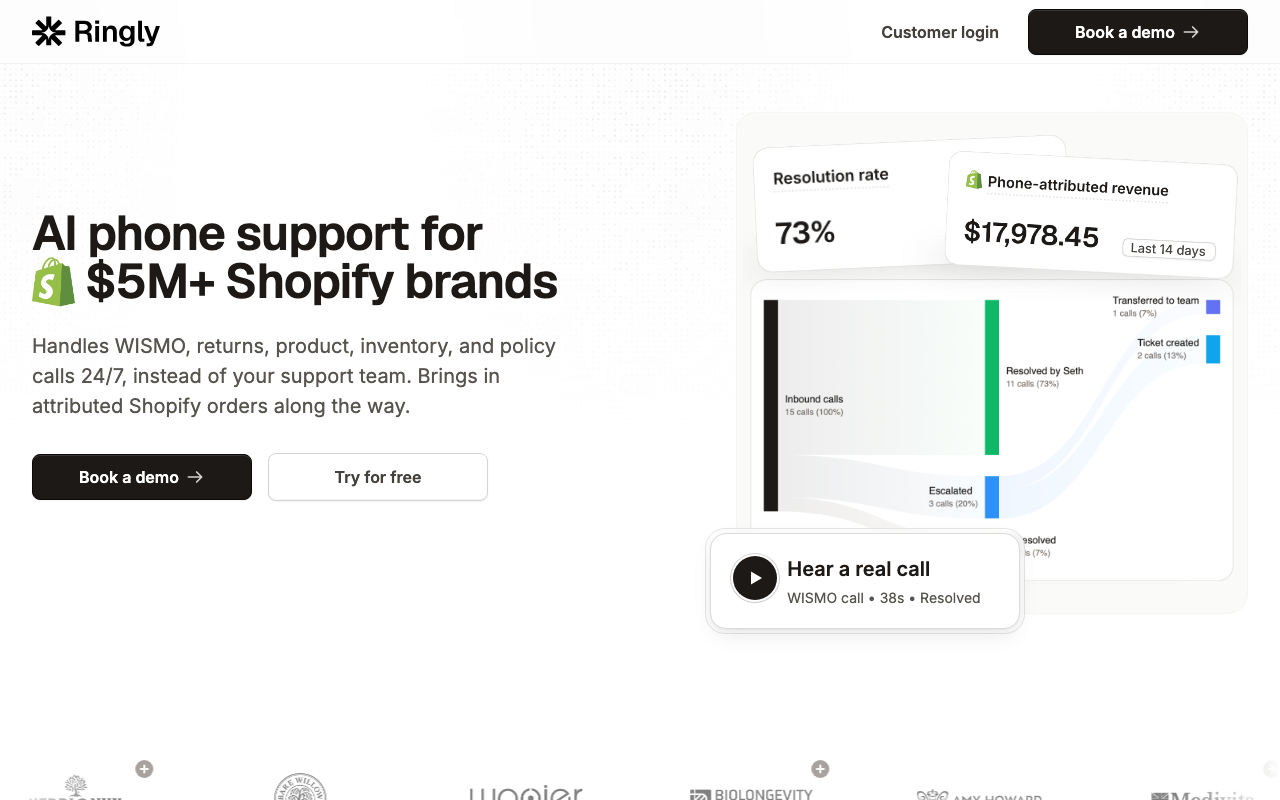
- Top pick for Shopify phone support: Ringly.io. It is a done-for-you AI phone agent that resolves about 73% of inbound calls on its own, and you only pay once it resolves at least 65% of your support calls.
- If you just want live chat on Shopify: Gorgias.
- If you are a larger or enterprise brand: Zendesk.
Ringly sits at the top because phone is the one channel almost every chatbot tool ignores, and it is the channel where you lose the most money when nobody picks up. The 7 chat tools after it cover everything else: live chat, tickets, and AI deflection.
See the comparison table below for a quick view of all 8 tools. Below the table you will find an in-depth, hands-on review of each one, starting with Ringly.io.
How I tested each tool: stopwatch from signup to onboarded. I installed each tool on a Shopify store, set up the basic features I needed to get going, then ran it for two weeks. Every tool here covers the basics, so I only call out the standout features unique to each one.
Quick comparison: all 8 tools
Ringly covers phone. The 7 tools after it cover live chat, tickets, and AI chat deflection. Here is the quick comparison, then the full hands-on review of each.
| Platform | Best for | AI chat / automation | Shopify app | Starting price |
|---|---|---|---|---|
| Ringly.io | AI phone support for Shopify | AI phone agent (~73% resolve) | 🟢 Native | Results-based (pay once ≥65% resolved) |
| Gorgias | Shopify live chat + tickets | ✅ Yes | 🟢 Native | From $10/mo (50 tickets) |
| Zendesk | Larger / enterprise brands | ✅ Yes | 🟢 Native | From $55/agent/mo |
| Intercom | SaaS & PLG companies | ✅ Yes | 🟢 Native | From $39/seat/mo + $0.99/AI res. |
| Freshdesk | Growing teams on a budget | ✅ Yes | ⚙️ Indirect | From $15/agent/mo |
| Kustomer | Enterprise done-for-you | ✅ Yes | 🟢 Native | Custom quote |
| Tidio | Ecom stores needing chat | ✅ Yes | 🟢 Native | From $29/mo (free plan) |
| Help Scout | Simple scalable support | ✅ Yes | 🟢 Native | From $20/user/mo |
1. Ringly.io: AI phone support for Shopify (top pick)
Best for Shopify brands that lose orders and burn money on missed or overflowing phone calls.
Every other tool on this list is built for chat and tickets. None of them answer your phone. That gap matters because phone calls are the highest-intent, highest-frustration channel you have. A shopper who calls is usually ready to buy or already angry about an order, and a missed call there costs more than a missed chat.
Ringly.io is a done-for-you AI phone agent built for Shopify. It picks up every call, looks up the order, answers WISMO and returns questions, and handles the calls your team does not have time for. It resolves about 73% of inbound calls on its own and speaks 40+ languages, so you are not staffing extra reps for off-hours or other time zones.
How it works: this is not a self-serve widget you wire up yourself. Ringly is sold through a call. The team builds your agent against your store data, your policies, and your real call types, then goes live, usually inside 14 days. One store recovered $22k in orders that would otherwise have been lost to missed calls.
The Resolution Promise: you only start paying once the agent resolves at least 65% of your calls. If it does not hit that bar, you do not pay. That is the opposite of every per-seat or per-resolution chat tool on this list, where you pay whether the AI works or not.
Standout features (pros):
- Answers the phone, the one channel chat tools skip
- Resolves around 73% of calls without a human
- Speaks 40+ languages out of the box
- Pulls live order status so it can actually resolve WISMO calls
- Done-for-you build, live in about 14 days
Pricing is results-based. You pay nothing until the agent resolves at least 65% of your calls. Trusted by 50+ Shopify brands.
Shopify integration is native and reads order and customer data live during the call.
Cons:
- Phone-first, so if you only want a chat widget the 7 chat tools below fit better
- Built with you on a call rather than instant self-serve signup
What is unique about Ringly is that it is the only tool here that owns the phone channel end to end and only charges you once it works.
2. Gorgias: support built for Shopify
Best for Shopify brands that want a chat and ticket tool built for their ecommerce platform.

How it went when I tried setting up Gorgias:
After the signup, I was led straight to the onboarding. They first ask you to connect your email and Shopify store, which is easy to do, and they have good documentation.
After the setup, navigating the platform was a bit difficult. The large number of features can be overwhelming.
What stood out most to me was the convert feature, which I have not seen anywhere else. It tracks how much money you are making from your support. Every support tool should have this.
Setting up the AI agent was almost no setup at all once I had connected my Shopify store.
Signup to onboarded took me exactly 9 minutes and 43 seconds. You can expect about the same for small to medium Shopify stores.
Standout features (pros):
- Support profit tracking
- AI analytics
Pricing starts at $10/month for 50 tickets, and scales with the number of tickets you need.
Shopify integration is native and syncs customer info like orders and refunds from Shopify automatically.
Reviews are mixed. On Trustpilot they score 3/5, and on Capterra a 4.6/5. Most negative reviews focused on price or complaints about Gorgias' cold outreach. I could not find many complaints about product quality, though there were a few 1-star reviews about in-app support, which is a little ironic for a support tool.
Cons:
- More expensive per ticket
- Dashboard feels a bit outdated
What is unique about Gorgias is that it connects support to revenue, and it is the most popular and proven option for Shopify merchants.
3. Zendesk: battle-tested enterprise support tool
Best for larger businesses that are leaning toward enterprise.

How it went when I tried setting up Zendesk:
After signup they guide you through all the steps required to get started. They immediately ask for your website to start training the AI agent.
After that, you are guided through a demo ticket resolution, which was very helpful, especially since the dashboard is a bit more complicated.
Over two weeks with Zendesk, I mostly felt I was not using most of the features. So if you are a smaller to medium-sized ecommerce brand, I would not recommend this tool.
The product functions perfectly, and there were things, like the macros feature, that I liked. The AI agent is decent, but not as capable as some other agents I have tested. It is mostly for filtering out the really simple tasks.
Signup to onboarded took me exactly 17 minutes and 51 seconds. In that time I set up the AI agent, invited my team, and set up all the routing rules for tickets.
Standout features (pros):
- Scalable
- Older and proven platform
- A big ecosystem with other tools
Pricing starts from $55 per agent per month.
Shopify integration is available through a native Shopify app that syncs order and customer data into tickets.
Reviews are not the best. On Trustpilot they score 1.9 out of 5, but on Capterra they score 4.4 out of 5. Common complaints are lack of available support, billing issues, and people who felt misled. On the flipside, some people say their support and platform are great, so reviews are mixed.
Cons:
- Difficult to use
- Per-agent pricing gets expensive fast
What is unique about Zendesk is that you will probably never grow out of it.
4. Intercom: proactive, product-led engagement
Best for SaaS and product-led companies.

How it went when I tried setting up Intercom:
You have to start a trial to get access, but you do not need to give them your card details. After I signed up, they asked if I had experience using similar tools.
I selected that I did not, and I was sent to a page showing the 5 onboarding steps. I just needed email and chat support.
Setting up the chat was pretty simple. I used the Shopify plugin to add it to my website. Email is a bit more difficult because you need to set up email forwarding, but the documentation was clear and useful, so I did not really have any problems.
The next thing they asked me to set up was their AI agent called Fin. This is a product they also sell separately, but using it together with Intercom makes it even better. Training the agent is as simple as choosing from templates and adding your knowledge.
Signup to onboarded took me 16 minutes and 21 seconds, mainly because of the large number of features they offer. These features are complex and robust, but they make setting them up very accessible.
Standout features (pros):
- Fin.AI, one of the best AI chat agents available right now
- Best looking UI
- All-in-one solution
Pricing starts at $39/seat per month, and Fin AI is charged per solved resolution ($0.99).
Shopify integration syncs customer data and triggers messages based on store behavior.
Reviews are pretty good, a 3.1/5 on Trustpilot and a 4.5/5 on Capterra. Most people are happy that one platform offers an all-in-one solution. The negative reviews were mainly about pricing or support not being good enough.
Cons:
- Pricing, AI resolutions, and seats are way more expensive
- Steeper learning curve
What is unique about Intercom is that it combines support, sales, and onboarding into one tool. Intercom is not really an ecommerce helpdesk, it is more focused on SaaS and product-led companies.
5. Freshdesk: affordable automation for growing teams
Best for growing teams that need a simple solution with automation capabilities.
How it went when I tried setting up Freshdesk:
After signing up, they immediately ask if you have used similar helpdesk tools before. I selected that I had not, and they sent me to a page with step-by-step instructions and videos.
They break the onboarding into 3 steps: connecting your email, getting to know the dashboard, and inviting your teammates. The only thing I had to do was follow along exactly with these steps.
Their dashboard looks very good and is easy to navigate. Unlike other tools, they also prefill data fields with dummy data, so it is significantly easier to understand what each feature is. One other thing I liked was the confetti visuals every time I completed a step in the onboarding.
Signup to onboarded took me only 9 minutes and 41 seconds. Their onboarding is one of the best I have seen.
Standout features (pros):
- Onboarding
- Very good knowledge base that adapts
- Most things are already set up when you give them your website
Pricing starts at $15/month per agent, and they offer a free trial.
Shopify integration is not native, but it does allow ticket creation directly from Shopify.
Reviews are mixed. On Trustpilot they score a 2.6/5, and on Capterra they scored 4.5/5. Most bad reviews were about the product not living up to expectations or claims of bad business practices. The positive reviews often mentioned high level of support, and a lot of people are very satisfied with the product.
Cons:
- Some newer features are a bit chaotic
- Not a lot of customization on the lower tiers
What is unique about Freshdesk is that it offers enterprise-level automation features at normal non-enterprise pricing, and it is easy to get started with.
6. Kustomer: done-for-you enterprise support tool
Best for enterprise ecommerce brands that want a custom setup and reliability.

How it went when I tried setting up Kustomer:
Kustomer is a done-for-you solution, so unlike the self-serve tools on this list you go through their team for setup rather than signing up and onboarding yourself. There is a paid implementation step before you go live, plus a sales conversation up front to scope your needs. It is built for larger ecommerce brands with real ticket volume, not a store that is just getting started.
Where Kustomer stands out is its data model. Instead of organizing everything around individual tickets, it organizes around the customer, so an agent sees a person's full history, orders, and past conversations in one timeline rather than a stack of disconnected tickets. For high-volume brands with a lot of repeat buyers, that single-view approach can make support feel more personal and cut down on back-and-forth.
The trade-off is complexity and cost. The custom setup and quote-based pricing make it overkill for small and medium stores, and the learning curve is real. The AI chatbot also draws the most criticism in reviews.
Standout features (pros):
- Gives a clear, full overview of a customer's journey
- Hands-off, done-for-you setup
- Customer-centric data model instead of disconnected tickets
Pricing is custom; you request a quote based on your needs.
Shopify integration is a native Shopify app. They have a lot of integrations, but a lot of them are custom.
Reviews are not the best. On Trustpilot they score a 2.4/5, and most complaints are about the AI chatbot being, quote, stupid.
Cons:
- Difficult to use
- Can become expensive with custom setup and pricing
What is unique about Kustomer is that it organizes support in a completely different way. Instead of tickets, they organize it by people.
7. Tidio: affordable and simple live chat with AI automation
Best for ecommerce stores that just need live chat.

How it went when I tried setting up Tidio:
After the signup, they asked quite a lot of questions to customize the experience for my use case. This felt reassuring, and they bring up things you might not have thought of yourself.
Installing the chat widget is very simple with the Shopify plugin, and it looks much better than some other tools.
Their main feature, and the biggest reason I like Tidio, is their AI agent. It is already pre-trained on your use case, and there are way more features available to get a higher AI resolution rate. The agent also becomes smarter the more you use it.
The ticketing part was also very good and, just like the chatbot, already customized to my use case. They set up categories for order status and other intents.
Their analytics are some of the best I have used. They give a clear overview and very good insight into how your team and AI are performing, and the handoff between the two is almost perfect.
Signup to onboarded took me only 9 minutes and 34 seconds. In that time my customized chat widget, AI chatbot, and knowledge base were completely set up. I also set up what they call flows, which can be used for sales and support. Over the two weeks this feature was very useful, so I set up more of these flows afterward.
Standout features (pros):
- No-code chatbot builder
- Mobile app
- Cart abandonment recovery
Pricing starts at $29/month, but they offer a free plan too.
Shopify integration is a native app that sources customer and order info from Shopify and triggers automations.
Reviews are decent. On Trustpilot they score a 3.7/5 and people are very enthusiastic, though there are complaints about bad support. On Capterra they score even higher, with 4.7 stars out of 5.
Cons:
- Not a lot of analytics depth
- Not very scalable
What is unique about Tidio is that it has really nailed live chat for ecommerce, which is its main focus. No-code ecom chatbots at entry-level pricing.
8. Help Scout: user-friendly, basic support platform
Best for small to medium stores that need a reliable support tool.

How it went when I tried setting up Help Scout:
After I signed up, the only onboarding I got was some explanations of where to find certain features. They also offered a tour where they walk you through the product.
The layout differs from others. The navigation bar is at the top of the screen and horizontal. The messaging inbox was a bit harder to oversee compared to other platforms I tested, so navigating that part and responding to tickets is not the best, but still pretty solid.
Overall, I managed to get the platform working pretty easily. But I can imagine that if you have never used a similar tool, you would need to schedule a demo to get started.
Signup to onboarded took me 13 minutes and 14 seconds. Connecting to Shopify was the hardest part. I had not fully set up my documentation, just the most basic FAQs. If you do not have that set up already, it will take some extra time to get started.
Standout features (pros):
- AI features are actually useful, unlike some other platforms
- Included hosted documentation
Pricing starts at $20/month per user.
Shopify integration gives access to customer data and lets AI or human reps handle everything without leaving Help Scout.
Reviews get a score of 3/5 on Trustpilot and a 4.4/5 on G2. Most negative reviews were about missing features. Ease of use is the most common positive theme.
Cons:
- Not really special, poor onboarding
- Missing some features that other tools offer
What is unique about Help Scout is that it is easy to use while still being scalable, unlike tools like Zendesk.
What to look for in an ecommerce AI chatbot (5 things)
- Make sure the tool connects to your current stack.
- Check whether it covers every channel your customers use, including phone, not just chat.
- Decide how much of your support AI should handle, and confirm the tool can actually resolve that, not just deflect.
- Make sure the tool can scale without forcing you to hire more humans.
- Check that the pricing model fits your business, and whether you pay for outcomes or just access.
While deciding, keep your specific ecommerce use cases in mind and make sure the support platform you pick will:
- Make your customers happier (increase CSAT)
- Reduce handle time
- Not cost you a fortune
- Fit your cost model at 2 to 5x the volume
If chat tools cover your website but your phone line is still ringing into voicemail, that is the gap Ringly fills. Most stores find phone is where they lose the most orders, and it is the one channel none of the 7 chat tools above touch. See how Ringly.io helps merchants like you save time and money.
Also read: Best eCommerce Call Center